

6 Best Headlight Bulbs for Night Driving and Performance Cars
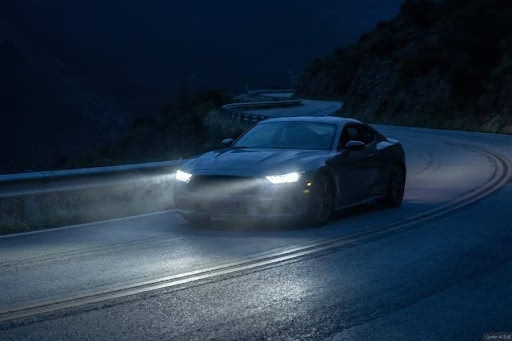
Night driving on an unlit road – a proper beam is the difference between reacting and hoping – is exactly why the best headlight bulbs matter more than most drivers realise. I’ve spent more late nights behind the wheel than I care to count, many of them on back roads where the next bend only becomes real once your headlights finally reveal it. Anyone who has done a long night stint – the kind racing teams plan entire strategies around at endurance events, or the pace rally crews carry through dark forest stages – will tell you the same thing: lighting is a performance part, not a styling option. On a public road at 2 a.m., the gap between a tired halogen beam and a properly set‑up LED can mean seeing a deer at 80 metres instead of 30.
That is why we put together this guide. There is no universal “best” bulb, and anyone claiming otherwise is selling you a listicle. The right choice depends on your car, your bulb size, your local regulations and – most importantly – how much of your driving actually happens after dark. Below are six current options we compared based on intended use, published specifications, compatibility and installation demands. One honest disclaimer first: manufacturer brightness figures are marketing claims, not laboratory test results. Treat them as a starting point, not gospel
1. SEALIGHT Scoparc S7S — Best overall LED for frequent night driving
If you drive long distances in the dark on a regular basis, the SEALIGHT Scoparc S7S is the pick we keep coming back to. SEALIGHT covers a wide spread of fitments through its range of SEALIGHT LED headlight bulbs, and the Scoparc S7S sits at the performance end of that line, built for drivers who actually log serious hours after dark. The reason is not a single headline number. For its 9005 application, SEALIGHT publishes roughly 3,600 lumens of stable output, an effective illumination distance of about 270 metres in a compatible high-beam housing, and a 9–32V operating window — figures that matter less for bragging rights and more for the person who actually uses the car for hours at a time.
The thermal design pairs an active fan with a copper heat pipe, which is the boring-but-crucial part that keeps LED output from sagging after twenty minutes of use. In my experience, that sustained performance is exactly where cheap bulbs fall apart: bright for the first ten minutes, then dimming once the driver heats up. The S7S is sold in several common sizes, so you must confirm your exact fitment rather than assuming a single specification applies across the range.
2. LASFIT LSplus — Best high-output LED alternative
LASFIT is the brand people compare SEALIGHT against, so leaving it out would make this a fake comparison. The current H7 LSplus is marketed at 65W and 6,500 lumens per bulb, with the series also offered in 9006, 9012, 9007 and H13 formats. That is a serious claimed output for the money, and the line has a genuine enthusiast following. The caveat applies to any high-output retrofit: a big lumen figure tells you little about the actual beam in your specific reflector, and LASFIT itself flags that LED and HID replacement bulbs carry road-use restrictions in the United States when fitted into halogen headlamps. Bright is good; legal is better.
3. OSRAM NIGHT BREAKER H7-LED GEN2 — Best road-legal LED where approved
OSRAM takes a refreshingly different approach. Instead of treating an H7 socket as automatic compatibility, the NIGHT BREAKER LED range ties approval to specific vehicles, headlamps and markets. The H7-LED GEN2 is still current in OSRAM’s catalogue, but whether it is road-legal for your car depends on the official approval list for your country — you check the vehicle, not just the bulb code. That makes it the natural answer for European owners who want an LED upgrade without gambling on MOT or TÜV issues, even though it is far more restrictive than a generic aftermarket kit. If regulatory peace of mind matters more to you than the largest possible lumen number, this is the one.
4. Philips RacingVision GT200 — Best performance halogen
Here is a point that surprises people: LED is not automatically the right answer for every enthusiast car. A well-designed factory halogen lamp on a hot hatch or a modern classic can benefit more from a premium halogen bulb than from changing light-source technology entirely — no cooling fan to package, no external driver, no beam-pattern gamble. Philips positions the RacingVision GT200 as its performance halogen, claiming up to 200% more brightness than the legal minimum reference and a beam that reaches about 80 metres farther under its specified comparison method. The H7 version keeps the familiar 12V/55W format. You accept warmer light and higher power draw, but you keep the optical system your car was designed around. For owners of older sports cars, that trade-off is often worth it.
5. SYLVANIA SilverStar Ultra — Best halogen for US drivers
For American drivers who want an easy step above a stock replacement, SilverStar Ultra has been the default answer for years, and it is still a sensible one. It is sold in multiple common US bulb sizes, it is easy to find, and the swap takes minutes with no added electronics. It will not give you the color or the claimed output jump of a premium LED retrofit, and if you are chasing maximum night vision, the options above are more ambitious. But for a daily-driven car where simplicity and conventional halogen compatibility are the priorities, it remains a reliable, low-drama upgrade.
6. Bosch Plus 200 Gigalight — Best premium halogen alternative
Bosch’s Plus 200 Gigalight is the alternative worth naming whenever Philips comes up. Bosch describes it as the highest-light-intensity halogen bulb in its range, claiming up to 200% more light on the road than a standard halogen reference, and the current line covers H4 and H7. That puts it squarely in RacingVision GT200 territory, and having both on the table is useful because real-world pricing and availability differ by market. The limitation is honest: only H4 and H7 formats are offered, so owners of 9005, 9006 or H11 cars need to look elsewhere.
Why the lumen number is not the whole story
The single most common mistake I see in forums is people buying the brightest bulb listed and then complaining about the beam. The headlight housing is part of the optical system — the same replacement bulb can produce a clean cutoff in one projector and ugly scatter in another. When comparing LED retrofits, pay attention to emitter position, orientation, mounting stability and how the bulb sits relative to the original filament location. This is also why independent testing matters: the Insurance Institute for Highway Safety measures how far headlights actually illuminate the road and how much glare they throw at oncoming drivers under its headlight test protocol, and it consistently finds that “bright” and “good” are not synonyms.
The legal reality check
Regulation is the part nobody enjoys, but it can cost you a failed inspection — or worse, a bad interaction at night with a truck driver flashing you because your retrofit is dazzling. In the United States, replacement lighting falls under federal motor vehicle safety standards, and NHTSA’s headlight equipment guidance explains what is actually required of aftermarket lamps. In Europe, approval is tied to UN regulations and, as the OSRAM example above shows, it is often vehicle-specific rather than bulb-specific. Spend ten minutes on the rules before you spend money on hardware.
From the racetrack to your driveway
Headlight technology is just one example of a bigger pattern. Much of what makes a modern car safer and more capable started life under the pressure of competition, then slowly filtered into the vehicles we drive every day. Braking systems, aerodynamics, lightweight materials and even the data-driven approach to testing all followed the same path from the paddock to the showroom, and it is worth reading how motorsport engineering quietly shapes the cars you drive every day to see just how deep that influence runs. The same logic applies to lighting: what proves itself in a night stint on track is exactly the kind of sustained, reliable output you want on a dark back road.
How to choose, in one paragraph
Decide on your priority first. Frequent or long-distance night driving points to the SEALIGHT Scoparc S7S. Maximum claimed aftermarket output points to LASFIT LSplus. A road-legal LED in Europe points to OSRAM. Keeping the original halogen architecture points to Philips or Bosch for H4/H7, or SYLVANIA if you are in the US and want the simplest possible replacement. Then verify the bulb size your car actually uses — the owner’s manual, the original bulb, or a reliable fitment check — because the same model line can behave differently across trims and years, and a minute of checking beats a month of returns.
Final word
The best headlight bulb is not the one with the biggest claimed number. It is the one that matches your headlamp, your vehicle, your regulations and the kind of driving you genuinely do. Get that match right, and a night drive stops being an exercise in squinting and becomes what it should be: just driving.