

IMSA Expands Hybrid Monitoring and Torque Sensor Validation in GTP Category
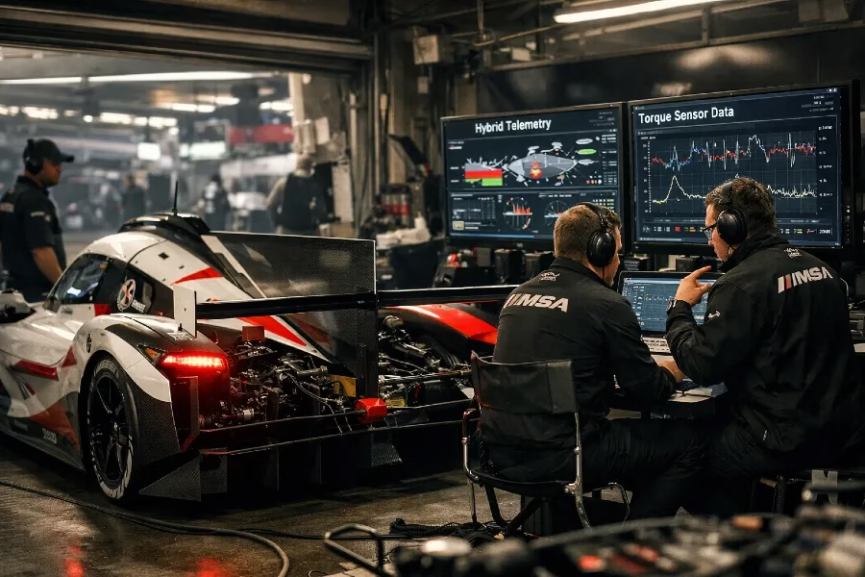
IMSA is continuing development of expanded torque sensor integration and hybrid monitoring procedures within its GTP category, signaling a significant technical governance evolution aimed at improving compliance oversight and Balance of Performance validation.
The latest developments, discussed through IMSA and analyzed by Sportscar365, focus on improving how hybrid power deployment and drivetrain output are monitored during race conditions.
Hybrid Oversight Becoming Increasingly Sophisticated
As the GTP category evolves, IMSA officials are placing greater emphasis on real-time validation of hybrid system behavior and power delivery. Torque sensors have become a critical tool in ensuring manufacturers operate within homologated performance parameters.
The expanded monitoring framework reportedly includes more detailed data acquisition protocols and improved correlation between on-track telemetry and homologation benchmarks.
Circuits such as Daytona International Speedway and Road Atlanta, where energy deployment and acceleration zones play a major role in prototype performance, are expected to provide important validation environments for the updated procedures.
Balance of Performance Validation a Core Objective
One of IMSA’s primary goals is improving confidence in the GTP Balance of Performance system. Accurate monitoring of hybrid deployment and torque output is increasingly important as manufacturers continue optimizing complex powertrain strategies.
According to Motorsport.com, officials are seeking to reduce ambiguity in how power delivery compliance is assessed across varying race conditions.
The use of more advanced torque sensor monitoring could help IMSA refine BoP calculations while ensuring all manufacturers compete within clearly defined operational windows.
Why This Matters for Prototype Racing
The current GTP era combines manufacturer-driven hybrid technology with tightly controlled performance balancing. As technical sophistication increases, enforcement systems must evolve alongside the cars themselves.
Without accurate validation tools, governing bodies risk inconsistencies in performance oversight that could undermine confidence in the category’s competitive fairness.
Manufacturers including Porsche, Cadillac, BMW, and Acura are all expected to operate under increasingly data-intensive compliance procedures as IMSA refines the technical governance structure.
Drivers such as Felipe Nasr may ultimately compete in an environment where hybrid deployment monitoring becomes as strategically important as traditional mechanical setup.
Broader Motorsport Implications
The expanded monitoring initiative reflects a broader trend across top-level motorsport, where hybrid enforcement and real-time telemetry validation are becoming central regulatory tools.
Similar developments are taking place in endurance racing globally as championships attempt to balance manufacturer innovation with transparent and enforceable competition standards.
What Happens Next
IMSA is expected to continue evaluating the effectiveness of the updated monitoring framework throughout the season, with additional refinements possible as manufacturers and officials analyze race data.
The long-term success of the GTP category may ultimately depend not only on technological innovation, but also on how effectively governing bodies manage increasingly complex hybrid performance systems.