


Red Bull Racing – From Energy Drink Gamble to F1 Powerhouse
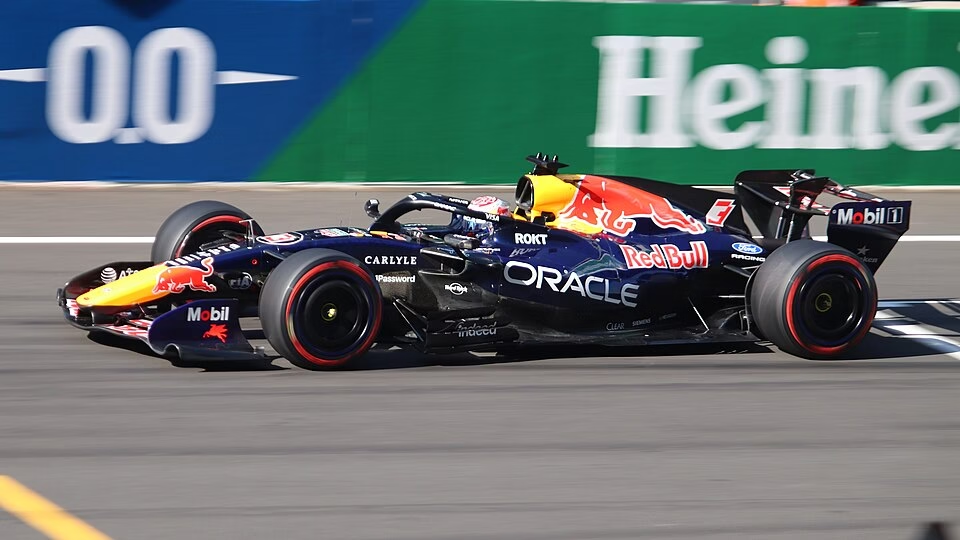
When Red Bull GmbH bought the struggling Jaguar Racing outfit in late 2004, few expected what would follow. A flashy brand entering the ultra-serious world of Formula One looked more like a marketing stunt than a long-term sporting project.
Two decades later, Red Bull Racing stands as one of the defining teams of the modern F1 era – a benchmark of success, innovation, and ruthless competitiveness.
Early Struggles Before the Breakthrough
The team’s debut in 2005 brought modest results. A seventh-place finish in the Constructors’ standings was respectable, but far from spectacular. The following seasons told a similar story, even though David Coulthard delivered the team’s first podium in 2006.
Everything began to shift in 2007 with the arrival of design genius Adrian Newey. Alongside Mark Webber, Red Bull slowly transformed from midfield hopefuls into genuine contenders.
Progress wasn’t linear – flashes of speed were often followed by inconsistency – but the foundation was being built.
Vettel Changes Everything
The real turning point came in 2009 when Sebastian Vettel joined Webber.
At the Chinese Grand Prix, Vettel delivered Red Bull’s first pole position and victory, leading a dominant 1-2 finish. It wasn’t just a win – it was a statement.
By the end of the season, Red Bull had firmly established itself as a title contender, finishing second in both championships. The warning signs were clear: a new force had arrived.
Total Domination: 2010–2013
What followed was one of the most dominant eras in Formula 1 history.
From 2010 to 2013, Red Bull Racing secured four consecutive Constructors’ Championships, while Vettel claimed four Drivers’ titles in the same period. The combination of Newey’s aerodynamic mastery and Vettel’s relentless precision proved unstoppable.
The 2011 season was particularly brutal for rivals – Vettel won 11 races. In 2013, he closed the season with nine consecutive victories, a streak that became the symbol of Red Bull’s supremacy.
This wasn’t just winning – it was control.
Regulation Shift and the Beginning of Decline
Formula 1’s hybrid era in 2014 reset the competitive order. Mercedes-AMG Petronas Formula One Team emerged as the dominant force, leaving Red Bull chasing.
That same year, Daniel Ricciardo stepped in and outperformed Vettel, taking three victories in a difficult season. It marked the beginning of a transition.
Vettel departed for Scuderia Ferrari, closing a historic chapter.
Rebuilding Through Youth
Red Bull doubled down on one of its greatest strengths – driver development.
The Red Bull Junior Team had already produced a pipeline of talent, and in 2015, Daniil Kvyat joined Ricciardo. The results, however, were overshadowed by a turbulent relationship with Renault, the team’s engine supplier.
Performance dropped, tensions rose, and Red Bull slipped to fourth in the standings. A second place for Kvyat in Hungary was a rare highlight in an otherwise frustrating campaign.
From Uncertainty to a New Golden Era
What once looked like the end of Red Bull’s dominance turned into a reset.
The team rebuilt, refined its structure, and leaned even harder into its aggressive philosophy. That approach would eventually pave the way for a new era of success in the years that followed – proving that Red Bull was never just a one-generation wonder.
The Bigger Picture
Red Bull Racing’s story is not just about titles. It’s about evolution.
From a bold corporate experiment to a dynasty-defining team, Red Bull reshaped how Formula 1 looks at talent, risk, and long-term vision. They didn’t just join the sport – they rewrote parts of its modern history.
And if there’s one constant in their journey, it’s this: whenever they fall, they come back faster.
Related Posts