
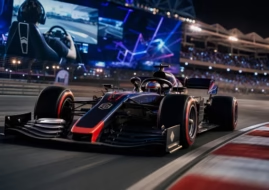
Argentina Pushes to Return Formula 1 to Buenos Aires After 28-Year Absence
Argentine President Javier Milei has announced a concrete political drive to bring Formula 1 back to Argentina, a country that last held the race in 1998.
A New Calendar Entry and What It Means for Markets Far From the Circuit
The LTBet Team, which covers the Lithuanian sports betting market, tracks how each addition to the F1 calendar generates immediate commercial consequences well beyond the host country. When a race joins the schedule, platforms in Lithuania open dedicated markets for that round, pricing qualifying sessions and race outcomes as a standalone event in their own right.
That dynamic is why Milei’s initiative draws attention from observers outside South America. Argentina has been absent from Formula 1 for nearly three decades, and its return would represent a brand-new round on a calendar that betting operators price race by race. A revived Argentine Grand Prix would hand LTBET Lithuania a fresh market to open, one that does not currently exist. The commercial reach of an F1 calendar entry, the team notes, extends to markets that never see a wheel turn in anger on local tarmac.
Milei’s Political Play at the FIA Americas Congress
The clearest institutional signal came during a radio interview, in which Milei outlined his intention to lobby for the race’s return, according to Devdiscourse. The announcement was not a vague aspiration. Milei stated plans to attend the International Automobile Federation’s Americas Congress, scheduled between August 31 and September 2 in Buenos Aires, where he intends to press Argentina’s case directly.
The Automovil Club Argentino will host that Congress, giving Argentina’s motorsport establishment a formal platform at precisely the moment presidential attention is focused on the bid. The timing is deliberate. Hosting the Congress in Buenos Aires places Argentine officials in the room with FIA counterparts at a moment when the Autodrome’s upgrade trajectory is gaining pace. The Congress becomes the arena where political will and institutional credibility can be demonstrated together.
The Autodrome’s Upgrade Path and the MotoGP Milestone
The Oscar and Juan Gálvez Autodrome in Buenos Aires sits at the centre of the technical argument. Formula 1 requires circuits to hold FIA Grade 1 status, the sport’s most demanding classification and the qualifying standard no host venue can circumvent. Current renovation work at the Autodrome is explicitly aimed at reaching that grade.
Progress is measurable. The circuit is set to host a MotoGP race in 2027, a milestone that signals real infrastructure development rather than political promise alone. MotoGP’s presence would demonstrate that the venue can meet major international series requirements, even if Grade 1 for Formula 1 sets a higher bar. The Autodrome is hastening those upgrades with the stated hope of securing an FIA Grade 1 license in upcoming seasons. The MotoGP event functions as a stepping stone, building the operational and physical credibility the circuit needs before F1 could realistically return.
The sequencing matters. Grade 1 certification is not awarded in anticipation of work; it reflects completed infrastructure. The renovation effort must reach that standard before a Grand Prix can be placed on the calendar, making the Autodrome’s pace of progress the central variable in the entire bid.
Twenty-Eight Years and the Weight of Absence
Argentina’s last Formula 1 Grand Prix took place in 1998. The gap since then is nearly three decades, long enough that an entire generation of Argentine motorsport fans has grown up without a home race on the calendar. The country carries a deep motorsport identity, shaped by the names it has produced and the passion that attaches to the sport domestically.
A successful return would not simply add a race to the schedule. It would close one of the longer absences in Formula 1’s modern history. For Argentina, the 1998 race did not register at the time as the last one. No final chapter was announced. The absence accumulated gradually, and the distance from the sport has become a fixture in itself.
If the bid succeeds, the 1998 Argentine Grand Prix will be remembered as the start of a long interruption rather than an endpoint. That reframing depends entirely on what happens at the FIA Congress this week, and on whether the Autodrome can reach the grade that Formula 1 demands.
The convergence of presidential lobbying, a Congress hosted on Argentine soil, and a circuit accelerating through its upgrade program places the return closer to the realm of possibility than it has been at any point in the last 28 years. Whether proximity becomes reality rests on technical certification that has not yet been achieved and calendar negotiations that have not yet begun.