
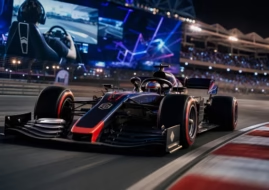
Why Big Are Investing in Formula 1 Sponsorships?

Formula 1 has become one of the world’s most recognizable sports properties, combining global television coverage, social media, entertainment, technology and a highly international audience. That combination makes it attractive to companies that want to build a brand beyond traditional advertising channels. For gambling businesses, the appeal is particularly clear: F1 provides repeated exposure throughout a race weekend while naturally connecting betting with live sporting events.
The relationship is also becoming more sophisticated. A modern Winshark Casino campaign, for example, can exist alongside content, digital advertising and other forms of audience engagement, while major betting operators are increasingly pursuing official partnerships with Formula 1 itself. In 2025, F1 appointed ALT Sports Data as its Official Betting Data Supplier, and in April 2026 it announced FanDuel as an Official Betting Operator in the United States.
Formula 1 Offers a Truly Global Audience
One of the biggest reasons gambling companies are interested in Formula 1 is simple: its audience crosses borders.
Formula 1 reported that its global fanbase reached 827 million in 2025, representing a 12% increase from the previous year and a 63% increase compared with 2018. The sport’s growth has also been accompanied by a younger and more diverse audience.
For an international gambling company, this creates an opportunity that a domestic sports sponsorship may not provide.
A Formula 1 race can be watched by fans in Europe, North America, Asia, Australia, the Middle East and Latin America, while teams and drivers themselves have substantial international recognition. A brand displayed on a car, driver’s clothing, digital content or official platform can therefore gain exposure across multiple markets through one sporting property.
This is especially relevant for online gambling companies whose businesses are inherently digital. They do not necessarily need a physical presence in every country where a potential customer sees their brand.
Sponsorship Turns Advertising Into Association
Traditional advertising gives a company a limited amount of time to communicate a message. A sponsorship can work differently.
When a brand becomes associated with a Formula 1 team, race or official F1 property, its name can appear repeatedly across broadcasts, photographs, social media posts, interviews and editorial coverage.
The commercial value is therefore not limited to the moment when an advertisement is shown.
Formula 1’s own 2025 global fan survey found that 76% of respondents said sponsors enhance the F1 experience, while one in three said they were more likely to purchase from F1 partners. Among Gen Z respondents, that figure rose to 40%.
These figures come from an F1 survey rather than an independent assessment of sponsorship effectiveness, so they should be interpreted in that context. Nevertheless, they illustrate why brands see sponsorship as more than simple logo placement.
The objective is often to make the brand part of the environment surrounding the sport.
Betting Fits Naturally Into Live Sports
There is an obvious connection between Formula 1 and sports betting.
Every Grand Prix creates multiple potential betting markets. Fans can follow qualifying, race results, podium finishes, driver matchups and other outcomes. The sport’s structure also produces a constant stream of new information: practice sessions, qualifying results, weather conditions, grid penalties, pit-stop strategies and changes in race conditions.
That creates opportunities for pre-race and in-play sports betting, subject to the laws and regulations applicable in each market.
Formula 1 itself has recognized this commercial opportunity. In February 2025, the sport announced ALT Sports Data as its Official Betting Data Supplier. The partnership involves real-time predictive analytics, proprietary data and odds solutions intended to support the regulated F1 betting ecosystem.
The significance is that betting is no longer treated simply as a separate advertising category. Data, content and betting can increasingly become part of the same digital experience.
The Growth of Official Betting Partnerships
The development of official partnerships provides another indication of how the relationship is evolving.
In April 2026, Formula 1 announced FanDuel as its first official betting operator in the United States. The multi-year partnership includes integration of FanDuel content into F1’s age-gated Betting Guide and editorial material, as well as betting markets covering race winners, podiums and driver head-to-head matchups.
This is different from simply placing a logo on a racing car.
An official betting partnership can give an operator access to branded content, data, digital integrations, hospitality opportunities and other forms of activation. The sport, meanwhile, gains another commercial relationship capable of generating revenue while creating additional ways for fans to interact with races.
F1 Is More Than a Weekend Sport
Another attraction is the amount of content generated between races.
Formula 1 teams publish interviews, technical explanations, behind-the-scenes footage, driver content and social media material throughout the season. Drivers have their own audiences, while races generate discussion long before the lights go out.
This creates a 365-day marketing environment rather than a few hours of exposure every couple of weeks.
Formula 1 has explicitly described its partnerships as part of an effort to remain relevant and connected with fans throughout the year. The sport more than doubled its partnership portfolio from 12 partners in 2020 to 27 in 2025, according to F1.
For an online gambling brand, this creates more opportunities to connect betting-related content with race weekends, driver stories, statistics and other forms of F1 engagement.
Data Makes Formula 1 Particularly Attractive
Formula 1 is also an unusually data-heavy sport.
Lap times, sector performance, tire strategies, pit stops, weather, qualifying gaps and historical results all contribute to the way fans understand a race. This makes the sport particularly compatible with companies whose businesses depend on data and real-time information.
Sports betting operators can use these data streams to develop markets and provide additional context around them.
The 2025 ALT Sports Data partnership demonstrates this direction. Formula 1 said the company would develop betting-focused real-time predictive analytics and proprietary data and pricing solutions for the wagering industry.
The result is a relationship in which data becomes part of the commercial product, rather than simply something displayed to fans.
Younger Fans Are Changing the Sponsorship Model
Formula 1 has also experienced substantial growth among younger audiences.
According to F1’s 2025 fan research, 40% of its reported fanbase was aged 16–34, while 61% of surveyed fans said they engaged with F1 content daily. The same research found that social media, streaming content and other digital formats are important entry points for newer fans.
This matters because online gambling companies operate primarily through digital channels.
A traditional sports sponsorship might once have been evaluated largely through television exposure and stadium visibility. Today, a single sponsorship can potentially generate short-form videos, social posts, branded statistics, interviews, digital promotions and other content.
The sponsorship therefore becomes a content engine rather than simply a branding exercise.
Hospitality Is Another Part of the Equation
Formula 1 sponsorships can also provide access to hospitality.
FIA financial regulations for F1 teams explicitly recognize sponsorship services that can include branding, display rights, hospitality, tickets, driver or team personnel appearances, media content, memorabilia and fan-engagement activities.
For gambling companies, hospitality can be commercially useful because it allows them to invite business partners, affiliates, media representatives and other stakeholders to major sporting events.
The value is therefore not necessarily limited to acquiring individual customers. A sponsorship can also support business-to-business relationships, networking and brand positioning.
A Grand Prix provides a particularly strong setting for this because the event combines sport, entertainment, corporate hospitality and international travel.
Why Formula 1 Rather Than Another Sport?
Formula 1 has several characteristics that distinguish it from many traditional team sports.
There are no fixed home teams in the conventional sense. The championship travels from country to country, creating a naturally international structure. The cars are also highly visible, meaning sponsorship branding can remain visible throughout television coverage and photographic coverage of a race.
The technical nature of F1 provides another advantage.
Technology, engineering, performance, analytics and innovation are already central parts of the sport’s identity. That makes it relatively easy for technology-driven gambling and betting companies to position themselves around concepts such as data, speed, precision and real-time decision-making.
This does not mean that these associations describe gambling outcomes themselves. Betting remains uncertain, and sporting data cannot eliminate that uncertainty.
Regulation Shapes How Gambling Brands Can Participate
The growth of gambling sponsorship does not mean that betting companies can market themselves without restrictions.
Gambling advertising and sponsorship are regulated differently across jurisdictions. Rules can cover age restrictions, responsible-gambling messaging, advertising placement, promotions and the use of sporting personalities or imagery.
Formula 1’s own commercial guidelines also distinguish between authorized and unauthorized uses of its intellectual property. The organization states that its rights cannot be used to imply an unauthorized sponsorship or endorsement of a third-party product or service.
That is why an official partnership is fundamentally different from simply using Formula 1 imagery in an advertisement.
For gambling companies operating internationally, understanding local regulations is particularly important because an advertising strategy that is permitted in one market may face different restrictions elsewhere.
Responsible Gambling Is Part of the Modern Sponsorship Conversation
There is another consideration that has become increasingly important as betting becomes more visible in professional sports: responsible gambling.
A sports sponsorship can increase brand awareness, but responsible gambling information and age restrictions remain important components of regulated gambling marketing. Formula 1’s partnership with FanDuel, for example, includes an age-gated Betting Guide and betting-related editorial content.
The distinction matters because sports audiences include people who may not be eligible to gamble.
A sophisticated sponsorship strategy therefore has to balance commercial visibility with the regulatory requirements of the markets in which the brand operates.
The Future of F1 and Online Gambling Partnerships
The relationship between Formula 1 and gambling companies is moving beyond traditional sponsorship logos.
Official betting partnerships, real-time data, digital content and interactive race experiences point toward a model in which sports betting becomes increasingly integrated into the wider digital ecosystem surrounding a race.
At the same time, Formula 1 continues to expand its commercial portfolio. In 2025, for example, F1 announced partnerships with brands including LVMH, PepsiCo, Disney and Allwyn, alongside its betting-data partnership with ALT Sports Data.
This broader commercial strategy suggests that gambling companies are competing for the same valuable resource as technology, entertainment, automotive, financial and consumer brands: attention from a global audience that follows the sport throughout the year.
Conclusion
Online gambling companies are investing in Formula 1 sponsorships because the sport combines several qualities that are difficult to reproduce elsewhere: a global audience, constant digital content, international events, highly engaged fans and a natural connection between live sporting outcomes and betting.
The relationship is also becoming more technologically sophisticated. Partnerships increasingly involve real-time sports data, betting markets, digital content and official integrations, rather than relying exclusively on logos displayed around a circuit.
Formula 1’s growing audience gives gambling companies an opportunity to reach potential customers across multiple markets, while the sport gains new commercial partners and additional ways to engage its fans. Recent agreements involving ALT Sports Data and FanDuel demonstrate how betting is becoming part of the sport’s wider commercial and digital ecosystem.
Ultimately, the appeal of Formula 1 for gambling brands is not just about visibility. It is about being present where sport, technology, data, entertainment and real-time fan engagement intersect. As long as sponsorship and betting activity continue to operate within applicable regulations, that intersection is likely to remain an important part of the modern sports-business landscape.