


Dallara GP2/11: Defining an Era in Single-Seater Racing
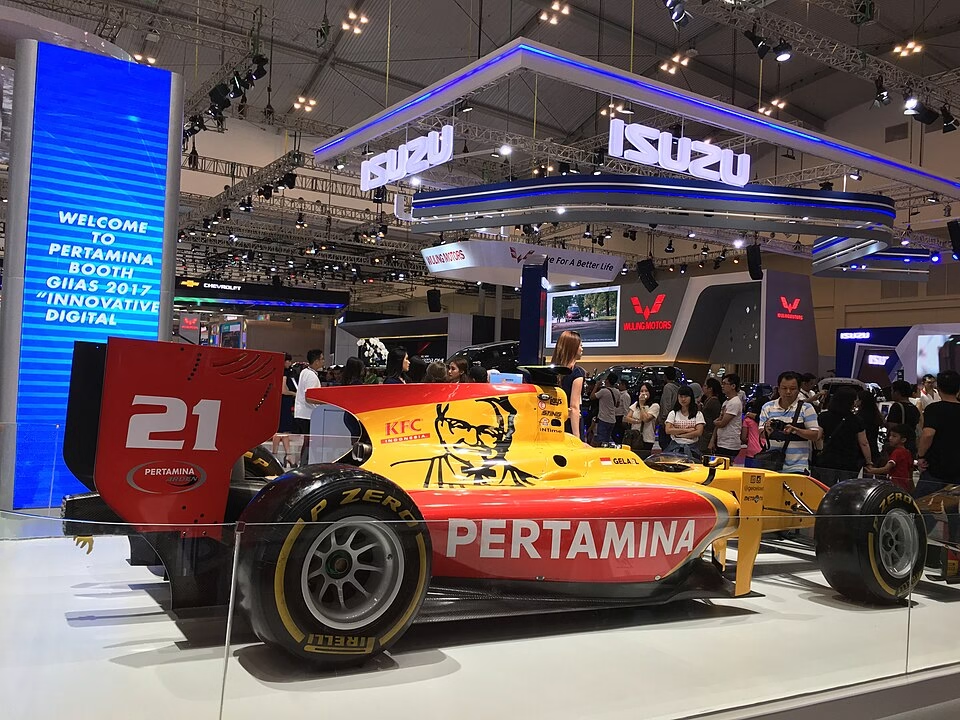
There are race cars that win championships, and there are race cars that define an era.
The Dallara GP2/11 belongs firmly to the second category-one of those machines that carried not only drivers but entire generations of motorsport fans, engineers, and dreamers toward Formula One. It arrived not as a revolution, but as an evolution; not loud in its promises, but thunderous in its execution.
Even today, more than a decade after its debut, those who lived through its prime still talk about it with the same affectionate tone people reserve for great mechanical companions. The GP2/11 was the kind of car that punished carelessness, rewarded bravery, and demanded that a driver grow up-fast.
A Machine Built for the Edge
When Dallara unveiled the GP2/11, the intention was simple: create a car that bridges young talent to Formula 1 without diluting the rawness that motorsport demands. Everything about the GP2/11 was shaped by this mission.
Technical Specifications
Chassis & Dimensions
-
Carbon-fibre monocoque
-
Weight: 688 kg (including driver)
-
Stiff, unforgiving, but precise—never hiding a driver’s mistakes
Engine
-
Mecachrome-tuned 4.0-liter naturally aspirated Renault V8
-
Power output: ~612 hp @ 10,000 rpm
-
Delivery: Immediate, violent, and gloriously analog
-
Sound: Somewhere between a scream and a battle cry
Gearbox & Drivetrain
-
Hewland 6-speed sequential, rear-mounted
-
Paddle shift
-
The gearbox was famous for its short, hammer-like upshifts that sent a shiver down the spine
Brakes
-
Carbon brakes with a narrow operating window
-
When cold: unpredictable
-
When hot: perfect razor-edge control
-
Flat spots? Almost guaranteed if you blinked
Performance
-
0–100 km/h: ~2.9 seconds
-
Top speed: ~320 km/h with DRS
-
Lap times often within 3-5 seconds of Formula 1
And critically-no power steering.
If a driver wanted to tame the GP2/11, they had to do it with their bare hands.
Between Two Worlds: The GP2/05 and the Dawn of Modern F2
To understand the GP2/11, you must first understand its position in the timeline.
Its Predecessor: GP2/05
The GP2/05 was already a respected car—fast, loud, and competitive. But time revealed its flaws: aging aerodynamics, outdated electronics, and a growing gap between its behavior and that of contemporary Formula 1 cars.
Drivers praised its energy but wished for something more refined, more modern—yet still dangerous enough to teach real lessons.
Enter GP2/11
The GP2/11 retained the soul of the ’05 car but sharpened it:
-
Cleaner aerodynamics
-
Better weight distribution
-
More robust gearbox
-
And a more efficient, yet equally angry V8
It wasn’t softer. It was smarter.
Its Successor: FIA Formula 2 (2018-present)
The modern Formula 2 car, with its turbocharged V6, ERS-inspired behaviors, and different weight profile, represents a new era-quieter, more controlled, and more aligned with hybrid-era Formula 1.
But ask almost any driver, and they’ll tell you the same thing:
“The GP2/11 was harder, more physical, and more honest.”
It was the last great pure stepping-stone car before the sport turned decisively toward complex hybrid engineering.
Notable Races and Moments That Defined a Legacy
The GP2/11 may have been a spec car, but it produced some of the most memorable races in junior-formula history.
2011 Istanbul – The Debut Chaos
No GP2 season opener had as much drama. The first GP2/11 races brought spins, tire explosions, carbon-fibre confetti, and a learning curve steeper than the Bosphorus shoreline. Teams and drivers quickly realized:
this was a car that demanded respect.
2012 Barcelona – Luis Razia vs. James Calado
A masterclass in tyre management: Razia, driving a car whose rear tyres were crying for mercy, somehow held off a charging Calado. The GP2/11 magnified every weakness in a driver’s approach, and this race became a case study in restraint versus pressure.
2013 Silverstone – Felipe Nasr’s Defensive Epic
Yan Ericsson attacked. Nasr defended. For lap after lap, the two danced at the limit—brake dust flying, tyres blistering, both drivers wrestling a car that offered no electronic safety nets. It was racing distilled to its essence.
2016 Bahrain – Gasly’s Statement Drive
Pierre Gasly’s victory wasn’t just a win; it was a proclamation. Hot desert asphalt, high degradation, and relentless pace changed the title narrative. It was the GP2/11 showing why strategy mattered as much as outright speed.
A Car That Built Champions
By the time the GP2/11 retired, it had shaped the careers of several future Formula 1 stars. The car didn’t just help them grow—it forced them to.
Notable champions and top graduates include:
-
Romain Grosjean (2011)
-
Davide Valsecchi (2012)
-
Fabio Leimer (2013)
-
Jolyon Palmer (2014)
-
Stoffel Vandoorne (2015)
-
Pierre Gasly (2016)
These were not drivers polished by electronics or groomed by simulators. They were hardened by the GP2/11’s demands: endurance, adaptability, and the ability to fight through declining grip on worn tyres in a car that refused to make life easy.
What Made the GP2/11 Truly Special
The GP2/11 was that rare balance of brutality and fairness. It didn’t pick favorites. If you were fast, it showed. If you were careless, it amplified your errors. It never lied, never pretended, never smoothed over the rough edges of a young driver’s craft.
It was the kind of car that made champions—not through comfort, but through hardship.
In a motorsport world increasingly filtered through software and energy-recovery systems, the Dallara GP2/11 stands as the final guardian of an older tradition:
a single-seater that teaches you how to fight, how to think, and ultimately, how to win.
