

From Track to Street: Understanding High-Speed Collision Dynamics
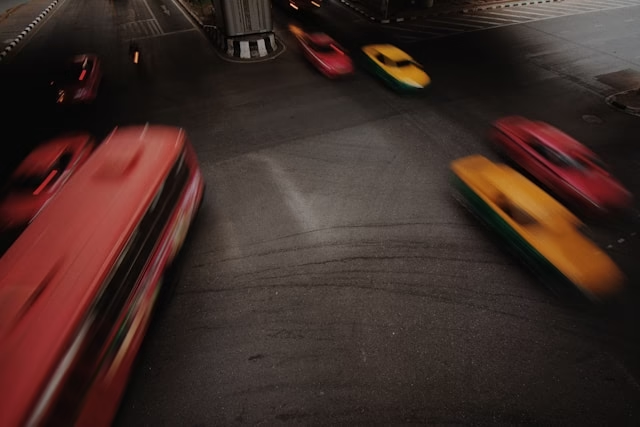
Whether they happen on the racetrack or the highway, high-speed traffic collisions are very dangerous and often fatal. That’s something that was likely drilled into your head when you first started to learn how to drive, but what exactly happens during such a crash? Let’s take a look.
Newton’s First Law of Motion
Newton’s First Law of Motion states that an object in motion will continue moving unless an external force acts upon it. This means that if a moving car hits something like a wall or another vehicle, it will come to a sudden stop, but the driver and passengers will keep moving forward unless they are restrained by seat belts. If they are unrestrained, they could be thrown around the interior of the vehicle or even go flying through the windshield. This is perhaps the biggest reason why high-speed collisions are so dangerous and why you should always wear a seat belt in a vehicle.
Newton’s Second Law of Motion
Newton’s Second Law of Motion states that acceleration is produced when a force acts on an object with mass. The greater the mass of the object, the more force is required to move it. This applies to the force needed to get a car moving when you drive, but it also applies to the impact force of a car on another object. A lighter vehicle or a vehicle that isn’t going very fast won’t do as much damage as a larger vehicle going over 30 miles per hour.
Newton’s Third Law of Motion
Newton’s Third Law of Motion states that every reaction has an equal and opposite reaction. A vehicle moving over 30 miles per hour will make quite an impact if it hits something, but it will also be subjected to a force equal to the collision. This is why a car will be all but destroyed if it’s in a high-speed crash.
What Happens in a High-Speed Crash?
A high-speed crash is generally one where vehicles are traveling at over 30 miles per hour, although some have argued that 40 miles per hour should be the threshold. Vehicles moving at those speeds will do serious damage to whatever they hit while being damaged themselves. Larger vehicles will suffer less damage unless they are going very fast, but they will also do more damage to whatever they hit. Anything inside a moving vehicle will keep moving forward if it isn’t secured tightly, including people. Occupants who aren’t wearing seat belts could be thrown around inside a vehicle and suffer injuries. If the vehicle was moving fast enough, they could be thrown through the windshield and away from the vehicle, a situation that is often fatal. Even if passengers are wearing seat belts properly, they could be crushed inside a vehicle that is moving fast enough or hit hard enough to crumple.
While high-speed driving is a given when you’re on a racetrack, there’s no reason to greatly exceed speed limits on the highway. Stay within the speed limit at all times, avoid tailgating as it increases your risk of an accident, be wary of other drivers on the road, and always wear your seat belt. If you race competitively, observe all safety precautions even when you’re driving at top speeds.
