

What a Truck's Black Box Actually Records and Why It Matters After a Florida Crash
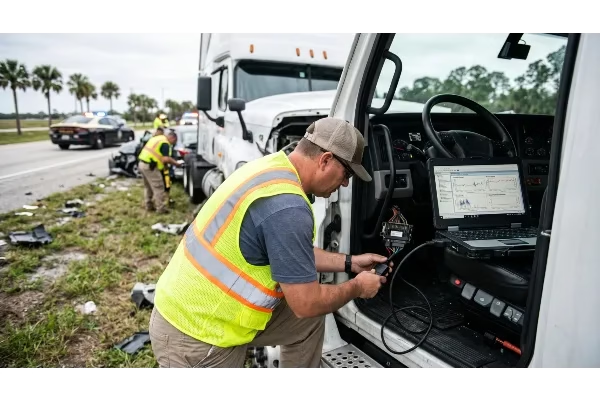
Anyone who has pulled a data log off a track car knows the difference between a channel that was actually sampled and a number somebody reconstructed afterward. The same distinction decides truck crash cases. People talk about the black box as though a tractor-trailer carries a single device holding the full story of a collision. It does not. There are three separate systems; they record different things, and only one of them is governed by a federal standard that specifies the data.
Three Devices, Commonly Confused
The federal EDR rule does not cover the truck
The regulation people cite is 49 CFR Part 563, which governs event data recorders. Its scope provision, Section 563.3, applies the rule to passenger cars, multipurpose passenger vehicles, trucks and buses with a gross vehicle weight rating of 3,855 kilograms, or 8,500 pounds, or less, manufactured on or after September 1, 2012, and only if they are equipped with an EDR.
A loaded semi is many times that weight. Part 563 therefore governs the car, not the truck that hit it. Reporting that treats the federal EDR rule as the source of heavy truck crash data has the regulation pointed at the wrong vehicle.
What the light vehicle EDR captures
For vehicles inside that scope, the required table is specific and short. It includes longitudinal delta-V, maximum delta-V and the time at which it occurred, indicated vehicle speed, engine throttle as a percentage of full, and service brake on or off. The speed, throttle, and brake channels are sampled from five seconds before the event to time zero, at two samples per second. Driver safety belt status and airbag deployment timing are also recorded.
Five seconds at two hertz is ten data points per channel. It is enough to show whether a driver lifted, braked, or did nothing. It is not a continuous log, and it does not record steering in the required set.
The heavy truck’s engine control module
A commercial tractor’s data comes from its engine control module, and the content is a manufacturer decision rather than a federal specification. Depending on the engine, an ECM may hold last stop records, hard brake events, road speed, engine speed, throttle position, cruise state, and fault codes. Because no rule dictates the contents, two trucks in the same crash can yield very different datasets.
The ELD is a different thing entirely
Electronic logging devices record duty status for hours of service compliance. They establish how long a driver had been working, which is often the more valuable evidence, but they are not crash recorders.
According to personal injury lawyer Nicholas R. Thompson, Principal and Managing Partner at RTRLAW, the practical problem in these cases is that the three data sources sit with three different custodians and operate on three different clocks, so a request aimed at one of them does nothing for the other two. That sequencing is a large part of why serious collisions reach Tampa attorneys for truck accident injuries within days rather than weeks, while the tractor is still intact and the logs are still inside their retention window.
Retention Is the Real Deadline
Duty status records are the clearest example. Under Section 395.8 of the federal motor carrier rules, a carrier must retain records of duty status and supporting documents for each driver for a period of not less than six months from the date of receipt.
Six months is the floor, not a promise. A carrier that discards records on the day the obligation ends has complied with the regulation. There is no federal rule requiring a carrier to keep ECM data at all, and the module can be overwritten by continued operation, cleared during repair or lost when the tractor is sold.
Continued driving degrades the evidence
An ECM that stores a limited number of events will overwrite the oldest as new ones occur. A tractor returned to service the following week is actively erasing the record while the claim is being evaluated.
How This Plays Out in Florida
Florida gives a negligence claim two years from the date the cause of action accrues. That is the deadline for filing suit, and it has almost nothing to do with the far shorter window in which the physical evidence remains available.
The mismatch is the point. A claimant can be comfortably inside the limitations period and still have lost the ECM download, the driver’s logs and the maintenance file, because none of those were preserved by anyone whose interest pointed that way.
What Is Worth Doing Early
Photograph the tractor and trailer, including the unit numbers, the carrier name and the US DOT number on the door, because those identify which company holds the records. Note whether the truck was towed and where. Ask the responding agency for the crash report number before leaving. If the vehicle you were in has an EDR, that module is in your own car and under your control, which makes it the one piece of data nobody else can quietly let expire.