

What Makes Motorsports So Thrilling?
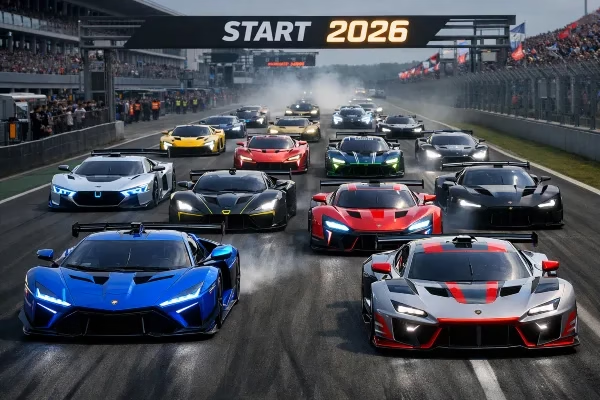
Few sports compress as much drama into so little time as motorsports. A single corner taken a fraction too fast, a tire that fades two laps too early, a pit call made a heartbeat too late, and an entire weekend’s work can unravel. The appeal isn’t just speed, though the speed is staggering. It’s the collision of human nerve, machine engineering, and split-second strategy, all playing out in real time with no second takes. Knowing what to look for turns a blur of fast cars into one of the most absorbing spectacles in sport.
Most newcomers assume motorsports is simply about who’s quickest. The people who fall for it discover something deeper: a contest decided as much in the garage and on the pit wall as on the track itself.
A Sport With Many Faces
Motorsports isn’t one thing. It’s a family of disciplines, each with its own character. Formula 1 sits at the technological summit, where open-wheel cars built around hybrid power units and intricate aerodynamics chase tenths of a second across a global calendar. MotoGP trades four wheels for two, with riders leaning their machines to impossible angles, knees and elbows skimming the asphalt at full lean.
Endurance racing tells a different story altogether. The 24 Hours of Le Mans and the wider World Endurance Championship ask cars and crews to survive a full day and night of racing, where reliability and rhythm matter as much as outright pace. NASCAR draws enormous crowds to high-speed oval racing, where drafting and door-to-door contact define the action. Rally throws competitors onto gravel, snow, and tarmac, with a co-driver calling out the road ahead at terrifying speed. And Formula E has built a following around all-electric cars racing on tight street circuits in the heart of major cities. Each format rewards a different blend of skill, and each builds its own devoted following.
The Human Element
Strip away the technology and motorsports is still a test of people. Drivers and riders operate under physical loads most athletes never face: sustained g-forces through high-speed corners, cockpit temperatures that climb past anything comfortable, and the mental discipline to make hundreds of precise decisions while fatigue sets in. A single lapse in concentration carries real consequences.
Behind every competitor stands a team that rarely gets the camera time. Engineers interpret torrents of live data, mechanics rebuild components against the clock, and strategists weigh the gamble of an early stop against the risk of staying out. When a driver crosses the line first, it’s the visible end of an effort that involved dozens of people working in near-perfect coordination.
Engineering at the Limit
Motorsports has always been a laboratory disguised as entertainment. Teams pour resources into shaving weight, sharpening aerodynamics, and squeezing more from every drop of fuel or unit of battery charge. Innovations forged under racing pressure, from disc brakes to hybrid systems to advanced materials, have a long history of eventually reaching the cars people drive every day.
That constant arms race is part of the drama. A clever piece of design can swing the balance of an entire season, and rival teams study one another obsessively, looking for the small advantage that competitors haven’t yet found. The machines evolve week to week, which means no two seasons ever look quite the same.
Strategy You Can Feel
What separates motorsports from a simple sprint is the layer of strategy running underneath it. Tire choice, fuel loads, pit-stop timing, and the ever-present threat of a safety car turn every race into a moving puzzle. A team can have the fastest car on the grid and still lose to a rival who simply read the race better. Watching a well-timed undercut unfold, or a driver nurse worn tires home to hold a position, delivers a tension that pure speed never could.
Beyond the Track
Modern motorsports lives well beyond the circuit. Global streaming, behind-the-scenes documentaries, and a flood of real-time data have pulled millions of new fans into the sport and deepened the obsession of longtime followers. The commercial side has shifted with it. Recent years have seen cryptocurrency brands become prominent sponsors across racing, putting their names on teams and events, while plenty of fans now follow races with a stake on the outcome through crypto-friendly platforms; a licensed Bitcoin casino JB, CloudBet, Stake, and BC.Game run sportsbooks covering Formula 1, MotoGP, and other series, letting supporters back a driver or a podium finish as the action unfolds. It’s one more sign of how far the sport’s audience and economy have grown beyond the grandstands.
Why It Endures
The question of what makes motorsports so thrilling has a layered answer. It’s the speed and the danger, but also the engineering, the human grit, the strategy, and the sheer unpredictability of a result that can turn on a single lap. Those elements stack on top of one another, race after race, season after season. That’s why the sport keeps pulling people in, and why, once it grabs you, it rarely lets go.