

Why Motorsports and Soccer Demand the Same Real-Time Platform Tech
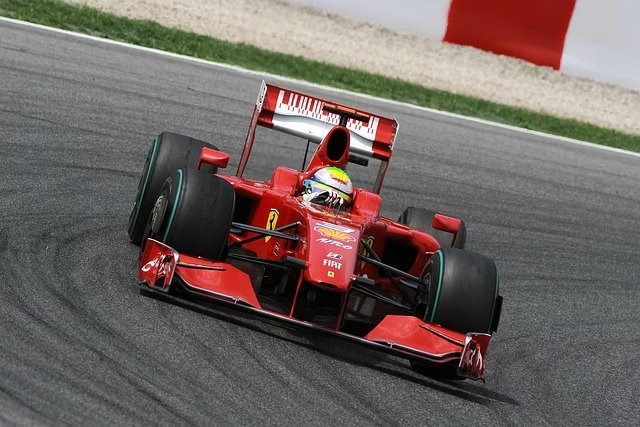
At first glance, motorsports and soccer could not feel more different. One is measured in laps, sectors, and split seconds. The other flows through ninety minutes with long stretches of buildup and sudden, decisive moments. Yet when you look at how people follow both sports online, the similarities become hard to ignore. From a platform perspective, they place almost identical demands on real-time tech.
Both sports unfold continuously. There is no clean pause between actions, no reset after every moment. A race is always moving forward, even when nothing dramatic is happening. A soccer match does the same, building pressure quietly before something finally breaks. That constant motion is what shapes the tech behind platforms built for these sports.
Early in the design of live soccer experiences, especially around options of placing a soccer bet or a motorsport bet through a betting platform like betway, platforms had to accept a basic truth. Updates cannot wait for neat breaks. The system has to move with the sport itself, even while people are watching, refreshing, and making decisions at the same time. Betway for instance, built its platform with that in mind, aiming for systems that stay responsive and predictable when matches and races start moving faster than traditional update cycles can handle.
Continuous flow, not isolated moments
Motorsports and soccer both rely on continuous state rather than isolated events. In racing, lap times, position changes, and pit decisions all build on what happened before. In soccer, possession, pressure, and momentum matter just as much as the scoreline. Platforms tracking either sport need tech that understands sequence, not just outcomes.
This is where event-driven systems come into play. Data arrives as a stream, not a checklist. Each update changes context. The platform has to process that stream in order, apply rules consistently, and reflect changes without creating confusion. Doing this well is less about speed alone and more about maintaining coherence under constant motion.
Handling sudden turning points
Both sports are defined by moments that change everything. A crash, a safety car, or a decisive overtake can flip a race instantly. A red card or a late goal can do the same in soccer. From a tech standpoint, these moments are stress tests.
Platforms need to know when to stop, when to change, and when to let things move again. React too slowly and it feels like something’s gone wrong. React too fast without checking the details and it starts to feel shaky. The real challenge is building tech that can take a breath, make the right adjustment, and carry on without leaving people wondering what just happened.
Managing attention
Another shared demand is how attention works. Fans of both sports check in constantly rather than watching every second with full focus. A race runs for hours. A soccer match has long stretches where little changes. Platforms are built for quick glances, fast updates, and immediate clarity.
That shapes front-end tech just as much as back-end systems. Interfaces must update without jumping around. Information has to be readable at a glance. Users need to trust that what they see reflects the current state, even if they looked away moments ago.
Scaling for peaks
Motorsports finales and major soccer matches create massive, unpredictable spikes. Platforms that handle these sports are not built around average traffic. They are built around extremes. This affects infrastructure choices, load management, and redundancy planning.
Betway is one example of a platform operating in this space, where tech decisions are shaped by peak moments rather than quiet ones. Reliability during those peaks is not just a technical goal. It is the foundation of user trust.
Different sports, same technical reality
What motorsports and soccer share is not style, but structure. Both demand platforms that can follow something that never fully stops, react to sudden shifts, and stay understandable throughout. The tech behind them has to balance speed, control, and clarity in equal measure.
That is why, despite their differences, these two sports end up relying on remarkably similar real-time platform tech. The challenge is not the sport itself. It is keeping up with reality as it unfolds.