

Motorsports Have Never Been Safer Than Right Now
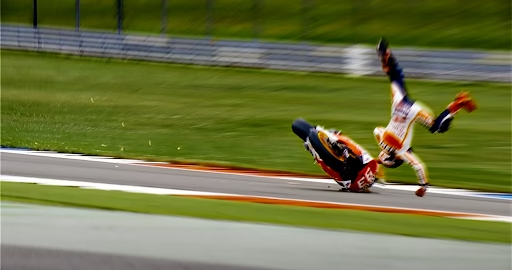
Crashes are still common in motorsports. However, significant injuries or worse, death, are almost nonexistent. Here’s how that happened.
If you poll 100 random people on the topic of safety and sports and ask em, “what’s the most dangerous sport?”
We’d guesstimate that a lot of answers will be motorsports. Maybe not the most responses (NFL probably No. 1 due to its popularity and easy-to-see violence), but motorsports will be in the mix of answers for sure.
And hey, we would understand why. The sport, on the surface, is highly dangerous. You have drivers pushing vehicles at insane speeds, and separated from one another by mere inches. All it takes is one bad maneuver, and boom, you have an awful crash, or worse, a pile-up of crashes.
But here’s the grand irony in all of this: racing has never been safer than it is right now. Never!
Yes, crashes still happen and when they do, they’ll probably go viral on social media sites. Those clips look terrifying because, well, they are. These images push the narrative that motorsports is a life-or-death thing every time out, when it’s really not anymore.
But the fact that so many drivers and riders walk away from those moments is not luck. It is the result of decades of engineering, rule changes, medical planning, and the hard lessons motorsports learned in the worst way possible.
That’s why in this article, we wanted to give the sporting organizations their flowers. A quick acknowledgment of what they’ve done to safeguard their leagues and drivers.
Formula 1 Turned Survival Into Engineering
Formula 1 is still having a moment. In the last decade, it’s exploded in popularity in the United States. You can measure that through TV viewership, revenue, social media dialogue, or the plethora of bets it gets at top California sportsbooks and the alike.
And this contingent of new fans is almost always amazed at how “safe” the sports actually is, when it probably shouldn’t be. We mean, the cars look fragile from a distance. But the part that matters most — the survival cell around the driver — is built like a fortress.
That became painfully obvious during Romain Grosjean’s crash at the 2020 Bahrain Grand Prix. His car hit the barrier, split in two, and burst into flames after a 53G impact. Once upon a time, maybe 15 years ago, that kind of crash probably ended in a horrific tragedy. But not anymore, as Grosjean escaped with burns to his hands and that’s about it.
The halo, the survival cell, the fireproof suit, and the fast medical response all played a role in preventing the disaster. That story best encapsulates modern F1 safety.
For those who weren’t around, the halo was controversial when it arrived in 2018 because fans thought it looked ugly. Seriously, that was the big complaint at the time. But thankfully, its intent was to save lives, not to farm aura for drivers. In that sense, it’s been a stunning success.
F1 has also made the HANS device mandatory, improved helmets, tightened fire-suit standards, upgraded crash testing, and designed cars so certain parts break away while the driver cell stays intact. That sounds boring until you watch someone hit a wall at 180 mph and climb out with just some scratches and burns. A modern miracle if ever one.
NASCAR Learned From Its Darkest Day
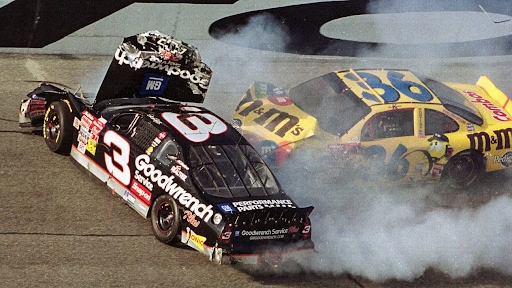
Dale Earnhardt’s death crash
Dale Earnhardt’s death forced NASCAR to put safety at a premium. It immediately implemented several changes, which have now prevented any new deaths on the track since then.
It took an awful, awful moment to cause an inflection for NASCAR. Of course, that was the 2001 Daytona 500 when the sport’s most famous driver, Dale Earnhardt, died in the sport’s most famous race.
A dark day, but one NASCAR learned from. That same year, the HANS device became mandatory across NASCAR. For those not in the know, it helps reduce the violent head and neck movement, which is what killed Earnhardt.
SAFER barriers also became a huge part of stock car safety. These are energy-absorbing walls designed to reduce the force transferred to the car and driver in a crash.
If you watch NASCAR regularly, you know crashes are still commonplace on the track. But nowadays, the cars absorb and redirect energy much better than they used to. And this is a major reason why no one has died racing NASCAR since Earnhardt.
IndyCar Protected The Open Cockpit
IndyCar has one of the toughest safety problems in racing. This is because the
cars are open-wheel. That means the wheel is exposed outside the car’s body and likewise, the cockpits are also exposed. You might be wondering, “how the hell do you protect a driver’s head without turning an IndyCar into something else?”
Aeroscreen, that’s how. IndyCar introduced the aeroscreen in 2020. Not to get too brainiac here, but essentially, the device makes use of a ballistic windscreen anchored by a titanium frame, and it is mandatory across ovals, road courses, and street circuits.
That’s not to say the aeroscreen makes IndyCar risk-free. No, no, let’s not get too ahead of ourselves. But it closes one of the biggest gaps the sport had of debris and/or other cars making their way into that exposed cockpit.
MotoGP Made The Rider The Safety Cell
MotoGP is different because there is no cockpit, no roll cage, and no survival cell. It’s just a rider, his helmet, and the motorcycle.
Crashes are different in this sport. When a rider wipes out, it’s he that’s being thrown across the track most — not the vehicle. So MotoGP safety went all-in on the rider’s gear, track design, and medical response. This is different than the other sports, which honed in on the vehicle itself.
Airbag suits are probably the biggest modern advancement. They had been used in MotoGP for years before becoming mandatory in 2018, with protection around areas like the back, shoulders, and ribs to absorb impact when riders fall.
Tracks matter, too. MotoGP needs large runoff areas, gravel traps, air fences, and circuit layouts that account for riders sliding a long way after a fall. Unlike car racing, the first impact is not always the scariest part. Sometimes the real danger is where the rider ends up.
To wrap this up, we want to reiterate that motorsports will always be inherently dangerous. Saying otherwise is just a bald-faced lie, and not what we’re getting at here.
But… the top leagues deserve their due. They’ve collectively done something remarkable here. With tech that’d make Silicon Valley blush, they’ve taken some of the most dangerous sports in the world and made the close-your-eyes scary crash completely survivable.
Related Posts