Circuit Gilles Villeneuve – Montreal F1 & Wall of Champions Guide
Originally published June 2016. Last updated September 2026: expanded Tier B circuit guide, facts table, table of contents, Wall of Champions context, internal links, FAQ schema, and editorial refresh while preserving legacy narrative and images.
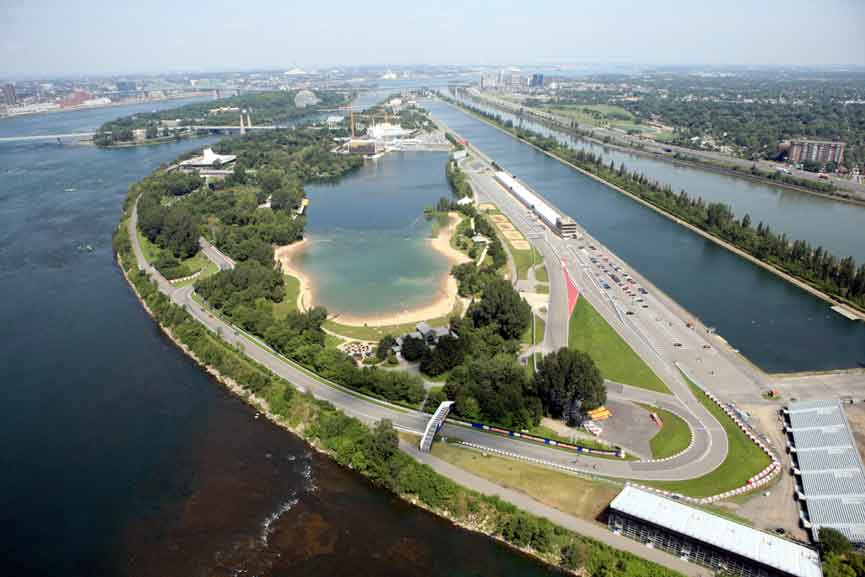
Circuit Gilles Villeneuve is a 4.361-kilometre semi-permanent street course on Notre-Dame Island in Montreal — home of the Formula One Canadian Grand Prix and one of the few venues to have hosted both F1 and NASCAR on the same layout. Opened in 1978 as the Île Notre-Dame Circuit, it gained its present name after the death of Gilles Villeneuve, who won the inaugural Grand Prix there.
The track matters because of the Wall of Champions at Turn 15, long straights into tight chicanes, and a Montreal festival atmosphere that fills Parc Jean-Drapeau every June. Compare Canada’s F1 home with Canadian Tire Motorsport Park, Circuit Mont-Tremblant, and Watkins Glen International.
Contents
- Circuit Gilles Villeneuve facts
- Île Notre-Dame origins
- 1978 Canadian Grand Prix and naming
- Layout, length, and FIA grade
- Wall of Champions
- Pit changes and safety revisions
- Formula One at Montreal
- NASCAR and other series
- Lap records and F1 winners
- Getting to Parc Jean-Drapeau
- Frequently asked questions
Circuit Gilles Villeneuve facts
| Location | Parc Jean-Drapeau, Notre-Dame Island, Montreal, Quebec, Canada |
|---|---|
| Former name | Île Notre-Dame Circuit (1978–1982) |
| Circuit type | Semi-permanent parkland / street course |
| Opened | 1978 |
| Length | 4.361 km (2.710 miles), 13 turns |
| Direction | Clockwise |
| FIA grade | Grade 1 |
| Capacity | About 100,000 in grandstands |
| Owner | City of Montreal |
| Main event | Formula One Canadian Grand Prix |
| Notable corner | Turn 15 — Wall of Champions |
Lap record note: F1, NASCAR Nationwide/Xfinity, and sportscar sessions use different cars and configurations. Compare times only within the same series and era.
Venue on the island waited to get the right purpose
The venue was opened in 1978 and was originally named Île Notre-Dame Circuit, situated on the artificial island in the St Lawrence Seaway. The plan of the local authorities was to build a venue for Expo ’67 and futuristic parkland, but when the Expo was finished, the site struggled to find a proper purpose. In 1976, it was used during the Summer Olympic Games before the decision was made to make this venue the home of Canada’s most prestigious racing event — the Formula 1 Canadian Grand Prix.

Hairpin at Circuit Gilles Villeneuve, home of the F1 Canadian Grand Prix
Named after a Formula 1 fallen hero
Works at the site were finished relatively fast and the first Canadian Grand Prix was held as the penultimate race of the 1978 season. The winner was the local hero Gilles Villeneuve, Canada’s best and most popular racer. The track was renamed after his death in 1982.

Gilles Villeneuve
Circuit Gilles Villeneuve is a twisty track
The circuit, owned by the City of Montreal, is 4.361 km long and has 13 turns. Grandstand capacity is around 100,000. Circuit Gilles Villeneuve holds FIA Grade 1 licence and over the years became popular among drivers because of its high-speed straights, twisty sections and tight hairpins.

Wall of Champions at Circuit Gilles Villeneuve
Wall of Champions
One of the best-known parts of Circuit Gilles Villeneuve is the Wall of Champions at turn 15, named after Damon Hill, Michael Schumacher, and Jacques Villeneuve all ending the 1999 Canadian Grand Prix after they hit the wall which was originally named “Welcome to Quebec”. Many champions from other series — including Ricardo Zonta, Juan Pablo Montoya, Nico Rosberg, Jenson Button, and Sebastian Vettel — also had unpleasant meetings with the wall.
The track layout never was drastically changed
During the second half of the 1980s, major modifications made more space for pit buildings. Later, chicanes were added or moved for safety reasons, but the layout of the track never was significantly changed. Circuit Gilles Villeneuve hosted F1 for the first time in 1978, but the race has not been held every year. 1987 is one exception as the race wasn’t held because of a dispute between sponsors, while in 2009 organisers could not reach an agreement with F1 administration.

Map: Circuit Gilles Villeneuve track layout
Formula 1 Canadian Grand Prix is one of the main events in Montreal
Besides the Formula 1 Canadian Grand Prix, Circuit Gilles Villeneuve is one of the very few in the world which was the host of NASCAR races and Grand-Am sports car races. Many other series have raced in Montreal, including the FIA World Sportscar Championship.

Moments before the start of the Formula 1 Canadian Grand Prix
NASCAR and the controversial 2007 race
The 2007 NASCAR Busch Series race won by Kevin Harvick was one of the most controversial in the series’ history after Robby Gordon claimed that he won the race before being disqualified.

Circuit Gilles Villeneuve during its NASCAR era
Barrichello holds the F1 lap record; Ferrari leads team wins
The fastest Formula 1 lap was set in the 2004 race when Rubens Barrichello in a Ferrari drove a lap in 1:13.622. By comparison, the fastest lap in NASCAR Nationwide Series was set in 2012 when Alex Tagliani in a Chevrolet scored 1:40.865.
The most successful Formula 1 driver at Circuit Gilles Villeneuve is Michael Schumacher with seven wins while Lewis Hamilton has won there on four occasions. Ferrari has the most constructor wins in Montreal (10), one more than McLaren.

Michael Schumacher in Ferrari wins the 2002 Canadian Grand Prix
Parc Jean-Drapeau is easy to get to
Given that Circuit Gilles Villeneuve is located in the centre of Montreal, getting there is straightforward. From Pierre Elliott Trudeau International Airport, allow around 20 minutes in normal traffic. Accommodation is plentiful, but parking near the island is limited on race days — the island closes to general traffic and public transport (metro to Jean-Drapeau station) is the practical option for Grand Prix weekend.
Address: Parc Jean-Drapeau, Montreal, QC H3C 6A1, Canada
Phone: +1 514 350 0000
Official website: circuitgillesvilleneuve.ca
Frequently asked questions about Circuit Gilles Villeneuve
Where is Circuit Gilles Villeneuve?
Circuit Gilles Villeneuve is on Notre-Dame Island in Parc Jean-Drapeau, Montreal, Quebec, in the St Lawrence River near downtown Montreal.
How long is Circuit Gilles Villeneuve?
The Formula 1 layout measures 4.361 km (2.710 miles) with 13 turns, run clockwise around the island park roads.
Why is it called Circuit Gilles Villeneuve?
The track opened in 1978 as the Île Notre-Dame Circuit. Gilles Villeneuve won the inaugural Canadian Grand Prix that year; the circuit was renamed after his fatal crash at Circuit Zolder in 1982.
What is the Wall of Champions?
The Wall of Champions is the unforgiving barrier at Turn 15. The nickname stuck after Damon Hill, Michael Schumacher, and Jacques Villeneuve all crashed there in the 1999 Canadian Grand Prix.
What is the F1 lap record at Montreal?
Rubens Barrichello set the listed Formula 1 lap record of 1:13.622 during the 2004 Canadian Grand Prix for Ferrari.
Who has the most F1 wins at Circuit Gilles Villeneuve?
Michael Schumacher won seven Canadian Grands Prix at Montreal. Lewis Hamilton has four victories there as of 2026.
Has NASCAR raced at Circuit Gilles Villeneuve?
Yes. NASCAR’s national touring series raced on the island layout, including the controversial 2007 Busch Series event won by Kevin Harvick after Robby Gordon was disqualified.
What FIA grade is Circuit Gilles Villeneuve?
The circuit holds FIA Grade 1 certification, allowing Formula One and other top international single-seater and sportscar categories on the current layout.
When was the Canadian Grand Prix not held at Montreal?
Notable gaps include 1987 (sponsor dispute) and 2009 (organiser agreement with Formula One). The race has otherwise been a regular June fixture when on the F1 calendar.
How do you get to the Canadian Grand Prix at Montreal?
Take the metro to Jean-Drapeau station on Île Notre-Dame. Parking on the island is restricted on race weekend; most fans use public transport from downtown Montreal or hotels near the airport (YUL).