

How Learners Build Judgement on Busy Urban Roads
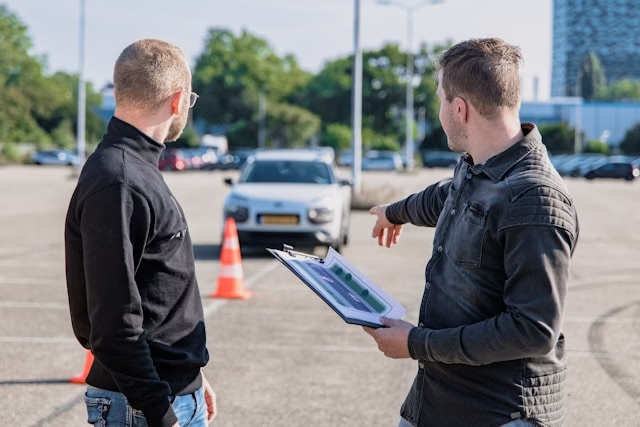
Urban driving can look chaotic from the passenger seat. Buses stop, cyclists filter, pedestrians appear between vehicles and road markings compete for attention. Learners do not become comfortable by trying to process everything at once. They build judgement by learning where to look, what to prioritise and how to create time for decisions.
The aim is not to react quickly to every surprise. It is to observe early enough that fewer events feel surprising.
Start by looking further ahead
New drivers often focus on the vehicle immediately in front because it feels like the most urgent object. A wider view provides more useful information. Traffic lights in the distance, a bus at a stop, brake lights several cars ahead and pedestrians approaching a crossing all help predict what may happen next.
The instructor can prompt a learner to describe developing situations in simple language. Saying “the bus may pull out” or “the crossing is partly hidden” turns passive looking into active planning. The learner can then adjust speed early instead of braking sharply later.
Use speed to buy thinking time
The appropriate speed is shaped by the limit, visibility, traffic and the possibility of change. Driving below the limit may be necessary when parked vehicles narrow the view or a junction is busy. Equally, unnecessary hesitation can confuse other road users, so the learner needs to connect speed choices to a clear reason.
A useful question is: could I stop safely within what I can see to be clear? This encourages control without relying on an arbitrary slow pace.
Treat parked vehicles as a changing environment
Parked cars can hide people, opening doors and vehicles emerging from driveways. Learners should scan beneath and between them for feet, wheels, lights or movement. They also need enough clearance while considering oncoming traffic and the width of the road.
Meeting situations are easier when anticipated. Identifying a safe place to wait before reaching a narrow gap is calmer than negotiating from the middle of it. With practice, this becomes planning rather than a last-second decision.
Share space with cyclists and buses
Cyclists may need to move away from the kerb to avoid drains, doors or broken surfaces. Buses need room to leave stops and may obscure people crossing. Learners should avoid assuming that another road user will remain on a fixed line simply because that is where they are now.
Patience creates safety. Waiting for a clear opportunity is not failure, but waiting should still involve observation and a plan to move when conditions allow.
Break difficult routes into repeatable skills
A complicated roundabout or busy junction can be divided into approach, observation, lane position, decision and exit. Practising those elements on several roads helps the learner understand the principle rather than memorise one route.
Someone taking driving lessons in Wimbledon may encounter dense traffic, residential streets and faster connecting roads. A structured lesson can vary the setting while retaining one clear skill focus, such as planning at crossings or choosing gaps at junctions.
Reflect after the drive
The most useful review is specific. Instead of deciding that the whole lesson was “good” or “bad”, identify one situation that improved and one decision to practice next time. Notes made shortly after the lesson can preserve that learning without turning every minor error into a setback.
Confidence grows from evidence. When a learner repeatedly spots a hazard earlier, adjusts smoothly and understands why a decision worked, busy roads begin to feel organized rather than unpredictable.
Urban judgement is a collection of habits: look further, manage speed, expect hidden movement, communicate clearly and review honestly. Those habits continue to matter long after the practical test.
Let unfamiliar roads test the method
Familiarity can make a learner feel confident without proving that the underlying judgement will transfer. Once core skills are stable, an instructor can introduce an unfamiliar area and ask the learner to follow signs or make independent route decisions. The purpose is not to catch them out. It is to see whether the same scanning, speed and positioning habits remain available when the next junction is not memorized.
If the learner misses a turning, the safe response is usually to continue and find another route. Sudden lane changes or rushed turns create more risk than arriving later. Learning to accept a navigation error calmly is part of independent driving.
This transfer from familiar to unfamiliar roads is a useful sign of progress. It shows that the learner is building a decision-making process rather than collecting answers for a small set of locations.
Manage pressure without rushing decisions
Busy roads can create a false sense that every gap must be taken immediately. A learner should recognise when waiting is the safer choice and avoid allowing a following driver to dictate speed or positioning. At junctions and roundabouts, a missed opportunity is usually less serious than entering without a safe view. Instructors can help by discussing how pressure feels, then rehearsing a calm sequence: observe, decide, act and review. The goal is not hesitation but a decision that remains controlled when other road users appear impatient.
Practise the same hazard in varied settings
One successful encounter with a bus, cyclist or parked-car obstruction does not make the skill automatic. Repeating similar decisions on roads with different widths, speeds and sight lines helps the learner identify the underlying principles. The instructor can vary the route while keeping the learning objective clear. Over time, the learner should need fewer prompts to reduce speed, improve the view or leave a safer margin. Varied practice builds judgement that transfers beyond a memorised test route.
Measure growing independence
Progress can be reviewed by the timing and quality of decisions rather than by counting only obvious mistakes. Notice whether the learner spots a developing hazard without a prompt, explains the relevant risk and chooses a proportionate response. Occasional coaching may still be useful even when the action is safe. A short review at the end of the lesson should identify evidence of independence and one specific situation to revisit. This creates a realistic picture of readiness without relying on confidence alone.
The review should also recognise recovery. An independent driver will occasionally choose the wrong lane, miss a turning or need more time than expected. What matters is whether the learner stays observant, avoids a rushed correction and returns to a safe plan. Practising that recovery builds resilience and helps ensure that one small error does not lead to several hurried decisions in quick succession.
Photo by Bas Peperzak on Unsplash