How Professional Racing Drivers Train Their Reaction Time
A racing driver has only fractions of a second to respond when a light goes out, another car changes direction, or an unexpected event develops on track. At high speeds, that small window can influence everything from a clean start to avoiding a collision. Similar demands for quick visual responses can also be found in digital gaming, including titles such as Jiligames, where players interact with rapidly changing on-screen cues.
However, fast reactions are not simply a matter of natural reflexes. Professional racing drivers train their visual processing, hand-eye coordination, concentration, and ability to respond to changing signals. Research has also found that elite racing drivers can demonstrate faster reaction times than physically active people of similar age.
So, how do professional drivers train this ability?
Reaction Time Is More Than Moving Quickly
Reaction time involves much more than just movement of the driver’s hands and feet. Before any action is performed, a driver’s brain must accurately perceive the stimulus, process it and choose the right response.
This is crucial in motor racing because drivers are exposed to multiple incoming forms of information. They receive information from the vision of drivers in other vehicles and the state of the track, and this must be combined with the cues provided by sound, steering, and the reactions of the vehicle.
Simply developing faster reaction times does not equal better performance because training should aim for developing the complete chain of reaction that goes from the moment of seeing to the moment of appropriate response.
Light-Based Reaction Drills
In motorsport, there is a training technique that consists of responding to lights that light up at random intervals.
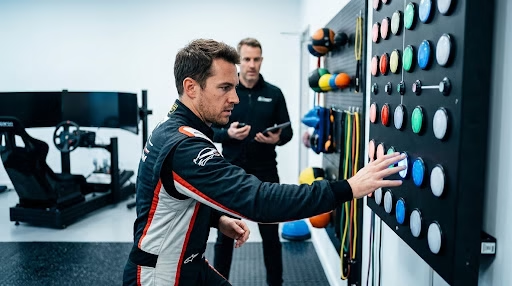
This technique is easy to grasp as lights light up in random order and drivers are required to touch the lamp or deactivate it as quickly as they can. Since the way the lights are switched on is unpredictable, participants need to make use of their reaction rather than their memory.
The FIA has explained that this method of training is being used in its driver-development programs. For instance, during the Girls on track Karting Challenge, the participants had the opportunity to train themselves with a Batak reaction machine through random light stimuli.
In an academic research, light reactive agility training among racing drivers was studied. The study lasted for six weeks and all participants had to undergo a training course involving visual light stimulation and eventually ended up with better scores on the measures of reactive agility and reaction time.
Hand-Eye Coordination Matters
The driver might understand the evolving scenario quickly, but if a poor physical response is executed, precious seconds might be lost. Hence, reaction training often involves exercises involving visual cues with motor actions. Examples of such exercises include light devices, ball drills, coordination tasks, and test runs on simulation machines, which imply observing the stimulus and instant executing the necessary movements.
However, speed cannot be the only aim. The ability to be accurate when under pressure matters just as much. In a race, responding quickly may also mean causing an accident by turning the steering wheel or pressing the gas pedal inappropriately.
Training the Brain While Under Pressure
As professional drivers are obliged to maintain their reactions even if they are physically exhausted or mentally overloaded, it should be noted that a race requires extended concentration, repetitive decision-making, and physical strain. It can be difficult to keep your concentration as fatigue accumulates.
That is why some training programs use the combination of cognitive work with physical training. Studies dealing with reactive agility training in motorsports have shown some improvements with some cognitive indicators as well as performance parameters. The FIA has also drawn attention to concentration as well as coordination, endurance, and reaction time.
Simulators Add a Realistic Element
A simulator could offer a different method for drivers to get practice on how to react to situations without the stress of constantly going to the track, both physically and financially.
Instead of only practicing a reflex, simulator usage can allow the drivers to have a design with an activity that gives pressure on them constantly, as they must make a variety of decisions, observing traffic and contingencies.
Due to this, the activity would become closer to racing, where reactions hardly happen in isolation.
Anticipation Is Part of Being Fast
As interesting as it seems, it’s safe to say that drivers don’t only depend on raw reaction speed. Thanks to the experience, the driver can forecast what is going to happen next. Everything changes when it comes to the case when a driver sees some external factors such as another car becoming unstable, the change of the track conditions, and the transformation of the curves of the track.
Apart from being fascinating, this fact is important because reacting to something after it happened is not good enough in the racing.
According to McLaren’s explanation, the performance definition of race start is more than just reaction speed.
Building Faster, More Controlled Responses
Training for professional racers is a blend of physical training and cognitive preparation.
Light-training drills help to test response ability. Coordination exercises combine visuals and movements. Simulators offer a chance to experience real-life racing situations. Physical and mental conditioning helps drivers focus as fatigue sets in.
Most important, professional racers learn how to react correctly as fast as possible without always aiming for the quickest reflex.
On a track, milliseconds count. However, it is not just speed that counts, but also the ability to interpret information as well as foresee certain situations and take action accordingly.
Photo by Morio, CC BY-SA 3.0, via Wikimedia Commons