
Martinsville Speedway – NASCAR Paper-Clip Oval Guide

Originally published February 2016. Last updated October 2026: expanded Tier B circuit guide, facts table, table of contents, internal links, FAQ schema, and editorial refresh while preserving legacy images and story.
Martinsville Speedway is a 0.526-mile paved oval in Ridgeway, Virginia, and the shortest track on the NASCAR Cup Series calendar. Opened in 1947, it is the only venue from NASCAR’s earliest championship seasons that still hosts the Cup Series today. Fans call it a “paper clip” because the straights are short and the corners tight, producing constant side-by-side racing on a surface where asphalt straights meet concrete turns.
The track matters because it survived every NASCAR ownership change, repave, and rules package while keeping the same basic shape. Richard Petty won here fifteen times — still a record — and winners since 1964 receive a grandfather clock, a nod to the furniture industry that built Martinsville’s economy.
Contents
Martinsville Speedway circuit facts
| Location | Ridgeway, Henry County, Virginia, United States |
|---|---|
| Circuit type | Paved oval (short track) |
| Opened | 1947 (first NASCAR-sanctioned race: 4 July 1948) |
| Layout length | 0.526 miles (0.847 km) |
| Turn banking | Approximately 12 degrees |
| Surface | Asphalt on straights; concrete in turns (since 1976) |
| Main events | NASCAR Cup Series; NASCAR Craftsman Truck Series; NASCAR Whelen All-American Series |
| Seating capacity | About 44,000–60,000 (varies by configuration and renovation phase) |
| Nicknames | Paper clip; Grandfather’s Clock track |
| Founder | H. Clay Earles |
Lap record note: Compare lap times only within the same series and session. A widely quoted NASCAR Cup qualifying benchmark is 18.898 seconds, set by Joey Logano on 28 March 2014.

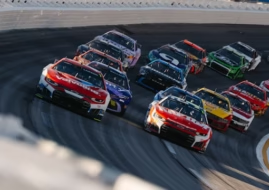
Pace lap at Martinsville Speedway
H. Clay Earles and the 1947 opening
Local businessman H. Clay Earles built Martinsville south of the town of Martinsville in Henry County when paved short tracks were still rare in the Southeast. The first NASCAR-sanctioned event arrived on 4 July 1948 with only about 750 permanent seats, yet more than 6,000 spectators crowded around the dusty oval.
Earles kept investing as NASCAR grew. By the 1950s the speedway was paved, and in 1956 Martinsville hosted its first 500-lap Cup race. The track’s survival through the superspeedway boom of the 1960s and 1970s proved that NASCAR still needed a bullring where fenders trade paint every lap.
Paper-clip layout and dual surfaces
Martinsville’s shape explains the “paper clip” nickname: two short straights linked by tight corners with only 12 degrees of banking. There is no room to breathe; drivers ride the brakes into every turn and fight for the inside line.
The unusual asphalt straights and concrete turns date to 1976, when rising tyre wear forced Earles to repave the corners in concrete while leaving asphalt on the straights. A full resurfacing in 2005 refreshed both materials and added safer barriers. The combination still feels unique on the modern Cup calendar next to mile-and-a-half intermediates and road courses.

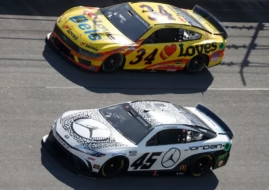
Contact is common at Martinsville Speedway
Pit road and repaves
For decades Martinsville famously operated with two pit roads — one on the front stretch and one on the backstretch. Teams pitting on the backstretch during cautions could lose track position because cars on the front stretch rejoined the field first. NASCAR eventually reconfigured pit road to run from the entrance of turn 3 through the exit of turn 2, simplifying strategy and improving safety.
Repaves in 1955, 1976, and 2005 each responded to higher speeds and modern tyre compounds. The track never needed a layout change; NASCAR’s challenge here is friction and patience, not finding the right aerodynamic balance.
NASCAR and major events
Martinsville typically hosts two NASCAR Cup Series weekends per season (spring and autumn), plus support races from the Craftsman Truck Series and local Whelen All-American divisions. The Xfinity Series left the calendar in 2007, but the Cup races remain anchor events for the France family’s track portfolio.
Because the oval is short and narrow, cautions cluster. That rhythm makes Martinsville a favourite for fans who want close racing and for broadcasters who know every restart can reshuffle the lead. Compare the experience to Bristol Motor Speedway (another short concrete bowl) or the egg-shaped Darlington Raceway superspeedway in South Carolina.
Records, clocks, and legends
Richard Petty remains the benchmark at Martinsville with 15 Cup Series wins, the most starts, most laps completed, and most top-five finishes at the track. Petty won here as a teenager in 1960 and kept winning for three decades, tying the speedway to the Petty dynasty as tightly as Daytona ties to the 500.
Since 1964 winners receive a grandfather clock trophy instead of a standard cup, celebrating the region’s furniture makers. The tradition survives even as Victory Lane photography has gone digital.

Winners at Martinsville receive a grandfather clock trophy
Safety upgrades and ownership
The France family’s International Speedway Corporation purchased Martinsville in 2004, placing the track alongside Daytona, Talladega, and Charlotte in the same corporate stable. SAFER barriers, pit-road redesigns, and digital scoring modernised the facility without altering the paper-clip outline.
Rumours of a night race surface periodically, but spring and autumn weather in the Blue Ridge foothills makes scheduling tricky. Even so, NASCAR has shown no appetite for dropping one of its last true short tracks from the playoff calendar.

Spectators sit close to the action at Martinsville
Visiting Martinsville Speedway
Martinsville sits off US Route 58 between Roanoke, Virginia, and the North Carolina border. Parking and camping fill early on Cup weekends; arrive with tickets confirmed through the track’s official sales channel. The infield is tight compared with superspeedways, which is part of the charm.
Martinsville remains NASCAR’s living short track
Every rules package NASCAR introduces is tested here: bump drafting on the straights, tyre fall-off in the concrete corners, and pit strategy under caution. Martinsville does not care how many horsepower the Next Gen car produces; it cares whether a driver can complete 500 laps without losing patience.
Related reading
- Bristol Motor Speedway — Theatre of Speed NASCAR guide
- Darlington Raceway — Southern 500 oval guide
- Charlotte Motor Speedway
- Daytona International Speedway
Address: 340 Speedway Road, Ridgeway, VA 24148, USA
Phone: +1 877 RACE TIX
Official website: martinsvillespeedway.com
Frequently asked questions
How long is Martinsville Speedway?
Martinsville Speedway measures 0.526 miles (0.847 km) per lap, making it the shortest track on the NASCAR Cup Series schedule.
Where is Martinsville Speedway?
The track is in Ridgeway, Henry County, Virginia, south of the city of Martinsville. The mailing address is 340 Speedway Road, Ridgeway, VA 24148.
Why is Martinsville called a paper clip?
Fans nickname the oval a paper clip because two short straights connect tight corners with only about 12 degrees of banking, producing a narrow, stop-and-go rhythm unlike larger superspeedways.
Who has the most NASCAR wins at Martinsville?
Richard Petty holds the NASCAR Cup Series record with 15 victories at Martinsville, along with the most starts, laps completed, and top-five finishes at the track.
Why do Martinsville winners get a clock?
Since 1964, race winners receive a grandfather clock trophy, celebrating the furniture industry that historically employed much of the local workforce around Martinsville and Ridgeway.
Is Martinsville asphalt or concrete?
Martinsville uses asphalt on the straights and concrete in the turns, a combination introduced when the corners were repaved in 1976 to cope with tyre wear from modern NASCAR stock cars.
Is Martinsville still on the NASCAR Cup schedule?
Yes. Martinsville is the only track from NASCAR’s earliest championship seasons that still hosts the Cup Series, typically with spring and autumn races each year.
What is the lap record at Martinsville Speedway?
A widely quoted NASCAR Cup qualifying benchmark is 18.898 seconds, set by Joey Logano on 28 March 2014. Compare lap times only within the same series and session type.
How does Martinsville compare to Bristol?
Both are short NASCAR ovals, but Bristol is a high-banked concrete bowl while Martinsville is longer in lap distance terms yet tighter, with lower banking and a paper-clip shape.