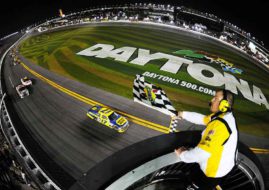

Daytona International Speedway – NASCAR and Rolex 24 Guide

Originally published February 2016. Last updated September 2026: added labelled tri-oval circuit map (Wikimedia Commons, with attribution in caption)
Daytona International Speedway is a 2.5-mile tri-oval superspeedway in Daytona Beach, Florida, and the spiritual home of American stock car racing and sports-car endurance competition. Bill France Sr. opened the track in 1959 to replace racing on the beach-and-road course. The Daytona 500 remains NASCAR’s season opener and most prestigious oval race, while the infield road course hosts the 24 Hours of Daytona — the flagship event on the IMSA calendar.
Daytona matters because it defined the superspeedway era: high banking, restrictor-plate drafting packs, and television moments that shaped NASCAR’s national profile. The same property combines oval speed with a technical infield used for Rolex 24 prototypes and motorcycles. Few venues bridge circle-track folklore and international endurance racing as completely.
Fans still call it the temple of endurance — a label earned by January’s twice-around-the-clock sportscar race as much as by February’s Harley J. Earl Trophy fight. The banking is steep, the infield is busy, and the history includes both Petty family dominance and the sport’s darkest Sunday in 2001.
Contents
- Daytona International Speedway facts
- Daytona Beach Road Course
- Bill France, Moneypenny, and construction
- Tri-oval layout and restrictor plates
- Daytona 500 and NASCAR
- Dale Earnhardt and Black Sunday
- Rolex 24 at Daytona
- Daytona Rising and fan experience
- Visiting Daytona International Speedway
- Frequently asked questions
Daytona International Speedway facts
| Location | Daytona Beach, Florida, United States |
|---|---|
| Circuit type | Tri-oval superspeedway with infield road course, motorcycle course, and flat track |
| Opened | 1959 (first Daytona 500: 22 February 1959) |
| Oval length | 2.5 miles (4.02 km) |
| Road course length | 3.56 miles (5.73 km) sports car layout; shorter motorcycle configuration |
| Turn banking | 31° in turns; 18° at start/finish (historic NASCAR figures) |
| Main events | Daytona 500 (NASCAR Cup); Coke Zero Sugar 400; Rolex 24 at Daytona (IMSA); ARCA; Bike Week |
| Capacity | About 101,500 permanent seats (expandable toward 125,000 after Daytona Rising) |
| Founder | William H. G. “Bill” France Sr. |
| Infield feature | Lake Lloyd (powerboat racing venue) |
Lap record note: categories use different cars and configurations. A widely quoted NASCAR Cup qualifying benchmark is 210.364 mph (42.783 seconds), set by Bill Elliott in 1987 before restrictor plates became mandatory at Daytona and Talladega. On the tri-oval, Colin Braun set a 222.971 mph prototype record in 2013. Compare times only within the same series, session type, and layout.
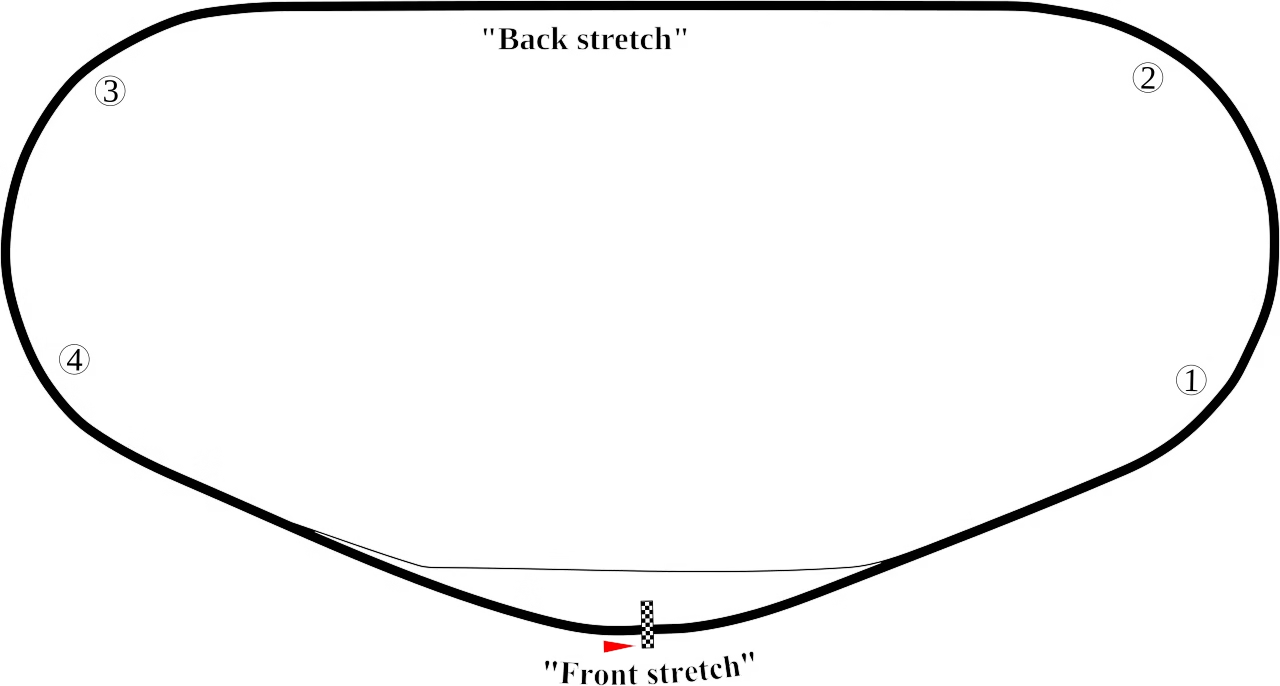
Daytona International Speedway — 2.5-mile tri-oval — Map: Will Pittenger / public domain via Wikimedia Commons
Daytona Beach Road Course
Before the superspeedway existed, NASCAR grew on the Daytona Beach Road Course — a hybrid of beach sand and public roads. Land-speed record attempts made the coastline famous; Bill France Sr. organised stock car races there from 1948. By the mid-1950s France wanted a permanent paved bowl that could host bigger fields and safer racing.

Daytona Beach Road Course was popular for land speed record attempts
Bill France, Moneypenny, and construction
France hired engineer Charles Moneypenny, who adapted high-banked test-track concepts so spectators could see more of the racing line. Construction began in November 1957 after the city leased land. Millions of tonnes of soil excavated from the infield became Lake Lloyd, named for Daytona Beach Speedway Authority member Joseph “Sax” Lloyd.
Extreme banking forced new paving techniques: bulldozers anchored at the rim held paving machines on the incline. Moneypenny patented the method and later designed Talladega Superspeedway and Michigan International Speedway. The track has been repaved several times — notably 1978, 2010, and infield work in 2004 — while grandstands were rebuilt under the Daytona Rising project completed in January 2016.

Daytona’s tri-oval improved sight lines for fans in the grandstands
Tri-oval layout and restrictor plates
The tri-oval is 2.5 miles with 31° banking in the corners and a 3,800-foot front stretch. The back straight — the superstretch — measures about 3,000 feet. The shape was revolutionary in 1959 because it kept cars visible across more of the lap than a simple oval.
Daytona and Talladega remain the only NASCAR Cup tracks that routinely use restrictor plates (and later equivalent rules) to cap speeds in the draft. Absolute lap records therefore belong to different eras and equipment. The infield adds a 3.56-mile sports car course, a shorter motorcycle layout, a quarter-mile flat track, and Lake Lloyd for powerboat racing.

Historic map: 2.5-mile Daytona oval with infield road course
Daytona 500 and NASCAR
Practice for the inaugural Daytona 500 began on 6 February 1959; the race ran on 22 February. Lee Petty beat Johnny Beauchamp in a photo finish that took three days to settle — NASCAR’s first superspeedway race immediately felt bigger than anything at Darlington.

Lee Petty won the first Daytona 500 in 1959
Sports cars debuted on the infield in April 1959; Champ Car and motorcycle events followed. The 500 became NASCAR’s crown jewel. Since 1982 it has opened the Cup Series season. Richard Petty holds the race record with seven Daytona 500 wins, including the 1979 edition — the first live flag-to-flag television broadcast that ended with a post-race fight involving the Allison brothers and Cale Yarborough.
Cale Yarborough won four times; Bobby Allison, Dale Jarrett, and Jeff Gordon each won three. The summer 400-mile race (today sponsored by Coke Zero Sugar) has its own lore — David Pearson won that event five times.

Richard Petty scored seven Daytona 500 wins
Dale Earnhardt and Black Sunday
Dale Earnhardt Sr. finally won the Daytona 500 in 1998 after two decades of near misses. Three years later, on the final lap of the 2001 race, he lost control and struck the outside wall in turn 4. The crash — remembered as Black Sunday — killed Earnhardt and accelerated NASCAR’s safety programme.
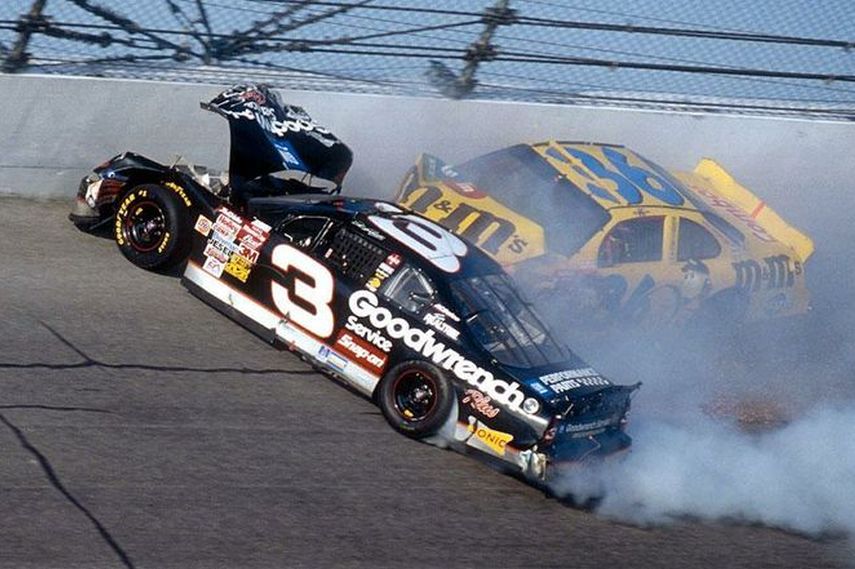
Dale Earnhardt’s fatal crash on 18 February 2001 remains NASCAR’s defining tragedy
Daytona’s long history also includes fatal accidents in other series and during testing. The track has invested in barrier and vehicle safety in the years since, but the 2001 500 remains the moment every fan of a certain generation can recount lap by lap.
Rolex 24 at Daytona
The infield hosted sports cars from 1959 onward. The endurance race began as a three-hour event in 1962, became a 24-hour race in 1966 (with a six-hour 1972 exception during the energy crisis), and now runs as the Rolex 24 at Daytona under IMSA.
Ken Miles and Lloyd Ruby won the first 24-hour edition in a Ford GT40. Ferrari’s 1-2-3 in 1967 inspired the unofficial Ferrari Daytona road-car name. Legends from Mario Andretti to Juan Pablo Montoya have won overall.

Night racing is standard at the Rolex 24 at Daytona
Hurley Haywood and Scott Pruett share the record of five overall Rolex 24 wins each. Porsche leads manufacturer victories. The event pairs with the Daytona 500 as the two pillars of January and February at the speedway.

Twenty-nine former Rolex 24 winners pictured in 2013
Daytona Rising and fan experience
The Sprint Fanzone (2004) let fans walk above garages and watch inspections through glass. Daytona Rising added concourses, hundreds of screens, suites, escalators, and themed displays — a $400 million rebuild finished for Speedweeks 2016. The speedway remains one of the few American venues where a single weekend can mean both NASCAR drafting and prototype headlights through the esses.

Fans in the Daytona fanzone during a race weekend
Visiting Daytona International Speedway
Speedweeks in February fills hotels from Ormond Beach to Orlando. The Rolex 24 in January draws a different crowd — sportscar specialists who camp in the infield. Tours, the Motorsports Hall of Fame of America, and Bike Week activities keep the property busy year-round.
Book accommodation early for the 500; traffic on International Speedway Boulevard stacks quickly on race morning. Use the official speedway site for tickets and parking maps.
Fast facts about Daytona International Speedway
- Bill France Sr. opened the track in 1959 to replace beach racing.
- The tri-oval measures 2.5 miles with 31° banking.
- Lee Petty won the first Daytona 500 after a three-day photo-finish review.
- Richard Petty’s seven 500 wins remain the record.
- Restrictor-plate rules tame Cup speeds at Daytona and Talladega.
- The Rolex 24 became a 24-hour race in 1966.
- Hurley Haywood and Scott Pruett each won the Rolex 24 five times.
- Dale Earnhardt Sr. died on the final lap of the 2001 Daytona 500.
- Daytona Rising modernised grandstands for the 2016 season.
- Lake Lloyd inside the oval hosts powerboat racing.
Frequently asked questions about Daytona International Speedway
Where is Daytona International Speedway?
Daytona International Speedway is in Daytona Beach, Florida, United States, at 1801 West International Speedway Blvd. The track sits inland from the Atlantic coast, roughly halfway between Jacksonville and Orlando.
How long is the Daytona oval?
The NASCAR tri-oval measures 2.5 miles (4.02 km). The infield sports car course is about 3.56 miles when the full Rolex 24 layout is used.
What is the Daytona 500?
The Daytona 500 is a 500-mile NASCAR Cup Series race held on the Daytona oval. First run in 1959, it is traditionally the season-opening race and one of NASCAR's crown jewel events.
Who won the first Daytona 500?
Lee Petty won the inaugural Daytona 500 on 22 February 1959 after a photo finish with Johnny Beauchamp that took three days to decide.
Who has the most Daytona 500 wins?
Richard Petty holds the record with seven Daytona 500 victories (1964, 1966, 1971, 1973, 1974, 1979, and 1981).
What is the Rolex 24 at Daytona?
The Rolex 24 at Daytona is a 24-hour sports car endurance race on Daytona's infield road course, run in January under IMSA. It is the premier American endurance event alongside the 24 Hours of Daytona heritage story.
Why do NASCAR cars use restrictor plates at Daytona?
Restrictor plates (and later equivalent speed-control rules) limit engine power at Daytona and Talladega so cars do not exceed safe speeds on the steep banking. The rule shapes the famous drafting packs fans see in the Daytona 500.
When did Dale Earnhardt die at Daytona?
Dale Earnhardt Sr. died in a crash on the final lap of the 2001 Daytona 500 on 18 February 2001 — an event often called Black Sunday in NASCAR history.
Who built Daytona International Speedway?
NASCAR founder Bill France Sr. commissioned the track, which opened in 1959. Engineer Charles Moneypenny designed the high banking and patented the paving method used on the inclines.
Can you visit Daytona International Speedway?
Yes. The speedway offers tours, museum displays, and major race weekends including the Daytona 500 and Rolex 24. Check daytonainternationalspeedway.com for schedules and tickets.
Daytona still anchors American racing
European fans know Spa-Francorchamps for Ardennes mist and Eau Rouge; Americans point to Daytona for February sunshine, draft battles, and a January night race that never sleeps. The venue is not interchangeable with Bristol or Jarama — it is the hub where NASCAR’s calendar and IMSA’s endurance season both begin.
Related reading
- Daytona 500 — NASCAR’s most prestigious race
- 24 Hours of Daytona — America’s greatest endurance race
- Darlington Raceway — Southern 500 oval guide
- Bristol Motor Speedway — Theatre of Speed
- Spa-Francorchamps — Belgian Grand Prix circuit guide
- Talladega Superspeedway
Address: 1801 West International Speedway Blvd, Daytona Beach, FL 32114, USA
Phone: +1 800 748 7467
Official website: daytonainternationalspeedway.com