Nürburgring Nordschleife: the Notorious Automotive Green Hell

The Nürburgring Nordschleife is one of the oldest, longest and most demanding purpose-built racing circuits in the world. Built in the Eifel mountains of Germany around the village of Nürburg, it has been a proving ground for racing drivers and road cars for nearly a century.
Jackie Stewart famously nicknamed it “the Green Hell”. The name stuck because the Nordschleife combines length, elevation change, blind crests and trees close to the road in a way few modern circuits still attempt. It is not merely a fast track. It is a place where concentration has to last for more than twenty kilometres at a time.
Today the complex includes the Nordschleife, the modern Grand Prix circuit and a tourist-drive tradition that keeps the old course alive between race weekends. This guide covers how the Ring was built, why Formula One left it, what still races there, and how visitors experience the place.
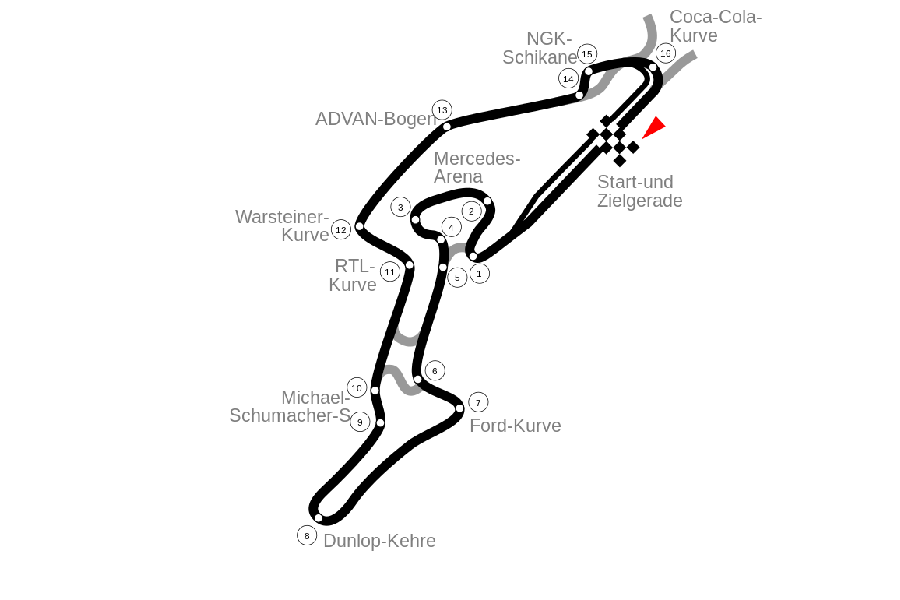
Visual representation of the Nürburgring circuit complex
Contents
- Nürburgring circuit facts
- Origins and the first races
- Why the Nordschleife is so difficult
- “The Green Hell” and Formula One
- Lauda’s 1976 crash and the end of F1 on the Nordschleife
- The Grand Prix circuit
- Lap records and the Bellof debate
- The 24 Hours of Nürburgring
- Road-car proving ground
- Visiting and Touristenfahrten
- Related reading
- Frequently asked questions
Nürburgring circuit facts
| Location | Nürburg, Rhineland-Palatinate, Germany (Eifel region) |
|---|---|
| Circuit type | Permanent complex: Nordschleife + Grand Prix-Strecke |
| Construction started | September 1925 (Gustav Eichler design) |
| Opened | 18–19 June 1927 |
| Nordschleife length | Approximately 20.8 km (modern race configuration) |
| Historic Gesamtstrecke | Nordschleife + Südschleife combined full course |
| Main events | 24 Hours of Nürburgring, NLS / endurance series, historic meetings |
| Best-known sections | Flugplatz, Schwedenkreuz, Adenauer Forst, Karussell, Pflanzgarten |
| Famous nickname | “The Green Hell” (Jackie Stewart) |
Exact official lengths vary slightly by configuration (Nordschleife alone, combined 24h layout with the Grand Prix loop, tourist sessions). Treat any single figure as a working description of the current course rather than a permanent laboratory measurement.
Origins and the first races
Construction of the Nürburgring began in September 1925 around the village of Nürburg. Gustav Eichler’s design used the natural hills and forests of the Eifel rather than flattening the landscape into a stadium bowl. From the beginning, the full Gesamtstrecke was conceived as a combination of the northern loop (Nordschleife) and southern loop (Südschleife).
The track opened on 18 June 1927 with a motorcycle race won by Toni Ulmen. A day later the first automobile race was held, won by the legendary pre-war German driver Rudolf Caracciola.
At 15:06.1, the official Gesamtstrecke record from the early years is associated with Louis Chiron, who drove a Bugatti Type 35C in the 1929 German Grand Prix. Those times belong to a different era of cars and surfaces, but they already show how long a “lap” at the Ring could be.
Why the Nordschleife is so difficult
The Nordschleife is not difficult only because it is long. It is difficult because the road never settles into a rhythm for long. Elevation changes, cambers, blind crests and tree-lined sections keep arriving after one another. A driver who is merely “quick” for three corners can still lose the lap somewhere between Adenau and the Karussell.
That is why the Ring became a proving ground as much as a race venue. A car that feels stable on a modern Grand Prix circuit can still feel nervous here. Suspension, brakes, cooling and driver concentration are all tested across a distance closer to a short stage than a conventional lap.
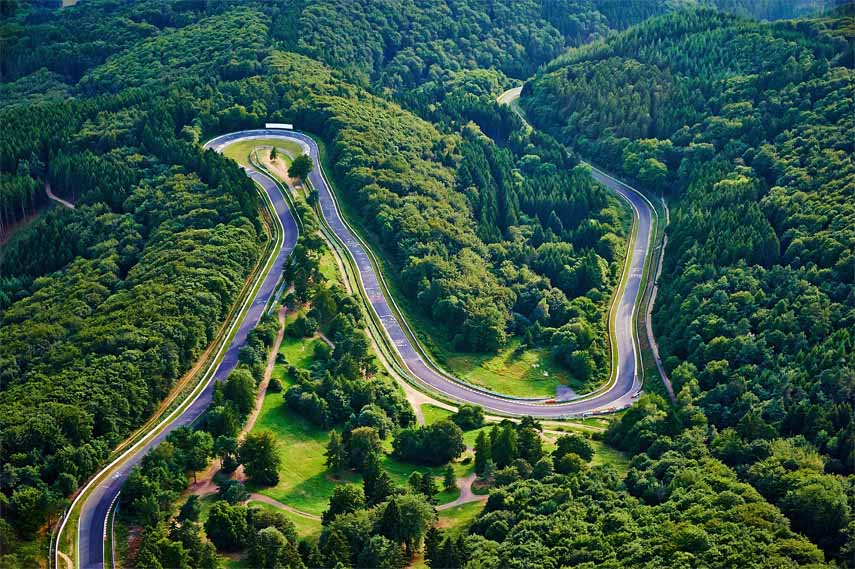
The Nordschleife threads through the Eifel countryside
“The Green Hell” and Formula One
After the Second World War, the Nordschleife became the principal Grand Prix layout used from 1947 into the early 1970s. The fifties also saw the introduction of the 1000 km Nürburgring endurance race, which further cemented the circuit’s place in sportscar history.
In 1961, Phil Hill broke the nine-minute barrier with a lap of 8:55.2 in the Ferrari 156. As Formula One cars became faster through the late sixties, the track’s safety problems became harder to ignore. The Hohenrain chicane was added before the start/finish straight in 1967, but the fundamental issue remained: a 20-kilometre forest circuit with limited runoff.
After winning the 1968 German Grand Prix, Jackie Stewart nicknamed the Nordschleife “the Green Hell”. The phrase captured both the beauty of the place and the seriousness of racing there.
In 1970 the first 24 Hours of Nürburgring was held. The same year, Formula One drivers boycotted the Nordschleife and the German Grand Prix moved to the Hockenheimring.
Lauda’s 1976 crash and the end of F1 on the Nordschleife
Formula One returned for a final chapter in the mid-1970s, after further circuit changes between 1971 and 1976. In 1975, Niki Lauda became the first driver to lap the Nordschleife in under seven minutes, recording 6:58.2.
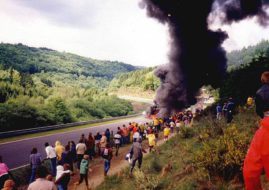
That era ended violently. Lauda’s near-fatal crash in the 1976 German Grand Prix made the safety argument impossible to dismiss. Formula One never returned to the Nordschleife. The old course kept its place among the most dangerous race tracks in the world — not as a slogan, but as a reminder of how racing safety changed after the 1970s.

Aerial view of the Nürburgring Grand Prix circuit
The Grand Prix circuit
Construction of a new Grand Prix circuit began in 1981. The Nürburgring Grand Prix-Strecke opened in 1984 as a modern FIA venue beside the old Nordschleife. Formula One raced there in 1985, with Michele Alboreto winning, before the German Grand Prix returned to Hockenheim for long stretches.
Formula One came back to the Grand Prix circuit in 2009, 2011 and 2013. Outside those years the venue remained important for other FIA and national championships, endurance support races and major German motorsport weekends.
The Nordschleife and Grand Prix loop can also be combined for events such as the 24-hour race, producing one of the longest competitive layouts still used in modern touring and GT racing.
Lap records and the Bellof debate
Nordschleife lap times are endlessly compared — and endlessly argued over. Configuration, rubber, weather, whether the time was set in qualifying or race traffic, and whether a car was a prototype or a modified road car all matter.
After major racing largely left the pure Nordschleife Grand Prix configuration in the mid-1980s, Stefan Bellof’s times from the Group C era remained the reference point for many enthusiasts. Driving a Porsche 956, Stefan Bellof recorded 6:11.13 in qualifying for the 1983 1000 km Nürburgring and also set a famous in-race mark of 6:25.91.
Those figures belong to a specific car class and a specific weekend. Later manufacturer marketing laps, Nordschleife “production car” claims and tourist-session videos use different rules again. When SnapLap cites a Ring record, the useful question is always: record of what, in what car, on which layout?
The 24 Hours of Nürburgring
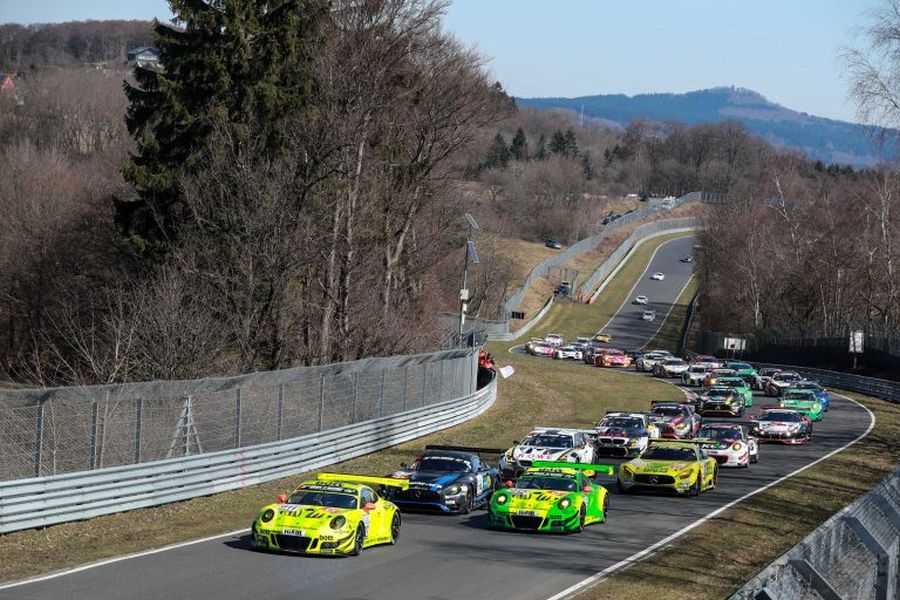
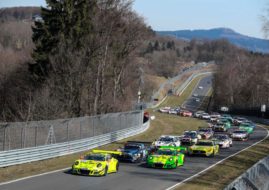
The highlight of the modern season is the 24-hour race. It can attract hundreds of thousands of spectators, more than 200 cars and a field that mixes amateurs, gentleman drivers, professionals and factory teams. The atmosphere is closer to a festival than a single Grand Prix weekend — campsites, packed hillsides and traffic that barely stops for a day.
That mixture is part of the event’s character. A privateer GT3 car can share the same night as a works entry. Former Formula One drivers appear beside club racers. For many German enthusiasts it is the one race weekend that still feels like the Ring of old: long, crowded and slightly chaotic in the best sense.

Sabine Schmitz became one of the Nordschleife’s public legends
Sabine Schmitz personified that public side of the Ring: a local expert who could explain the Nordschleife to television audiences while also racing there seriously. Few circuits produce characters quite like that.
Road-car proving ground
Between race meetings the Nordschleife remains a development tool for manufacturers. Production and near-production cars are still brought here because a hot lap on a short modern track does not expose the same weaknesses. Cooling, tyre wear, aero balance and brake fade show up differently over twenty kilometres of mixed corners.
Those marketing times keep the Ring in the news, but they should be read with the same caution as historic race records: session type, preparation level and measurement method are rarely identical from one press release to the next.
Visiting and Touristenfahrten
One reason the Nordschleife stays sacred to enthusiasts is public access. On designated Touristenfahrten sessions, visitors can drive the northern loop themselves — not as a race, and not without risk, but as a rare chance to experience a historic Grand Prix road course from behind the wheel.
Sessions, prices, vehicle restrictions and cancellation rules change. Anyone planning a visit should check the official Nürburgring information for the specific date rather than relying on old trip reports. The Ring is also busy during major race weekends and events such as Rock am Ring, when accommodation and roads fill quickly.
Walking or riding around the complex outside a tourist session still shows why the place matters: the elevation, the forest, the scale of the Grand Prix facilities beside an old public road that somehow became motorsport mythology.

Detailed map of the Nordschleife
Related reading
- 24 Hours of Nürburgring history
- Porsche 956 — Bellof’s Group C weapon
- Porsche 917 — another icon of the endurance era
- Hockenheimring — the other great German Grand Prix venue
- Spa-Francorchamps — another long, dangerous classic
- Norisring — Germany’s famous street circuit, not to be confused with the Ring
Frequently asked questions about the Nürburgring
Where is the Nürburgring?
The Nürburgring is in the Eifel region of Rhineland-Palatinate, Germany, around the village of Nürburg.
What is the Nordschleife?
The Nordschleife is the northern loop of the Nürburgring — the long historic course of roughly 20.8 km that earned the nickname “the Green Hell”. It is separate from the modern Grand Prix circuit built beside it.
How long is the Nürburgring Nordschleife?
The modern Nordschleife race configuration is generally described as approximately 20.8 kilometres. Combined 24-hour layouts that include the Grand Prix loop are longer.
Why is it called the Green Hell?
Jackie Stewart nicknamed the Nordschleife “the Green Hell” after the 1968 German Grand Prix, reflecting its beauty, length and danger.
Does Formula One still race on the Nordschleife?
No. Formula One left the Nordschleife after Niki Lauda’s near-fatal crash in 1976. Later German Grands Prix at the Nürburgring used the modern Grand Prix circuit, not the old northern loop.
What is the Nürburgring lap record?
It depends on the category and configuration. Stefan Bellof’s Group C qualifying time of 6:11.13 in a Porsche 956 (1983) is the best-known historic Nordschleife racing benchmark. Road-car marketing times use different rules and should not be mixed with race records.
Can you drive the Nürburgring yourself?
Yes, on designated Touristenfahrten (tourist drive) sessions, subject to the circuit’s current rules, vehicle restrictions and opening times. Check nuerburgring.de for the specific date.
What is the 24 Hours of Nürburgring?
It is the circuit’s flagship endurance race, usually run on a combined Nordschleife and Grand Prix layout with a huge mixed field of amateur and professional drivers. See SnapLap’s 24 Hours of Nürburgring history.
Is the Nürburgring the same as the Norisring?
No. The Nürburgring is the permanent complex in the Eifel. The Norisring is a temporary street circuit in Nuremberg.
When did the Nürburgring open?
The circuit opened on 18–19 June 1927, with motorcycle racing on the first day and automobile racing on the second, won by Rudolf Caracciola.
Why the Nordschleife still matters
Almost a century after Toni Ulmen and Rudolf Caracciola opened the story, the Nürburgring remains one of motorsport’s few sacred places. Formula One left the Nordschleife, safety standards changed, and a modern Grand Prix circuit grew beside the old road. The Green Hell itself did not become ordinary.
It is still long. It is still serious. And for drivers, manufacturers and visitors who make the journey into the Eifel, it is still the place against which so many other tracks are quietly measured.
Location: Nürburgring Boulevard, 53520 Nürburg, Germany
Official website: nuerburgring.de