Senna vs Prost Rivalry - The Defining Conflict in Formula 1 History
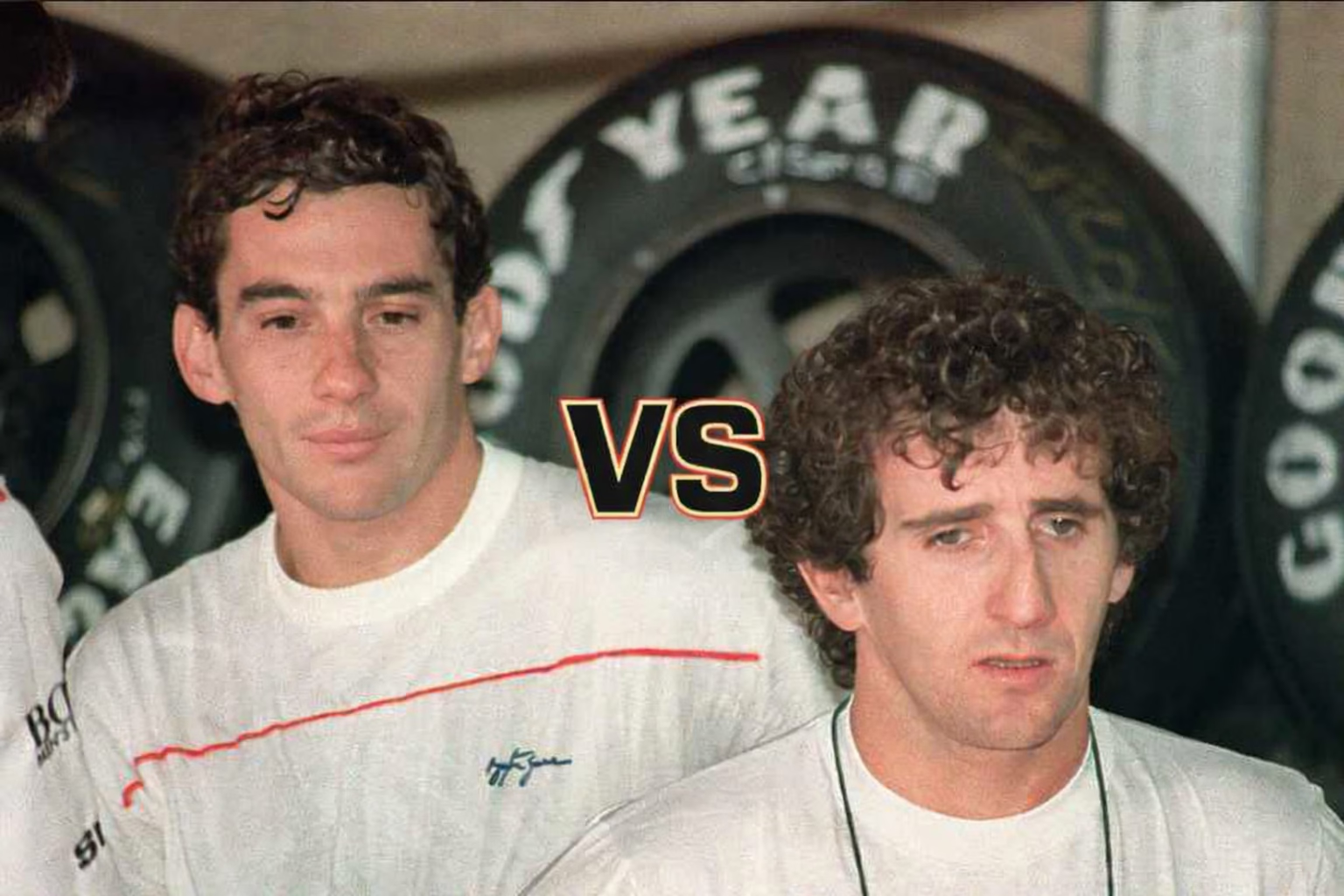
In Formula 1, rivalries are inevitable. But some go beyond competition and become defining chapters in the sport’s history. The clash between Ayrton Senna and Alain Prost was one of those rare moments – a rivalry shaped not just by speed, but by ideology, personality, and control.
Prost was the thinking driver, precise and methodical, earning the nickname “The Professor.” Senna operated differently, driving on instinct and absolute commitment, often beyond the conventional limits of risk. When McLaren brought them together in 1988, it created the most dominant driver pairing of the era. Fifteen wins in sixteen races told one story. What happened inside the garage told another.
1988 McLaren Dominance – Success Without Harmony
The 1988 season remains one of the most dominant campaigns in Formula 1 history, largely thanks to the McLaren MP4/4. Senna and Prost overwhelmed the field, but their internal battle quickly overshadowed their success. Prost expected hierarchy and structure within the team. Senna rejected both, relying instead on outright speed and personal conviction.
This was not yet open conflict, but the foundation was set. Two elite drivers, equal machinery, and incompatible approaches.
1989 Season Turning Point – Imola and the Breakdown of Trust
The rivalry escalated during the San Marino Grand Prix 1989. Following a restart, both drivers had agreed not to attack into the first corner, prioritizing safety and team results. Senna ignored the agreement, overtook Prost immediately, and secured the lead.
For Prost, this was a breach of trust. For Senna, it was racing.
From that moment, cooperation ended. McLaren effectively split into two camps, each centered around its driver. The rivalry was no longer internal tension – it became open conflict.
Suzuka 1989 – Collision, Disqualification, and Political Fallout
The championship battle reached its peak at the Japanese Grand Prix 1989. Prost entered the race leading the standings, while Senna needed victory to stay in contention.
Late in the race, Senna attempted an overtake at the chicane. Prost closed the door, and the two collided. Prost retired immediately, believing the title was secured. Senna continued after rejoining the track, replaced his front wing, and crossed the finish line first.
The result did not stand. Senna was disqualified for cutting the chicane and receiving assistance, handing the championship to Prost. In the aftermath, Senna accused FIA president Jean-Marie Balestre of favoritism. The rivalry had now extended beyond the circuit into governance and politics.
Suzuka 1990 – Controversy and Deliberate Collision
One year later, the same circuit hosted another title decider at the Japanese Grand Prix 1990. Prost, now driving for Ferrari, lined up alongside Senna, who held pole position.
At the start, Prost gained the advantage. As both approached the first corner, Senna chose not to yield. The resulting high-speed collision eliminated both drivers instantly and secured the championship for Senna.
The incident remains one of the most controversial in Formula 1 history. Senna later admitted the move was intentional, framing it as a response to the events of the previous year. The rivalry had fully crossed the boundary between competition and retribution.
1991–1993 – De-escalation and Emerging Respect
In the following seasons, the intensity of the rivalry gradually decreased. Prost temporarily stepped away before returning with Williams in 1993, where he secured his fourth world title. Senna, frustrated with McLaren’s declining performance, explored a move to Williams but was prevented by a contractual clause requested by Prost.
Despite occasional public criticism, the tone between the two drivers began to shift. By the final race of the 1993 season in Adelaide, the hostility had largely subsided. On the podium, they shared a moment that reflected mutual understanding rather than rivalry.
San Marino 1994 – Tragedy and the End of a Rivalry
The rivalry came to an abrupt end during the San Marino Grand Prix 1994, when Ayrton Senna was fatally injured in a crash. The loss shocked the motorsport world and immediately reframed the narrative of his career and his rivalry with Prost.
In a moment that defined their relationship more than any on-track incident, Prost served as a pallbearer at Senna’s funeral. What had long appeared to be hostility was revealed as something more complex – a rivalry grounded in deep respect and shared understanding at the highest level of competition.
Legacy of Senna vs Prost – Precision vs Instinct
The significance of Senna and Prost extends beyond statistics and championships. They represented two contrasting philosophies of racing: Prost’s precision, patience, and calculated approach against Senna’s instinct, intensity, and uncompromising pursuit of performance.
Neither philosophy proved universally superior. Instead, their rivalry demonstrated that greatness in Formula 1 can be achieved through fundamentally different paths.
That is why this rivalry endures. Not simply because of the collisions, controversy, or titles, but because it captured the essence of competition at its highest level.