

Sepang International Circuit – Malaysian Grand Prix Guide

Originally published February 2016. Last updated September 2026: added labelled Grand Prix circuit map (Wikimedia Commons, with attribution in caption)
Sepang International Circuit is a Hermann Tilke-designed permanent track in Sepang, Selangor, about 50 km south of Kuala Lumpur, Malaysia. Opened in 1999, it hosted the Formula One Malaysian Grand Prix until 2017 and remains a benchmark for modern Asian motorsport facilities — wide straights, two DRS zones, and weather that can flip from dry heat to monsoon rain within a single lap.
Sepang matters because it was the template for many Tilke circuits that followed: Bahrain, Abu Dhabi, Turkey, and the Circuit of the Americas all borrowed ideas from its generous runoff and spectator sight lines. Drivers praise the flowing layout even after F1 left; MotoGP, endurance racing, and national championships still treat the venue as Malaysia’s primary racing home.
The circuit is not a street track or a narrow European classic. It is a purpose-built Grand Prix bowl next to Kuala Lumpur International Airport — hot, humid, and technically demanding for tyres and brakes.
Contents
Sepang International Circuit facts
| Location | Sepang, Selangor, Malaysia (near Kuala Lumpur International Airport) |
|---|---|
| Circuit type | Permanent road course (clockwise) |
| Opened | 7 March 1999 (first F1 race: October 1999) |
| Designer | Hermann Tilke |
| Layout length | 5.543 km (Grand Prix circuit) |
| Turns | 15 |
| Main events (historic) | Formula One Malaysian Grand Prix (1999–2017); MotoGP Malaysian Grand Prix |
| Main events (today) | MotoGP; Sepang 12 Hours; Malaysian national car and bike championships; track days |
| Capacity | About 130,000 (main grandstand roughly 30,000) |
| Notable sections | Turns 1–2 complex; long back straight; tight hairpin before pit straight; final straight DRS zone |
Lap record note: the official F1 race lap record is 1:31.790, set by Sebastian Vettel during the 2017 Malaysian Grand Prix. Fernando Alonso set the fastest race lap of 1:32.582 in 2005. Qualifying pole times from the V10 and hybrid eras are not directly comparable — compare within the same regulations year.
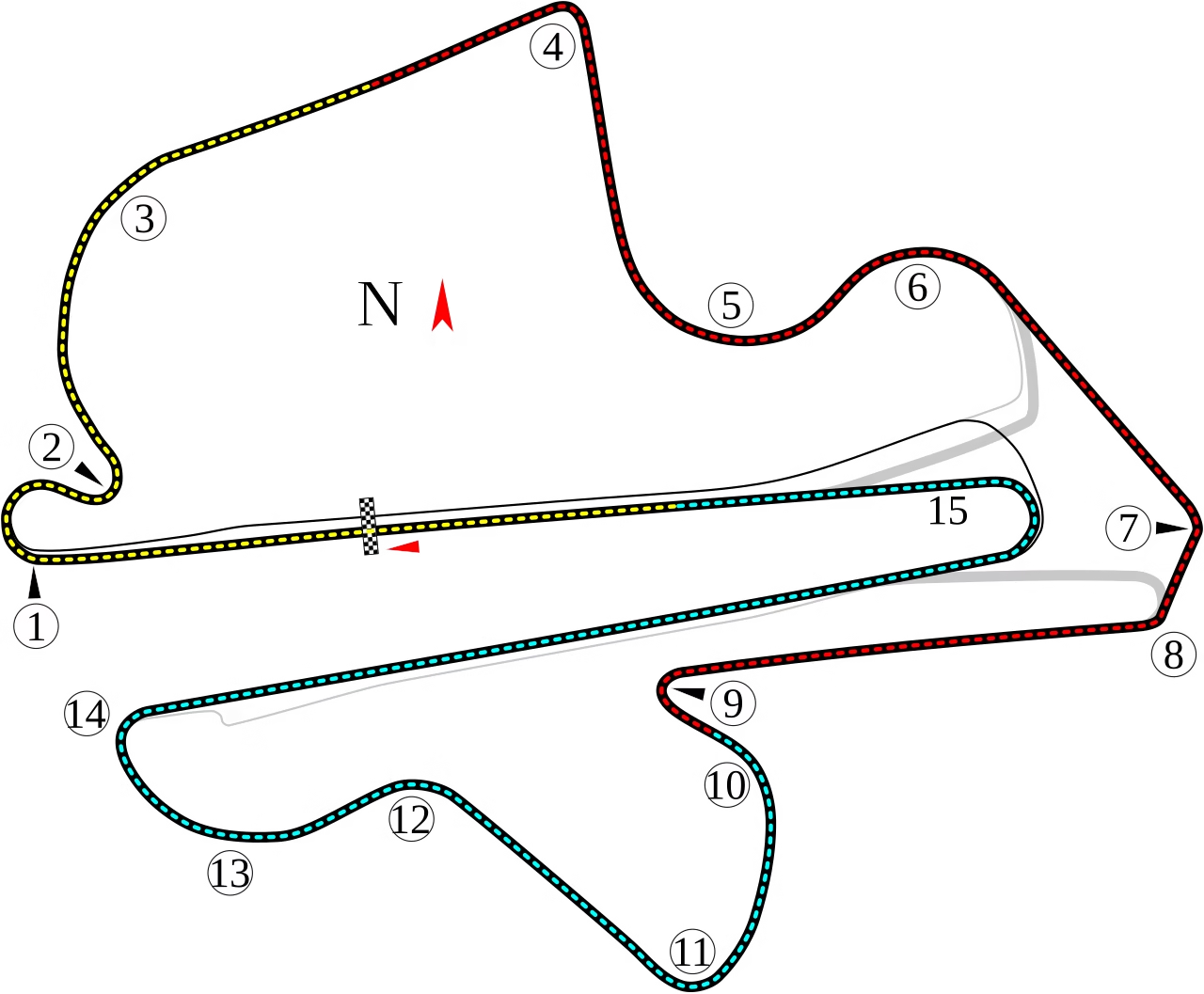
Sepang International Circuit — 5.543 km Grand Prix layout — Map: Will Pittenger / public domain via Wikimedia Commons
Tilke design and 1999 opening
Malaysia’s government backed a world-class facility to showcase the country’s industrial ambitions. Construction took about 14 months and roughly $12 million in late-1990s figures — modest by today’s F1 standards but enormous for the region. The circuit opened officially on 7 March 1999; MotoGP arrived in April and Formula One in October, with Eddie Irvine winning for Ferrari in a rain-affected race.

Main grandstand and tower at Sepang International Circuit
Tilke’s layout became a reference for later Middle Eastern and American tracks: long straights for overtaking, generous runoff, and a media centre sized for a global television feed. Sepang could split into northern (2.71 km) and southern (2.61 km) loops for smaller events — a flexibility many newer venues copied.
Layout, straights, and DRS
The Grand Prix circuit runs clockwise over 5.543 km and 15 corners — relatively few turns for the distance, which keeps average speeds high. A very long back straight, nearly one kilometre, connects to the pit straight through a tight hairpin. Formula One used two DRS zones on the pit straight and the final straight.
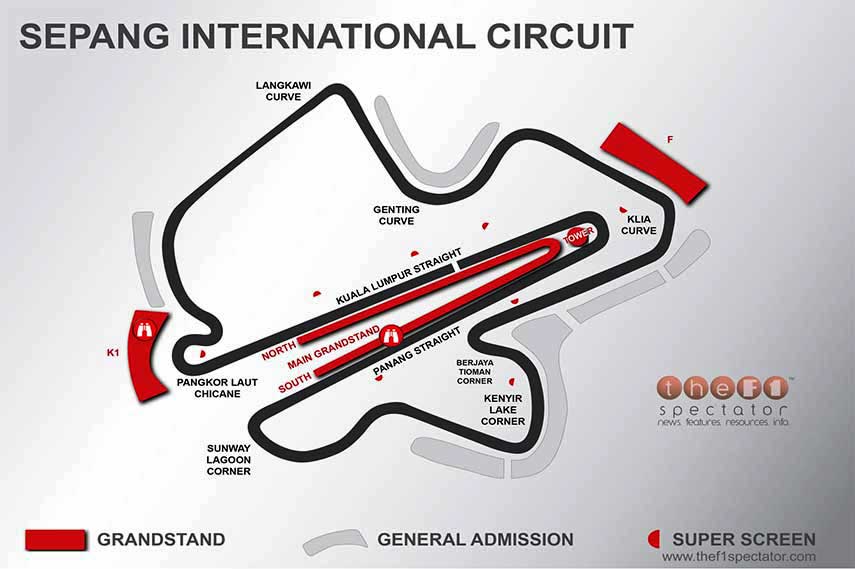
Historic map: Sepang International Circuit
Drivers describe Sepang as a flowing track rather than a stop-start street circuit. Lewis Hamilton once called it special because the car must move corner to corner without constant braking zones — a challenge that rewards rhythm and rear tyre stability.
Formula One Malaysian Grand Prix
The Malaysian Grand Prix anchored the calendar from 1999 until 2017, when F1 left amid commercial and calendar reshuffles. Highlights include Michael Schumacher’s Ferrari dominance, Fernando Alonso’s wet-weather mastery, and the 2009 race stopped after 31 laps when monsoon rain made the track undriveable — half points were awarded because the distance did not reach 75% of scheduled laps.

Formula One Malaysian Grand Prix at Sepang International Circuit
Juan Pablo Montoya set a qualifying lap of 1:34.223 in 2004 — still quoted as the benchmark pole time from the V10 era. Sepang also produced memorable team orders controversies and last-lap battles before F1’s departure; fans hoping for a return still watch MotoGP and sportscar events for top-level action on the same asphalt.

Lewis Hamilton at Sepang International Circuit in 2015
Heat, rain, and tyre drama
Humidity around 80% and track temperatures that can exceed 60 °C punish tyres and drivers. Storms arrive quickly; drainage has improved but standing water still appears when drivers believe a dry line exists. That unpredictability defined many Malaysian Grands Prix and still shapes MotoGP weekends.
MotoGP, endurance, and national racing
MotoGP remains a headline event. The Sepang 12 Hours endurance race — organised by Stephane Ratel Organisation — brings GT and touring machinery to the same layout. National car and motorcycle championships use the circuit year-round, and corporate track days are common thanks to airport proximity.

Racing at Sepang International Circuit
Visiting Sepang International Circuit
Kuala Lumpur International Airport lies about 12 km away — a short taxi or train ride. The circuit connects to KLIA and downtown Kuala Lumpur by road and rail; more than 100 hotels serve race weekends near the airport corridor.
Check the official Sepang calendar before booking travel; tropical rain can interrupt sessions even when the forecast looks clear. Combine a visit with time in Kuala Lumpur for food and culture between on-track days.
Fast facts about Sepang International Circuit
- Hermann Tilke designed the track; it opened in March 1999.
- The Grand Prix layout measures 5.543 km with 15 turns.
- F1 raced here from 1999 until 2017.
- Two DRS zones featured on the pit straight and final straight.
- Eddie Irvine won the inaugural F1 Malaysian Grand Prix in 1999.
- Sebastian Vettel holds the official F1 race lap record (2017).
- The 2009 GP awarded half points after a rain stoppage at 31 laps.
- MotoGP continues to headline international events at Sepang.
- Capacity is about 130,000 spectators.
- KLIA is roughly 12 km from the paddock.
Frequently asked questions about Sepang International Circuit
Where is Sepang International Circuit?
Sepang International Circuit is in Sepang, Selangor, Malaysia, about 50 km south of Kuala Lumpur and roughly 12 km from Kuala Lumpur International Airport (KLIA).
How long is the Sepang F1 circuit?
The Grand Prix layout is 5.543 km long with 15 turns. Cars run clockwise on the permanent road course.
Who designed Sepang International Circuit?
German architect Hermann Tilke designed Sepang. The circuit opened in 1999 and influenced many later Tilke tracks in the Middle East and Americas.
When did Formula One race at Sepang?
The Malaysian Grand Prix joined the F1 calendar in 1999 and remained until 2017. Eddie Irvine won the inaugural race for Ferrari in wet conditions.
What is the F1 lap record at Sepang?
The official F1 race lap record is 1:31.790, set by Sebastian Vettel during the 2017 Malaysian Grand Prix. Compare times only within the same car regulations.
Does Sepang still host MotoGP?
Yes. MotoGP continues to visit Sepang for the Malaysian motorcycle Grand Prix even after Formula One left. The circuit also hosts national championships and endurance events such as the Sepang 12 Hours.
Why is Sepang known for difficult weather?
Sepang sits in a tropical climate with high humidity and sudden storms. Track temperatures can exceed 60 °C, and heavy rain can create standing water — famously cutting the 2009 F1 race short at 31 laps with half points awarded.
How many DRS zones did Sepang have in Formula One?
Formula One used two DRS zones at Sepang: one on the main pit straight and one on the final straight before the last corner complex.
What is the capacity of Sepang International Circuit?
Total capacity is about 130,000 spectators, including roughly 30,000 seats in the double-fronted main grandstand overlooking the start-finish line.
How do you get to Sepang International Circuit?
Fly into KLIA for the shortest transfer (about 10–15 minutes by road). Trains and taxis also connect the circuit to central Kuala Lumpur. Confirm event shuttle details on sepangcircuit.com before race weekend.
Sepang outlasted Formula One on the calendar
F1’s exit did not mothball the facility. Sepang remains the reference point for how Malaysia wanted to be seen in global motorsport — the opposite of a forgotten autodrome. For comparison with other modern Tilke venues, see Istanbul Park and Lusail International Circuit; for classic road-course contrast, read Spa-Francorchamps or Circuito del Jarama.
Related reading
- Istanbul Park — Turkish Grand Prix circuit guide
- Lusail International Circuit — Qatar F1 and MotoGP
- Spa-Francorchamps — Belgian Grand Prix circuit guide
- Circuito del Jarama — Spanish Grand Prix history
- Monaco Grand Prix — street circuit guide
- Suzuka Circuit
Address: Jalan Pekeliling, 64000 KLIA, Selangor Darul Ehsan, Malaysia
Phone: +60 3 8778 2222
Official website: sepangcircuit.com