


Shanghai International Circuit - Chinese Grand Prix Guide (Layout, FAQ)

Originally published February 2016. Last updated September 2026: added labelled Grand Prix circuit map (Wikimedia Commons, with attribution in caption)
Shanghai International Circuit is Hermann Tilke’s flagship Chinese venue in Jiading, Shanghai — home of the Formula One Chinese Grand Prix since 2004. The 5.451 km permanent track replaced Zhuhai International Circuit as China’s F1 candidate and remains one of the longest back straights on the calendar, with grandstands shaped like the character shang (上) when viewed from the air.
Shanghai matters because it proved a developing market could host a world championship at scale: roughly $450 million of construction, team pavilions modelled on the Yuyuan Garden, and crowds above 250,000 for early Chinese Grands Prix. Formula One left the calendar during the COVID-19 pandemic (2020–2023) but returned in 2024.
For Asian neighbours see Sepang International Circuit, Macau Guia Circuit, or Lusail International Circuit; for another Tilke template track read Istanbul Park.
Contents
- Shanghai International Circuit facts
- Tilke design and Zhuhai’s failed F1 bid
- Layout, straights, and corner names
- Grandstands and paddock architecture
- 2004 inaugural Chinese Grand Prix
- Schumacher, Hamilton, and hybrid eras
- Calendar gaps and F1’s return
- WEC, WTCC, and support series
- Visiting Shanghai International Circuit
- Frequently asked questions
Shanghai International Circuit facts
| Location | Jiading District, Shanghai, China (2000 Yining Road) |
|---|---|
| Circuit type | Permanent road course (clockwise) |
| Opened | 2004 (construction May 2003 — September 2004) |
| Designer | Hermann Tilke |
| Length | 5.451 km (Grand Prix layout) |
| Turns | 16 |
| Main events | Formula One Chinese Grand Prix; FIA World Endurance Championship; FIA WTCR / WTCC; MotoGP (2005–2008); TCR International Series |
| Capacity | About 200,000 (main grandstand roughly 30,000) |
| Notable sections | 1.17 km back straight (Turns 13–14); snail corner complex; wing-shaped main grandstand |
Lap record note: the official Formula One race lap record remains 1:32.238, set by Michael Schumacher in the 2004 Chinese Grand Prix. Hybrid-era cars post slower race laps because of heavier weight and different tyres — compare within the same regulations year. Oscar Piastri’s 1:30.641 pole lap in 2025 is the current qualifying benchmark on the resurfaced track.
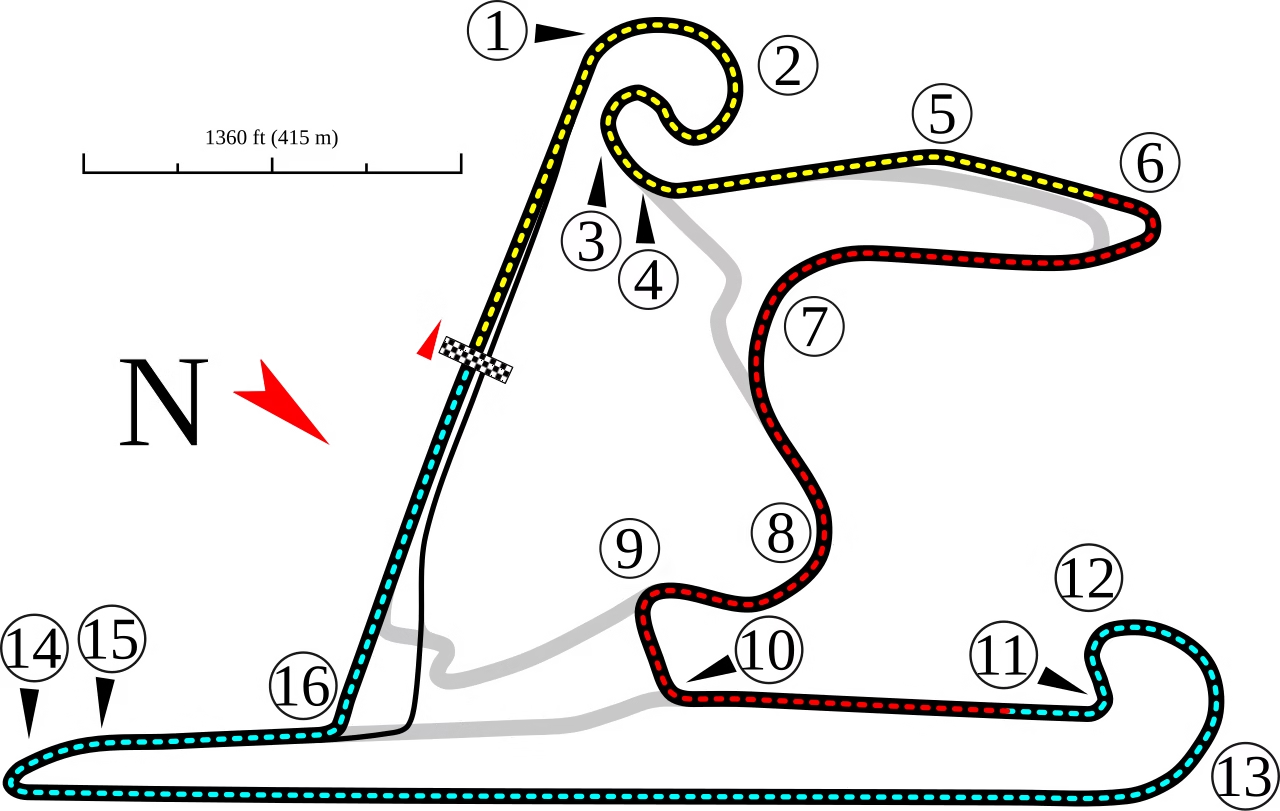
Shanghai International Circuit — 5.451 km Grand Prix layout — Map: Will Pittenger / CC BY-SA 3.0 via Wikimedia Commons

Map: Aerial view of the Shanghai International Circuit
Hermann Tilke designed the Shanghai International Circuit
The idea of the Chinese Grand Prix was born in the early 1990s, so the Chinese government decided to build a permanent circuit in Zhuhai in the Guangdong Province. Zhuhai International Circuit was opened in 1996 and it was added to the 1999 Formula One calendar. The track failed to meet FIA standards and Formula One never came to Zhuhai.
The Chinese government didn’t give up and they ordered the construction of a completely new circuit in Shanghai. Famous architect Hermann Tilke designed the facility and an ultra-modern circuit was built with a 5.451-km long track. Constructors started their work in May 2003 and everything was finished in 18 months. When completed in 2004, it was the most expensive Formula One circuit facility, costing about $450 million. A few years later, Abu Dhabi’s Yas Marina Circuit became the most expensive one.

Shanghai International Circuit – main grandstand and the start/finish straight
China holds one of the longest straights in Formula 1
Tilke-designed 15-turn track layout was inspired by the Chinese character shang (上), the first character in the name of the city Shanghai. The whole circuit, plus seating areas and other areas for spectators, covers a total area of 5.3 km². Track features a very long back straight (1170m) between turns 13 and 14, followed by a hairpin turn. Formula One cars can reach almost 330 km/h on that straight, which is one of the longest ever in Formula One.
Outstanding design of the circuit grandstands
The circuit is also recognizable by modern buildings and grandstands at the start-finish straight. The vast complex is dominated by the main grandstand and pit complex, which featured wing-like viewing platforms crossing the circuit at either end. The main grandstand can hold 30,000 spectators, and the total capacity of the circuit is 200,000.??Paddock facilities were also unique — each of the F1 teams had its own building, arranged like pavilions in a lake to resemble the ancient Yuyuan-Garden in Shanghai.

Attractive grandstands at the 1170m long back straight
The first Chinese Grand Prix in history won by Rubens Barrichello
Before construction started, it was announced that the management of Shanghai International Circuit had signed a 7-year contract with the Formula One management to host Formula One races, starting from the 2004 season. The historic first Chinese Grand Prix was held on 26 September 2004. The race attracted 260,000 spectators.
It was the sixteenth race (of eighteen) of the 2004 Formula One season. The 56-lap race was won by Ferrari’s Rubens Barrichello, from a pole position start. Jenson Button finished second for the BAR team, with Kimi R??ikk??nen third in a McLaren.
Record lap-time set by Michael Schumacher
The reigning champion and championship leader Michael Schumacher started from the pitlane after he spun in the qualifying, and finished the race at 12th place.??Although his race result was modest, Schumacher set the fastest lap of 1:32.238 — still the official Formula One race lap record on this layout.

Rubens Barrichello won the first ever Chinese Grand Prix in 2004
Schumacher’s last career victory
Even more spectators (270,000) attended the race next year. The 2005 Chinese Grand Prix was the last race of the season. Renault’s driver Fernando Alonso had already secured his first F1 world title, but the race was decisive for the Constructors’ championship. Alonso started from pole and won the race, McLaren’s Kimi Raikkonen was second and Toyota’s Ralf Schumacher was third. Another Renault driver Giancarlo Fisichella was fourth and the French manufacturer took the title.
In 2006, the Chinese Grand Prix was won by Michael Schumacher. It was his last victory in his Formula One career. In 2007, Kimi Raikkonen scored the Ferrari’s third victory in China and 200th Grand Prix since Formula One started in 1950. The winner of the 2008 Chinese Grand Prix was Lewis Hamilton, who later became the world champion for the first time.
Sebastian Vettel was the winner in 2009. That year, the Chinese Grand Prix was the third race of the season, which was a change compared to previous events which were held at the end of the season. In 2010 Chinese Grand Prix, the seventh different winner in seven years was McLaren’s Jenson Button.

Victory at the 2006 Chinese Grand Prix was the last career win for Michael Schumacher
Second 7-year deal for the Formula 1 Chinese GP was arranged
Immediately after the 2010 race, Bernie Ecclestone announced that Shanghai will be in the Formula One calendar in the future. The deal was officially finished in February 2011 between F1 and the organizers. Reasons for the delay appears to have been over the fee which the organizer had to pay. Only after F1 reduced the fee was the new agreement made for Shanghai to host Formula One races until 2017.
In 2011, Lewis Hamilton scored his second win in China and third for McLaren. He triumphed two more times in 2014 and 2015, driving for Mercedes. Another Mercedes driver Nico Rosberg won in 2012, whilst Ferrari’s Fernando Alonso achieved his second China victory and fourth for Ferrari in 2013. Rosberg repeated a victory in 2016.

2008 Chinese Grand Prix – the first victory in China for Lewis Hamilton
WEC and WTCC at Shanghai since 2012
Other major international racing series with multiple appearances at Shanghai International Circuit are the FIA World Endurance Championship and the FIA World Touring Car Championship.
WEC drivers had inaugural 6 hours of Shanghai race in 2012, when Toyota’s Alexander Wurz and Nicolas Lapierre took the win. In the following years winners were:??Andre Lotterer, Benoit Treluyer and Marcel Fassler for Audi (2013), Anthony Davidson and Sebastien Buemi for Toyota (2014), Mark Webber, Timo Bernhard and Brendon Hartley for Porsche (2015). Webber, Bernhard and Hartley scored one more win in 2016.
Record lap time of LMP1 prototypes was about 14 seconds slower compared to Formula One cars. Record holder is Andre Lotterer with Audi R18 e-tron quattro, who drove a lap in 1m46.685s.
The World Touring Car Championship attended Shanghai every year since 2012. They had two races in every event, so eight races were held at shortened Shanghai’s track, which was 4.603-km long. Eight different drivers won in ten races, and the only one who repeated a victory was Citroen’s driver Jose Maria Lopez by winning in 2014, 2015 and 2016. He also holds the record lap time of 1m48.782s.

TCR International Series came to Shanghai International Circuit in 2015
Popular among many racing competitions
In 2015, TCR International Series came to Shanghai as a supporting series at Formula One Grand Prix event. The winners of two races were Gianni Morbidelli (Honda Civic) and Andrea Belicchi (Seat Leon Cup Racer).
Australian V8 Supercars Championship had one three-race event at Shanghai during the 2005 season. Todd Kelly was a double winner, Mark Skaife has won one race. In April 2007, Shanghai hosted the penultimate round of 2006/2007 A1 Grand Prix series. From 2005 to 2008, Moto GP championship also raced at Shanghai International Circuit, with two victories of Valentino Rossi and one win each for Dani Pedrosa and Casey Stoner.
Visiting Shanghai International Circuit
The circuit lies in Shanghai’s Jiading District, roughly 30 km northwest of the city centre. Metro line 11 serves the Jiading area; taxis and ride-hailing apps are common on Chinese Grand Prix weekends.
Confirm ticket and transport details on the official Chinese Grand Prix channels before travel — April race dates can coincide with public holidays and heavy airport traffic at Shanghai Pudong and Hongqiao.
Fast facts about Shanghai International Circuit
- Hermann Tilke designed the track; it opened for the 2004 Chinese Grand Prix.
- The Grand Prix layout is 5.451 km with 16 turns.
- Rubens Barrichello won the inaugural race in September 2004.
- Michael Schumacher’s 1:32.238 (2004) still stands as the F1 race lap record.
- Schumacher’s 2006 victory was his last in Formula One.
- Formula One skipped 2020–2023 before returning in 2024.
- The back straight measures about 1.17 km — one of F1’s longest.
- WEC’s 6 Hours of Shanghai ran from 2012 until 2019.
- MotoGP raced here from 2005 to 2008.
- Total spectator capacity is about 200,000.
Frequently asked questions about Shanghai International Circuit
Where is Shanghai International Circuit?
Shanghai International Circuit is in Jiading District, northwest Shanghai, China, at 2000 Yining Road — roughly 30 km from the city centre.
How long is the Shanghai F1 circuit?
The Grand Prix layout is 5.451 km long with 16 turns. Cars run clockwise on Hermann Tilke's permanent road course.
When did Formula One first race in Shanghai?
The inaugural Chinese Grand Prix was held on 26 September 2004. Rubens Barrichello won for Ferrari from pole position.
What is the F1 lap record at Shanghai International Circuit?
The official Formula One race lap record is 1:32.238, set by Michael Schumacher in 2004. Hybrid-era race laps are slower because of car weight and tyre rules.
Did Formula One leave Shanghai during COVID-19?
Yes. The Chinese Grand Prix was absent from 2020 through 2023 because of pandemic travel restrictions. Formula One returned to Shanghai in 2024.
Who designed Shanghai International Circuit?
German architect Hermann Tilke designed the track. Construction ran from May 2003 to September 2004 at a reported cost of about $450 million.
Why is Shanghai's back straight famous?
The straight between Turns 13 and 14 measures about 1.17 km — one of the longest on the Formula One calendar. Cars exceeded 330 km/h there in the V10 and V8 eras.
What other series race at Shanghai besides F1?
Shanghai has hosted FIA World Endurance Championship six-hour races, WTCC/WTCR, MotoGP (2005–2008), A1 Grand Prix, and TCR International Series support races.
How does Shanghai relate to Zhuhai International Circuit?
China first pursued Formula One at Zhuhai International Circuit, which opened in 1996. After Zhuhai failed FIA inspection, the government built Shanghai as the dedicated Chinese Grand Prix venue.
How do you get to Shanghai International Circuit?
Metro line 11 serves Jiading; taxis and ride-hailing are common on race weekend. Allow extra time for Shanghai Pudong or Hongqiao airports during the April Chinese Grand Prix.
Related reading
- Zhuhai International Circuit — China’s first permanent track
- Macau Guia Circuit — China’s street-racing tradition
- Sepang International Circuit — Malaysian Grand Prix
- Lusail International Circuit — Qatar Grand Prix
- Istanbul Park — Tilke circuit in Turkey
- Suzuka Circuit — Japan’s figure-of-eight classic
Related Posts