

What to Do in the First 72 Hours After a Multi-Vehicle Collision
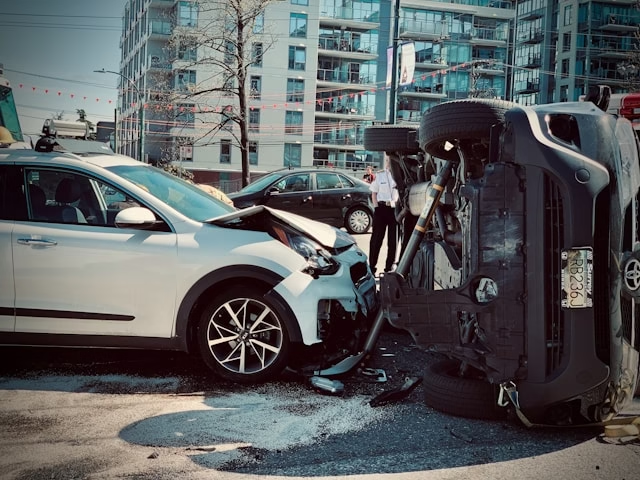
A multi-vehicle collision occurs when three or more vehicles are involved in an accident. What really happened during the collision may not be clear. Each driver had his own perspective on the accident, and each account of “what really happened” may be completely different from the others.
The initial 72 hours are critical in terms of retaining facts that could be used later in the course of your claim. Evidence disappears, video footage gets overwritten, and your very first statements will stick with you throughout the whole year.
Why accounts of the collision could differ
To illustrate how things might go wrong, let us consider an example of a chain-reaction collision. One vehicle collides with another. This collision triggers two or three rear-end collisions of other vehicles.
The driver who was hit from the rear end is the last driver of that chain of collisions. The driver who triggered the chain-reaction collision is the first one. The drivers in between may not have known what really happened because their cars were hit from behind without any warning.
It is not a case of lying or dishonesty. It is just about physics and perception because a collision lasts for less than two seconds, and a person may perceive things differently depending on the level of noise and adrenaline during that time.
If there is a dispute concerning the accident, the insurance adjusters, and possibly attorneys, will examine your account of events along with accounts of all other drivers. The inconsistencies will be marked. Inconsistencies in the accounts can be used to establish your percentage of fault in the accident, even though it may not reflect the true percentage of fault.
The principle of shared fault states that you cannot recover damages if you were more than 50 percent responsible for the accident. Your recovery amount will be reduced by your percentage of fault if you were found less than 50 percent responsible for the accident. Therefore, your initial statements could lead to your inability to recover any damages.
Evidence that may vanish in the first few days
Roads are not controlled or isolated environments. The scene of a multi-vehicle collision can be cleaned up and altered in less than 72 hours.
All evidence that may be found on the road, such as skid marks, debris, etc., disappears fast because of the rain and vehicles that run over that area. After 72 hours, a crash investigator may have little chance of preserving that evidence.
Skid marks could tell about pre-impact braking and yaw marks could reveal whether a tire had slid. Skid marks could disappear in 72 hours because of the rain and traffic. Yaw marks could be lost because of weather conditions and traffic as well.
In addition, the signs and any other safety equipment that had been broken during the collision may be fixed, and there may be no photographs of it. The debris field can be cleared within 72 hours or disturbed by other vehicles and street-sweeping equipment.
There is the same 72 hour period concerning the digital evidence. In most cases, the surveillance cameras at any business automatically overwrite the footage in 48-72 hours. All doorbell cameras, traffic enforcement cameras, and traffic monitoring cameras also save video footage for three days. Even the residential surveillance cameras save the footage for 3 days.
The footage that might prove your innocence must be saved immediately. You should ask for that footage in writing to create a record that you tried to preserve the evidence. The footage that was not saved in 72 hours is simply gone.
Creating a clear timeline without guessing about fault
Making guesses could be damaging for you. If you say something like “I think I was driving at 40 mph,” “probably, I braked 2 seconds before the impact,” then you may be guessing about what really happened. But these statements will be considered official statements.
To preserve your position after a multi-vehicle collision, consider consulting a Philadelphia car accident lawyer and taking the following steps during the initial 72 hours:
- Take pictures of all vehicles that were involved in a collision from a safe distance. Take pictures from various angles, including the position of vehicles, road signs, signals, skid marks, debris, and any causes of an accident.
- Get the contact information of all witnesses before they leave the scene.
- Write down your account immediately. Your account should be your priority. Write down what you saw, heard, and felt. Write down what you know for sure, not what you guess.
- Record the police report number so that you could get the full report later.
Even though the police report is an important document, it is not infallible. The police officer arrives after the collision occurs, and he reconstructs what really happened using accounts of drivers. Factual errors may be present in accident reports, and they can be challenged later. But it is possible only if you have some independent proof.
Why vehicle damage, road layout, and video matter
The accident reconstructionists analyze crush profiles, paint transfer patterns, and vehicle weight data to understand the sequence of impacts in a chain-reaction collision. The angle of damage on the front bumper and the height of damage on the rear end of another vehicle help to understand the direction and speed of the impact.
For this reason, it is useful to take pictures of damage geometry, including the color of paint transfer, the height of damage compared to the vehicle frame, and the damaged parts.
As for the road layout, it helps to confirm or deny the driver’s account of the collision. Take the pictures of the road surface, all skid marks, signs, and the traffic signal configuration.
The black box data, officially known as the Event Data Recorder (EDR) data, is also a valuable piece of information. The EDR data records the speed, braking, and steering in the last seconds before a crash. This data can be extracted from a vehicle, but a vehicle has to be in the same condition as it was right after a crash. Otherwise, the destruction or repair of the vehicle can lead to spoliation of the EDR data.
GPS systems (including GPS data from the vehicle) and smartphones that have location-tracking applications can record the route of the driver before and during a collision. Toll data can show the location of a vehicle before and during a crash. Information about the activation of the crash-avoidance system can be valuable in a litigation process.
Keeping insurance communications organized
After a multi-vehicle collision, you may start receiving phone calls from several insurance adjusters for different drivers. Every insurer tries to protect its policyholder. You do not have to give a recorded statement to another motorist’s insurer, and giving a recorded statement may be dangerous.
Create a log on the day of the accident and include all incoming calls. You should write the date, adjuster’s name, carrier, claim number, and the brief summary of the conversation.
In addition, keep all the correspondence from the insurer and do not agree to anything verbally unless it is also in writing.
Your own insurer is another case. According to your contract, you have to provide them with necessary information. If you have the Personal Injury Protection (PIP) insurance, your insurer will pay for your crash-related medical expenses regardless of the fault. That process is independent from the liability issue, and you will receive medical benefits even if the fault issue is not resolved yet.
Organization is difficult when you have multiple claim numbers. However, it is the stage in the process when people often make contradictory statements.
When it makes sense to seek legal advice
Multiple vehicle crashes involve many complex issues, such as the presence of two or more parties with differing views, fault rules that reduce compensation in accordance with the comparative negligence determinations, evidence like digital imagery that is available for only a short period, and the fact that insurance processes begin immediately and usually do not stop until the liability issue is solved.
There are cases when all of these issues can be resolved without an attorney. However, there are other cases, including cases involving serious injuries, disputed liability issues, evidence that is difficult to acquire, and aggressive insurer demands for a recorded statement, in which early legal assistance may be useful.
You do not have to hire an attorney immediately at the scene of the accident. But waiting for too long – until the second or third day, for example – may mean that many evidence-preservation steps are no longer possible, the physical evidence is gone, and the memories of witnesses start fading away.
Good records help to clarify the situation
Multi-vehicle accidents are chaotic. There are more witnesses, more drivers, more attorneys, and more insurers. The complexity of the situation grows with the factors typical for multi-vehicle collisions, such as chain reaction, contributory negligence, speeding, and road hazards.
Chain reaction collisions are collisions involving several vehicles and occurring in a row. Such accidents usually happen in high-traffic situations, such as highways and interstates. They can result in complicated disputes between several insured drivers and their insurance companies about who caused each collision.
Contributory negligence happens when you are partially responsible for the collision. Pennsylvania law states that you cannot recover any damages if you are more than 50% responsible for the incident. If you are found to be less than 50% responsible for the accident, your damages will be reduced in proportion to your percentage of fault.
Speeding may cause serious collisions. Pennsylvania sees tens of thousands DUI arrests per year and a lot of crashes caused by impaired drivers. In cases where speed or impairment is an issue, it is important to gather as much evidence as possible.
Lastly, it is the responsibility of the government authority in charge of the road to ensure that all the hazards on that road are recognized and eliminated. It is important to notice and document how a physical hazard led to the accident.
All these factors together result in one thing – many opportunities for your view on the collision to be questioned by another lawyer. They may challenge your memories because of the stress you experienced in the days after a crash. They may rely on a police report that had been written before evidence analysis. Also, they may question why you have said something in the immediate aftermath of a collision.
All your activities in the first 72 hours have an impact on the ability to prove your version of events in the future. Pennsylvania had more than 115,000 traffic accidents in one recent year, and multi-vehicle collisions are quite a big part of them. Many become disputed and turn into a battle over the best evidence-based version of events. Your account should be supported by the best available evidence.