

Z Library’s Ultimate Guide to Motorsport Engineering
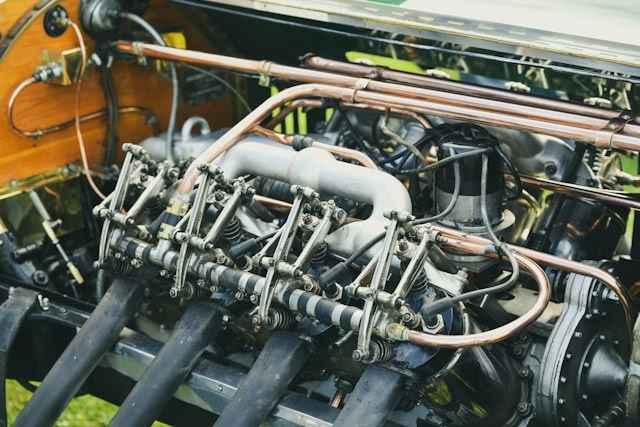
Motorsport engineering is where precision meets adrenaline. It is a discipline that demands understanding every bolt and gear while keeping pace with ever-evolving technology. From Formula One to rally racing every aspect of a vehicle must be optimized for performance safety and efficiency. Engineers balance physics with creativity making split-second decisions that can define races. Learning the science behind engines aerodynamics and materials opens doors to innovation and pushes boundaries beyond ordinary driving experiences.
The wealth of information available today has grown exponentially. Access to diverse reading materials feels easier and more flexible with Z-library, making it possible to explore technical manuals research papers and detailed guides all in one place. This e-library allows enthusiasts and aspiring engineers to gather knowledge at their own rhythm without limits of physical shelves or subscription walls. The convenience supports both focused study and casual exploration encouraging deeper understanding of motorsport mechanics.
Core Principles of Motorsport Engineering
At the heart of motorsport engineering lies the mastery of powertrains. Engines are no longer just a source of speed; they are intricate networks of sensors and control units working in harmony. Engineers analyze torque curves combustion cycles and fuel efficiency to achieve the perfect balance. Coupled with aerodynamics every car must slice through air while maintaining grip on the tarmac. Suspension systems are tuned to adapt to corners bumps and track surfaces ensuring stability and responsiveness.
Materials science also plays a pivotal role. Lightweight alloys and composites reduce mass without compromising safety. Every component undergoes rigorous testing for stress fatigue and heat resistance. Data acquisition systems track performance in real-time allowing adjustments that can shave milliseconds off lap times. Such precision engineering demonstrates that even the smallest tweaks can ripple through the entire system changing handling and acceleration.
Techniques and Innovations in Vehicle Design
Innovations in vehicle design often start at the intersection of theory and experimentation. Computational fluid dynamics and wind tunnel testing allow engineers to predict airflow patterns before a single car touches the track. Active suspension systems dynamically adjust to conditions while electronic stability programs manage power distribution between wheels. These technologies work together to optimize cornering speed braking and overall vehicle balance.
Important design considerations include:
- Engine Management Systems
Modern engines rely on complex electronic control units to regulate combustion timing fuel injection and ignition. These systems collect data continuously from sensors monitoring temperature pressure and engine load. Engineers interpret this information to fine-tune performance under different conditions ensuring reliability across demanding circuits. Advanced diagnostics also help predict maintenance needs before failures occur improving both efficiency and safety.
- Aerodynamic Optimization
Aerodynamic design focuses on reducing drag while increasing downforce. Engineers analyze wing profiles diffusers and body contours to manipulate airflow. Even subtle changes can alter tire contact and cornering stability. Computational modeling allows rapid iteration of designs producing cars that maintain speed through straights while hugging corners with precision. This combination of theory and practical testing exemplifies the art and science of high-speed design.
- Lightweight Materials Integration
Use of carbon fiber titanium and other advanced composites reduces mass significantly. Engineers must balance strength and flexibility ensuring components endure stress without failing. Material selection affects suspension dynamics braking efficiency and fuel consumption. Innovations in this area have led to faster lighter and safer race cars capable of handling extreme conditions consistently throughout events.
These innovations form the backbone of competitive performance. Continuous refinement of these systems results in vehicles that perform predictably under pressure and give engineers insight into the next frontier of motorsport technology.
Expanding Knowledge Through Reading
Technical mastery grows alongside exposure to research and case studies. Books like “Race Car Vehicle Dynamics” and “Competition Car Aerodynamics” provide both theory and practical examples. Z-library offers a way to explore such titles without limits bringing classical texts and contemporary studies into one accessible space. Engineers can trace the evolution of design principles from early prototypes to modern hypercars and understand the reasoning behind every technical decision.
The journey through motorsport engineering is never static. As track layouts change and regulations evolve every season brings new challenges. Learning through reading allows patterns to emerge connecting theory to real-world outcomes. This continuous curiosity transforms raw information into skill and intuition guiding engineers toward innovation with confidence and clarity.
