

Hockenheimring – German Grand Prix and DTM Circuit Guide

Originally published May 2016. Last updated September 2026: expanded Tier B circuit guide, facts table, table of contents, internal links, FAQ schema, and editorial refresh while preserving legacy narrative and images.
Hockenheimring in Baden-Württemberg is one of Germany’s two great Grand Prix venues — a Rhine-valley circuit that hosted Formula One when the Nürburgring Nordschleife was deemed too dangerous and later traded the forest straights for Hermann Tilke’s stadium-focused modern layout. Motorcycle racing began in the 1930s; Mercedes and Auto Union tested in the woods; and from 1970 the track became a regular home of the German Grand Prix.
The circuit matters because it links Jim Clark’s death, Michael Schumacher’s four home wins, and the biennial hosting deal with the Nürburgring. Today DTM, GT World Challenge, and historic festivals share a 4.574-km lap where spectators once saw only a blur through the trees.
Compare German motorsport heritage with Norisring, Lausitzring, and Monza.
Contents
- Hockenheimring facts
- 1932 origins and Kurpfalzring
- Jim Clark and the 1968 changes
- 1970 and the first F1 German Grand Prix
- Formula One at Hockenheim 1977–2019
- Tilke rebuild and the modern lap
- Michael Schumacher’s four wins
- Sharing the German GP with Nürburgring
- DTM and World Rallycross
- Visiting Hockenheimring
- Frequently asked questions
Hockenheimring facts
| Location | Hockenheim, Baden-Württemberg, Germany (Rhine valley) |
|---|---|
| Official name | Hockenheimring Baden-Württemberg (since 2002 rebuild) |
| Circuit type | Permanent road course with stadium section |
| Opened | May 1932 (original forest circuit) |
| Current length | 4.574 km (2.842 miles) since 2002 |
| Previous length | Up to 12.045 km (1932); 6.825 km forest layout until 2001 |
| Direction | Clockwise (since 1966 reconstruction) |
| Main events | Historic German Grand Prix host; DTM; GT World Challenge; ADAC events; FIA World Rallycross (2015–2017) |
| F1 German GP wins record | 4 — Michael Schumacher |
| Last Formula One race | 2019 German Grand Prix (Lewis Hamilton won) |
Lap record note: F1, DTM, GT, and rallycross use different cars and track configurations. Compare times only within the same series and layout.

Hockenheim racing circuit in 1936
The original Hockenheimring was built in 1932
Hockenheimring was built in 1932 as a 12.045-km circuit through forests near the town, with one section entering Hockenheim itself. It opened in May 1932 and was used mainly for motorcycle racing. From 1936, Mercedes-Benz and Auto Union used the track for testing.
In 1938 the course was shortened to 7.692 km and renamed Kurpfalzring, with two long straights, fast Ostkurve, and slower Stadtkurve. That oval-shaped layout survived until the modern circuit opened in 2002.
After the Second World War, Wilhelm Herz and regional enthusiasts revived the venue. The first German Motorcycle Grand Prix at Hockenheim was held in 1957.
First major reconstruction in 1966
Planned Autobahn A6 construction forced changes in the early 1960s. Rebuilding ran from spring 1964 until 1966, when the German Motorcycle Grand Prix returned to a new 6.769-km layout with a stadium-shaped Motodrome section.
Jim Clark lost his life at Hockenheimring
Racing direction switched to clockwise for the first time after the 1966 rebuild. Further changes followed the death of Jim Clark in a Formula 2 race in April 1968: two chicanes and new barriers were added.

1970 Formula One German Grand Prix at Hockenheimring
Jochen Rindt won the first German Grand Prix at Hockenheimring
Formula One arrived on 2 August 1970 after safety concerns about the old Nürburgring Nordschleife. Jochen Rindt won in a Cosworth-powered Lotus 72C ahead of Jacky Ickx and Denny Hulme.
The German Grand Prix returned to the modernised Nordschleife in 1971. After the last F1 race on the Nordschleife in 1976, Hockenheim became the regular German GP host from 1977 to 2006, except 1985 when the race used the Nürburgring GP circuit.

Niki Lauda’s winning Ferrari at the 1977 German Grand Prix
Formula One at Hockenheim 1977–2019
Niki Lauda won the first race of the long Hockenheim F1 era in 1977. The 1980 weekend was overshadowed by the death of Patrick Depailler in pre-event testing with Alfa Romeo, prompting chicane work at Ostkurve in 1982 and again in 1992.
Didier Pironi’s qualifying crash into Alain Prost’s car in 1982 ended his career. Nelson Piquet, Ayrton Senna, Nigel Mansell, and Alain Prost scored multiple wins through the turbo and V10 years. Gerhard Berger, Damon Hill, Mika Häkkinen, and Eddie Irvine added 1990s victories.
Rubens Barrichello won the 2000 race on the old forest layout; Jean Alesi’s serious crash in the woods helped push the case for a shorter, more spectator-friendly design.
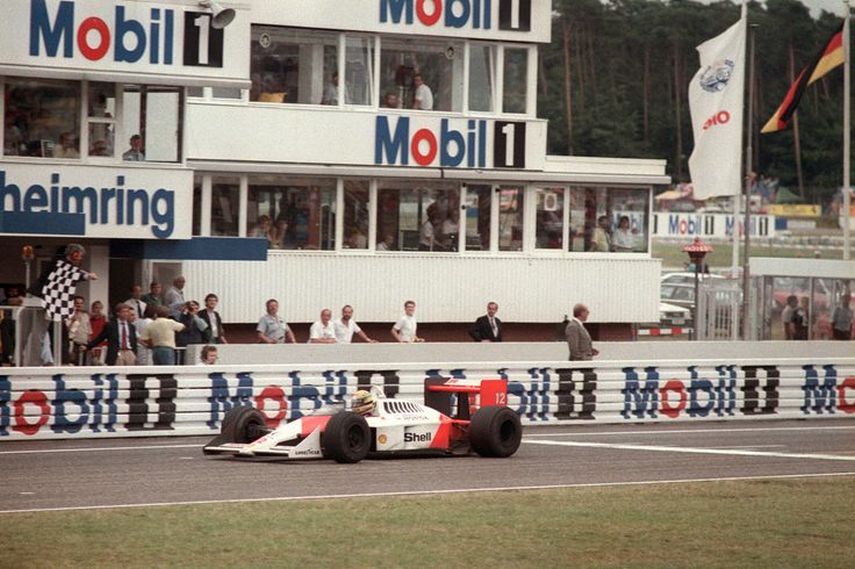
Ayrton Senna scored three consecutive Hockenheim wins in the late 1980s
Hermann Tilke designed a new track
Ralf Schumacher won the last race on the old 6.825-km layout in 2001. Hermann Tilke designed the replacement; public funding changed the official name to Hockenheimring Baden-Württemberg. The forest section was removed, the stadium Motodrome stayed largely intact, and capacity grew to about 120,000 spectators.

Hockenheimring track layout since 2002
Michael Schumacher’s victory opened a new era
The rebuilt circuit hosted its first German Grand Prix on 28 July 2002. Michael Schumacher started from pole and won — the first of four Hockenheim victories (also 2004, 2005, and 2006), a record no other driver has matched. Juan Pablo Montoya (2003) and Fernando Alonso (2005) won on the new asphalt in the V10 era.

Grandstands at Hockenheimring — the Motodrome stadium section
Sharing the German GP with Nürburgring
Financial pressure on both venues produced a biennial German Grand Prix from 2008: Hockenheim hosted in 2008, 2010, 2012, 2014, 2016, 2018, and 2019, with Lewis Hamilton taking four of those wins. There was no German Grand Prix in 2015 or 2017; the 2019 race at Hockenheim — won by Hamilton in wet conditions — was the last Formula One round at the circuit as of 2026.
DTM and World Rallycross
Beyond Formula One, Hockenheim anchors the DTM calendar with season openers and finales. GT, Formula regional, and historic festivals fill the rest of the year.

FIA World Rallycross at Hockenheimring from 2015
The FIA World Rallycross Championship visited from 2015 to 2017 on a temporary course inside the stadium. Petter Solberg won the inaugural event; Mattias Ekström took both 2016 and 2017.
Visiting Hockenheimring
Major DTM and GT weekends sell grandstand tickets across the Motodrome; the museum and guided tours operate on selected dates. Hockenheim sits between Mannheim and Heidelberg with motorway links from Frankfurt and Stuttgart.
Frequently asked questions about Hockenheimring
Where is Hockenheimring?
Hockenheimring is in Hockenheim, Baden-Württemberg, in Germany’s Rhine valley between Mannheim and Heidelberg. The address is Am Motodrom, 68766 Hockenheim.
How long is Hockenheimring?
The current Grand Prix layout measures 4.574 km (2.842 miles), in use since Hermann Tilke’s 2002 rebuild. The old forest circuit was up to 6.825 km before the woods section was removed.
When did Hockenheimring open?
The original circuit opened in May 1932 as a long forest course. Major reconstructions followed in 1966 (Motodrome stadium section) and 2002 (current lap).
How many Formula One races has Hockenheimring hosted?
Hockenheim hosted 38 Formula One world championship German Grand Prix races between 1970 and 2019 (including the one-off 1970 race and the biennial sharing era with the Nürburgring). The 2019 German Grand Prix was the most recent F1 round at the track as of 2026.
Who has the most F1 wins at Hockenheimring?
Michael Schumacher won four German Grands Prix at Hockenheim (2002, 2004, 2005, and 2006). Lewis Hamilton also won four times on the modern layout.
Why did Formula One leave the old Hockenheim forest layout?
After Jean Alesi’s 2000 crash in the forest section, critics cited safety and poor spectator visibility — most action happened out of sight in the woods while fans in the stadium saw little. The 2002 Tilke design shortened the lap and kept racing in the Motodrome.
What happened to Jim Clark at Hockenheimring?
Jim Clark was killed in a Formula 2 race in April 1968. Two chicanes and upgraded barriers were added afterward.
Does Hockenheimring alternate the German Grand Prix with the Nürburgring?
From 2008 onward, financial pressure led to a biennial German Grand Prix split between Hockenheim and the Nürburgring. Several seasons had no German GP at all; F1 has not returned to Hockenheim since 2019.
What races happen at Hockenheimring today?
DTM remains a headline series, alongside GT World Challenge, ADAC national championships, and historic festivals. The FIA World Rallycross Championship ran inside the stadium from 2015 to 2017.
How do you visit Hockenheimring?
Tickets for DTM, GT, and festival weekends are sold via hockenheimring.de. The Motodrome grandstands offer the classic view of the stadium section; museum visits are available on selected dates.
Germany’s stadium in the forest’s shadow
Hockenheim survived world war, Clark’s death, forest-speed criticism, and F1 calendar politics. The modern lap trades history for sightlines, but the name still means German Grand Prix Sundays and Schumacher-era noise.
Related reading
- Nürburgring — Nordschleife and Grand Prix circuit
- Norisring — Germany’s street circuit in Nuremberg
- Lausitzring — EuroSpeedway and DTM heritage
- Monza Circuit — Italy’s Temple of Speed
Address: Hockenheimring Baden-Württemberg, Am Motodrom, 68766 Hockenheim, Germany
Phone: +49 6205 9500
Official website: hockenheimring.de