

Norisring Circuit: Historic Street Racing in Nuremberg
Originally published February 2016. Last updated July 2026: expanded circuit guide, facts table, internal links, images, and FAQ.
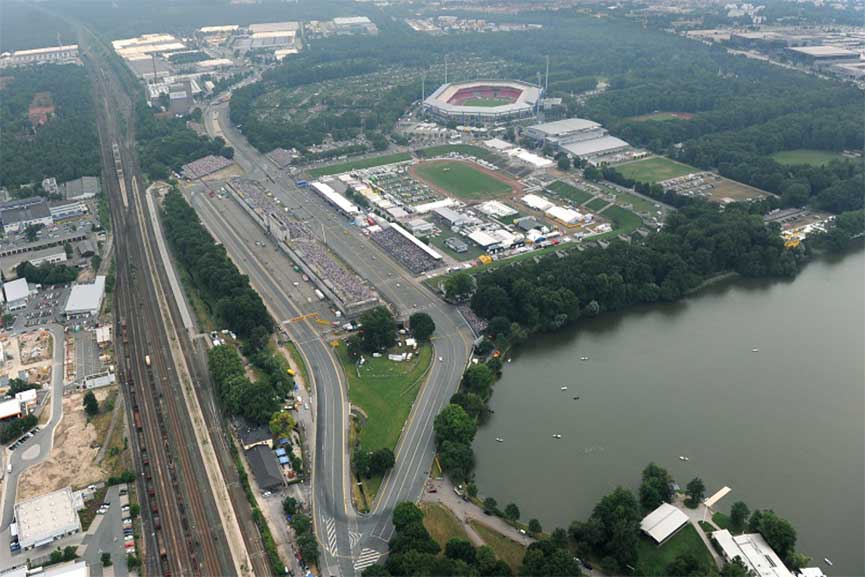
The Norisring is a temporary street racing circuit in the German city of Nuremberg. First used for post-war motorcycle racing in May 1947, it has developed into one of Germany’s best-known motorsport venues and one of the most distinctive circuits on the DTM calendar.
The track is built on public roads surrounding the imposing stone grandstand at the former Nazi Party Rally Grounds. Its setting gives the Norisring a difficult historical background, but also makes it unlike almost any other racing circuit in Europe.
Despite its short lap and apparently simple layout, the Norisring produces demanding racing. Long straights, heavy braking zones, tight hairpins and concrete barriers leave drivers with little room for error. Every summer, the streets are transformed into a compact racing venue where spectators can watch the action from unusually close range.
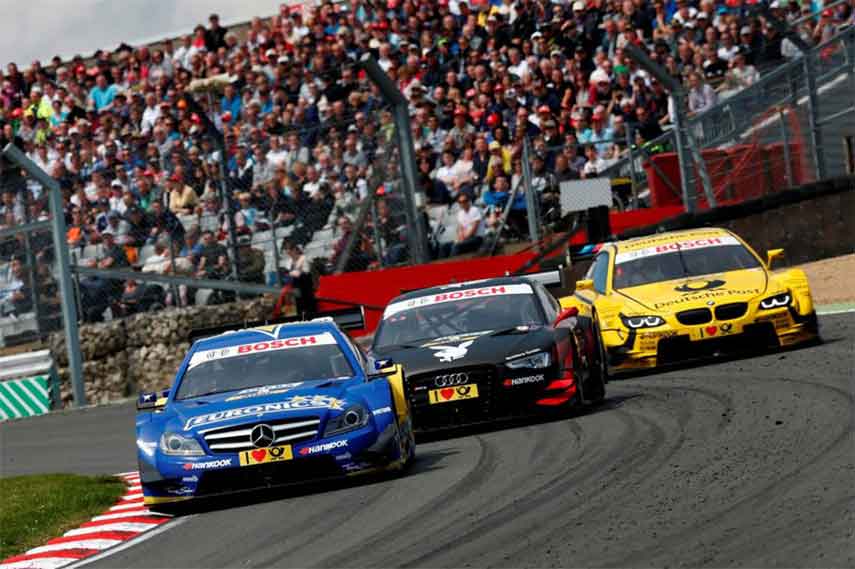
Mercedes-AMG, Audi and BMW — DTM race at the Norisring
Contents
- Norisring circuit facts
- A racing circuit with a dark history
- The first races at the Norisring
- Why it is called the Norisring
- Circuit layout and characteristics
- The Norisring and the DTM
- Other racing series at the Norisring
- Fatal accidents and circuit safety
- The historic Norisring lap record
- Visiting the Norisring
- Frequently asked questions
Norisring circuit facts
| Location | Nuremberg, Bavaria, Germany |
|---|---|
| Circuit type | Temporary street circuit |
| First post-war race | 18 May 1947 |
| Traditional circuit length | Approximately 2.3 km |
| Current configuration introduced | 1972 |
| Main event | DTM race weekend |
| Best-known sections | Grundig hairpin, Schöller S and Dutzendteich hairpin |
| Circuit setting | Public roads around the former Nazi Party Rally Grounds |
The exact competition distance and official corner count may vary slightly between events because temporary barriers, timing lines and track limits can be adjusted when the street circuit is assembled.
A racing circuit with a dark history
The Norisring occupies part of the former Nazi Party Rally Grounds in the south-east of Nuremberg. The vast complex was developed during the 1930s for mass political rallies and propaganda events organised by the National Socialist regime.
The circuit runs around the Zeppelinfeld area and its monumental stone grandstand, commonly known as the Steintribüne. The surviving structure remains one of the most recognisable features of the track.
Large parts of Nuremberg were destroyed by Allied bombing during the Second World War. After the war, the roads around the grandstand were among the areas that could be adapted relatively quickly for public events. Motorsport subsequently gave the site a new civilian purpose, although its original function remains an essential part of its history.
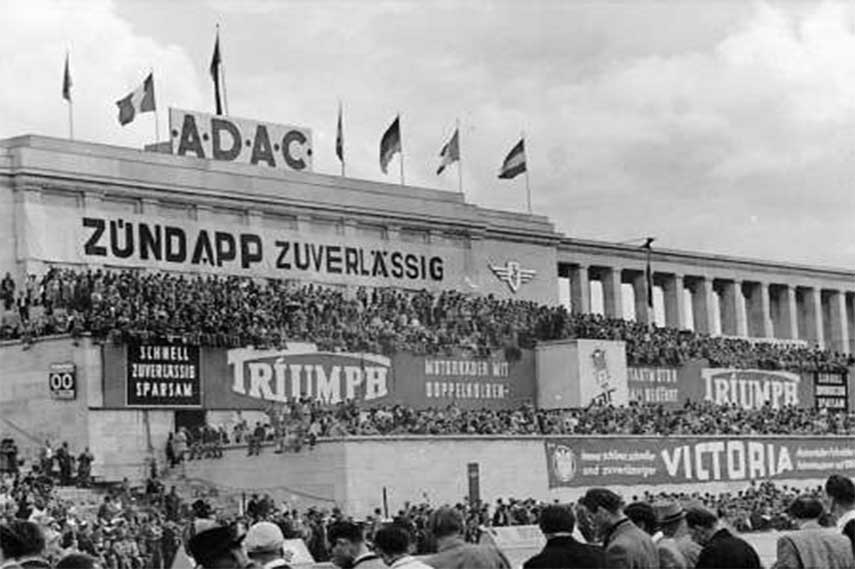
Full stands at the Norisring during an early post-war race (1947)
That background should not be reduced to a colourful detail in the circuit’s story. The Norisring is both a racing venue and part of a historically sensitive area that documents one of the darkest periods in Germany’s past.
The first races at the Norisring
The first post-war race around the site took place on 18 May 1947. It was primarily a motorcycle event, and approximately 60,000 spectators reportedly attended. Fuel was provided with assistance from the United States occupying forces, as fuel remained difficult to obtain in post-war Germany.
The first automobile race followed in 1948. Motorcycles nevertheless remained the main attraction during the circuit’s early years, helped by Nuremberg’s importance as a centre of German motorcycle manufacturing.
As the local motorcycle industry declined, automobile racing gradually became more prominent. By the 1960s, sports cars and single-seaters had taken a central place in the Norisring programme.
The Norisring Trophy, introduced during the 1960s, helped establish the event as an important meeting in German and European motorsport. Over the following decades, the circuit hosted powerful sports prototypes, touring cars, Formula Three machinery and several one-make championships.
Why it is called the Norisring
The circuit was not immediately known as the Norisring. Its present name was selected through a public competition in 1950.
“Noris” is a historic and poetic name for Nuremberg. Using it helped create a distinctive identity for the circuit while avoiding confusion with the much longer and already internationally famous Nürburgring.
The similarity between the two names still causes confusion, but the venues are completely different. The Nürburgring is a permanent racing complex in the Eifel region, while the Norisring is a short temporary street circuit in Nuremberg.
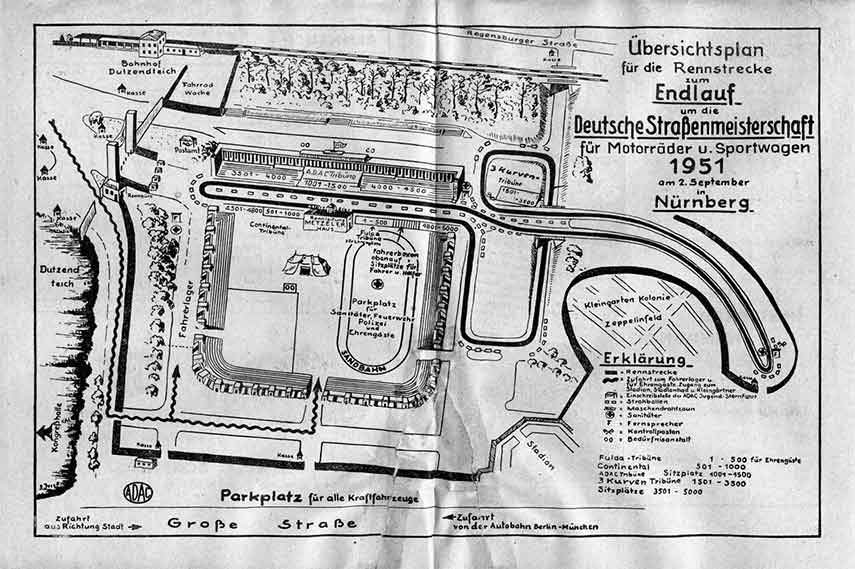
Norisring track layout in 1951
Circuit layout and characteristics
Several different Norisring configurations were used during the circuit’s early history. Some layouts were considerably longer than the version used today, and a figure-eight configuration also appeared during the early post-war period.
The familiar modern layout has been in use since 1972. It is traditionally listed as approximately 2.3 kilometres long, although event documentation may show a slightly shorter measured competition distance.
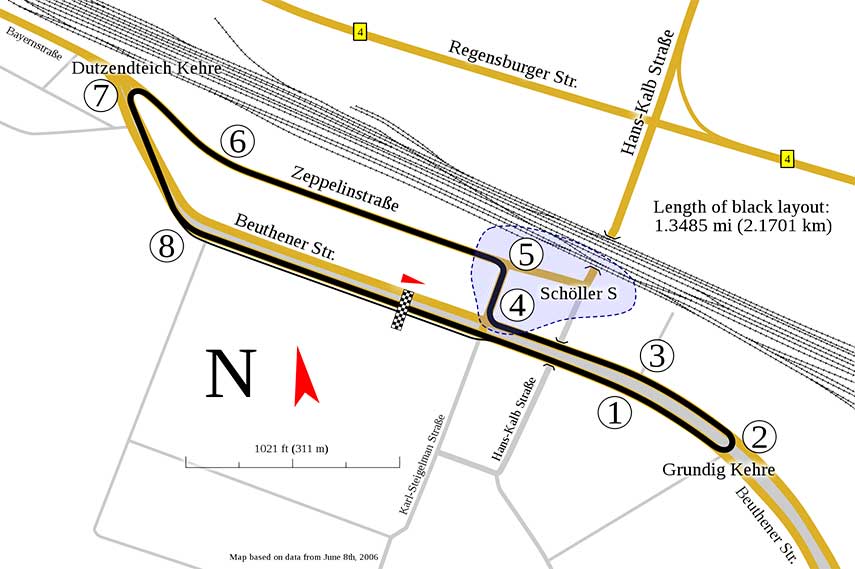
Map of the modern Norisring circuit in Nuremberg
On paper, the Norisring appears simple. The circuit is built around two long straights, two tight hairpins and the fast Schöller S section. In practice, it is one of the most demanding short circuits in touring car racing.
The Grundig hairpin
One of the circuit’s most important overtaking areas is the Grundig hairpin at the end of a long, fast section. Drivers must brake heavily while defending or attacking for position, often with several cars arriving almost side by side.
The corner regularly produces overtaking, contact and changes of position. A good exit is equally important because poor traction can leave a driver vulnerable on the following acceleration zone.
The Schöller S
The Schöller S is the quickest and most unforgiving part of the lap. Cars pass between barriers with little space available to correct a mistake. Precision and confidence are essential, particularly when drivers are running closely together.
Its speed and narrow surroundings give the Norisring much of its street-circuit character. Even a small error can result in contact with the wall or force a driver away from the ideal racing line.
The Dutzendteich hairpin
The second major hairpin provides another opportunity to attack under braking. Drivers must slow the car sharply, rotate it at low speed and find traction for the run back towards the start and finish area.
Because the lap is so short, a minor error at either hairpin can cost several positions. Time differences are usually small, making qualifying particularly important.
Brakes, traction and tyre management
The Norisring places unusual demands on a racing car. The long acceleration zones are followed by some of the hardest braking points of the lap, giving brakes little time to recover. Brake cooling and stability under deceleration are therefore critical.
Drivers also need strong traction when leaving the slow corners. Wheelspin costs valuable momentum along the straights and can increase tyre wear, especially in hot summer conditions.
The public-road surface can be uneven and may offer different levels of grip as the weekend progresses. Painted road markings, surface repairs and changes in asphalt add another layer of difficulty.
Why the Norisring produces close racing
The Norisring is frequently compared with Monaco because of its historic setting, temporary construction and close barriers. It is sometimes promoted as the “Franconian Monaco,” although its racing character is quite different from that of the Formula One circuit.
Its long straights and heavy braking zones create more conventional overtaking opportunities. Slipstreaming allows cars to close on one another before attempting a move at one of the hairpins.
The short lap also keeps the field tightly grouped. Traffic becomes a factor in qualifying, while small mistakes can have an unusually large effect on starting position. Safety cars and interruptions can further compress the field and produce unpredictable finishes.
Concrete walls remain close to the racing line, so drivers must balance aggression with precision. That combination has made the Norisring responsible for many memorable touring car races.
The Norisring and the DTM
The annual DTM meeting is now the circuit’s main event and one of the most recognisable weekends in German motorsport. The Norisring is the only temporary street circuit on the modern DTM calendar.
For many years, the event was associated with the intense rivalry between Audi, BMW and Mercedes. Different manufacturers and teams have participated as the championship’s regulations have changed, but the character of the race has remained consistent: short lap times, close qualifying margins, forceful overtaking and little room for error.
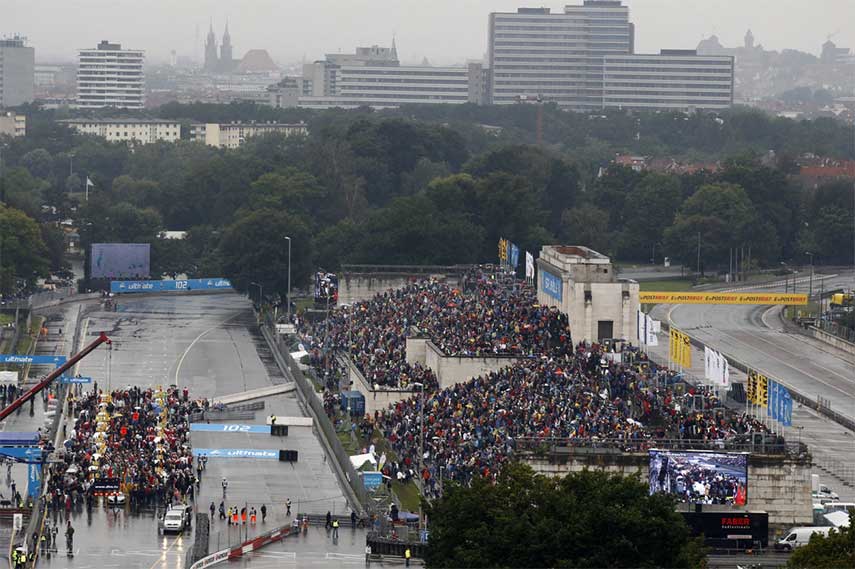
Packed grandstands during a DTM race at the Norisring
Video: DTM 2015 race at the Norisring
The circuit also poses a logistical challenge. Public roads must be closed, barriers and safety systems installed, temporary paddock facilities created and grandstands prepared before the racing can begin. After the event, much of the venue is dismantled and the roads return to everyday use.
Its urban location and compact layout allow spectators to remain close to the cars. The sound reflects from the concrete structures, while the crowded grandstands help create a festival-like atmosphere that differs from events at permanent circuits.
Other racing series at the Norisring
Although the Norisring is now most strongly associated with the DTM, many important championships have appeared there.
Sports car racing played a major role in the circuit’s history. The Norisring hosted races for the Deutsche Rennsport Meisterschaft, commonly known as the DRM, as well as powerful Group C sports prototypes and events connected with international sports car competition.
The speed of those prototype cars was particularly impressive on such a short street circuit. Their appearances during the 1980s remain among the most spectacular chapters in Norisring history — including the era when Sauber Mercedes C9 prototypes ran at the circuit.
Formula Three was another important part of the programme for many years. The circuit’s narrow layout, close barriers and heavy braking zones provided a demanding test for young drivers developing their careers.
The Porsche Carrera Cup Germany and various manufacturer-backed or one-make series have also supported the main event. The exact programme changes from year to year, so visitors should consult the official event schedule before travelling.
Fatal accidents and circuit safety
The history of the Norisring also includes two particularly serious accidents in which Pedro Rodríguez and Csaba Kesjár lost their lives.
Pedro Rodríguez
Mexican racing driver Pedro Rodríguez was killed at the Norisring on 11 July 1971 while competing in an Interserie sports car race.
Rodríguez was driving a Ferrari 512 M when the car crashed into the barriers and caught fire. He was 31 years old and was already internationally respected for his success in Formula One, endurance racing and major events such as the 24 Hours of Le Mans — including victory in the Porsche 917 at Le Mans in 1970.
A memorial plaque at the circuit commemorates Rodríguez and marks his connection with the venue.
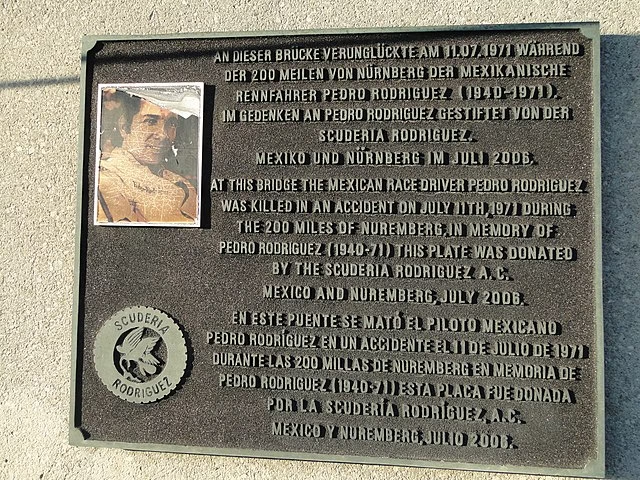
Pedro Rodríguez memorial plaque at the Norisring
Csaba Kesjár
Hungarian Formula Three driver Csaba Kesjár was killed during practice at the Norisring on 24 June 1988. His car continued towards the Dutzendteich hairpin and struck the barriers at high speed.
Kesjár was one of Hungary’s leading young racing drivers and had previously become the first Hungarian to drive a Formula One car during a demonstration appearance.
As at other street circuits, safety at the Norisring has evolved substantially. Barrier systems, debris fencing, trackside procedures and medical provisions have been developed over time, while the temporary circuit must meet the safety requirements of the competitions it hosts.
The historic Norisring lap record
One of the most frequently quoted laps in Norisring history was recorded by Jean-Louis Schlesser in 1988.
Driving a Sauber C9 during a German Supercup Group C race, Schlesser completed a lap in 47.79 seconds. The combination of an extremely powerful sports prototype and the Norisring’s long straights produced an average speed of more than 170 km/h.
Lap records at the Norisring should be treated carefully because different categories, circuit measurements and event configurations may produce separate official records. Schlesser’s 47.79-second lap remains the best-known historic benchmark associated with the circuit.
Visiting the Norisring
The circuit is situated in the south-east of Nuremberg, close to Dutzendteich lake, the former Nazi Party Rally Grounds and the city’s large sports and event complex.
Because the Norisring is formed from public roads, there is no permanent racing circuit to visit in the same way as the Nürburgring or another purpose-built venue. Outside the event period, visitors can walk around parts of the area and see the historic grandstand, but the barriers, paddock and other racing infrastructure are temporary.
Travelling by public transport
Public transport is usually the easiest way to reach the circuit during a race weekend. The area is served by Nuremberg’s suburban rail, tram and bus network, although routes and access arrangements may change while roads are closed for the event.
Visitors should check the latest information published by the DTM, the event organiser and Nuremberg’s public transport operator. Any combined event-ticket and transport offer should also be confirmed for the relevant year rather than assumed from previous editions.
Arriving by car
Driving directly to the area can be difficult during race weekend because of road closures, restricted access and heavy traffic. Visitors arriving by car may need to use designated parking areas and continue by public transport or on foot.
Allow additional time and follow the temporary signs and official event instructions rather than relying exclusively on standard navigation routes.
Grandstands and viewing areas
The large stone grandstand is the defining structure of the venue and provides views across an important part of the circuit. Other temporary grandstands may offer better views of the principal braking zones and overtaking attempts.
The best choice depends on whether a visitor prefers a broader view of the event, close-up braking action or a position near the start and finish area. The grandstand plan should be reviewed before tickets are purchased because seating arrangements may differ between editions.
Camping and accommodation
Camping has been offered near the circuit for some previous events, but availability, reservation procedures and access rules can change. Anyone planning to camp should use the official booking channel for the specific race weekend.
Nuremberg also has a wide range of hotels, hostels and private accommodation. Rooms close to the circuit and city centre can fill quickly during major events, so early booking is advisable.
Accessibility
Accessibility services and designated viewing areas may be available, but visitors should confirm the current arrangements before travelling. Temporary street circuits can involve uneven surfaces, long walking distances and altered pedestrian routes.
Fast facts about the Norisring
- The first post-war race was held on 18 May 1947.
- The first event focused primarily on motorcycles.
- Automobile racing followed in 1948.
- The circuit takes its name from “Noris,” a historic name for Nuremberg.
- The name helps distinguish it from the Nürburgring.
- The familiar modern layout has been used since 1972.
- The track is assembled on public roads for its annual race meeting.
- It is the only street circuit on the modern DTM calendar.
- Its two major hairpins provide the main overtaking opportunities.
- Jean-Louis Schlesser’s 47.79-second Group C lap is its best-known historic benchmark.
Frequently asked questions about the Norisring
Where is the Norisring?
The Norisring is located in Nuremberg, Bavaria, in southern Germany. It runs around the Zeppelinfeld and stone grandstand within the former Nazi Party Rally Grounds.
Is the Norisring a permanent racing circuit?
No. The Norisring is a temporary street circuit. Most of its course consists of roads that are used by ordinary traffic outside the race-event period.
How long is the Norisring?
The traditional modern layout is generally described as approximately 2.3 kilometres long. Official event documents may list a slightly different measured distance depending on the precise configuration and timing points.
When was the first Norisring race held?
The first post-war event was held on 18 May 1947 and was primarily a motorcycle race. The first automobile race followed in 1948.
Why is it called the Norisring?
“Noris” is a historic name for Nuremberg. The circuit’s name was selected in a public competition in 1950 and also helped distinguish it from the Nürburgring.
Is the Norisring the same as the Nürburgring?
No. The Norisring is a short temporary street circuit in Nuremberg. The Nürburgring is a permanent motorsport complex in Germany’s Eifel region and includes the famous Nordschleife.
Which championship races at the Norisring?
The DTM is the circuit’s principal modern championship. Supporting categories such as the Porsche Carrera Cup and other one-make or historic series may also appear, depending on the year.
Why is the Norisring difficult?
The circuit combines long straights with extremely heavy braking, tight hairpins, an uneven public-road surface and barriers close to the racing line. Its short lap also produces very small time differences between drivers.
What is the Norisring lap record?
Jean-Louis Schlesser’s 47.79-second lap in a Sauber C9 during a 1988 Supercup race is the circuit’s best-known historic record. Modern category records vary according to the vehicle class and exact circuit configuration.
Can the Norisring be visited outside race weekend?
Yes, the surrounding public area can be visited, but there is no complete permanent race circuit infrastructure outside the event period. Visitors should also remember that the location forms part of a historically sensitive heritage site.
Norisring remains one of Germany’s most distinctive circuits
More than seven decades after its first post-war race, the Norisring remains one of Europe’s most recognisable street circuits. Its simple appearance hides a demanding combination of high speed, heavy braking, close barriers and constantly changing grip.
The circuit’s setting also gives it a significance that extends beyond motorsport. Racing takes place within an area shaped by the history of Nazi Germany, and any account of the Norisring must acknowledge that background respectfully.
Today, the annual DTM weekend continues the sporting tradition that began in 1947. The compact track, crowded grandstands and close racing make the Norisring one of the most atmospheric events of the German motorsport season.
Location: Zeppelinstraße, 90471 Nürnberg, Germany
Official circuit website: norisring.de
DTM event information: dtm.com