

Automotive Logistics: Key Challenges And How To Tackle Them
Introduction
The global manufacturing sector is constantly evolving. This extends to the automotive manufacturing sector as well, and this is where automotive logistics comes into the picture. It plays a vital role in this challenging sector as it helps manufacturers to stay efficient, maintain or increase profits, and prevent wastage or unnecessary downtime.
Automotive logistics is also important from a global perspective, as globalization has created a very complex supply chain that requires meticulous planning and execution for optimal results. But what exactly constitutes automotive logistics? The next section covers this question.
What is Automotive Logistics?
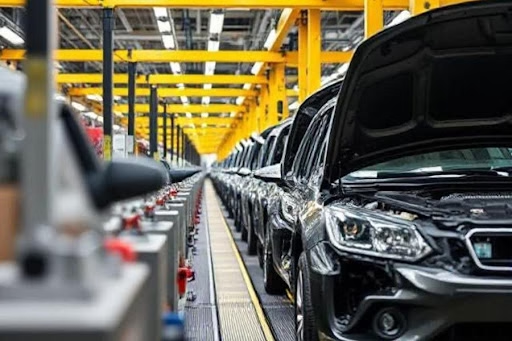
Automotive logistics is a broad term that is used to connect various parts of the production process, ranging from supply and manufacturing to distribution. This covers the flow of various materials and spares from suppliers to the production facility, and consequently, from the production facility to the distributors and car dealerships.
To ensure clear connection and communication across all levels, it is absolutely vital to ensure proper planning, execution and management, all of which fall under automotive logistics. Why is this so important? The automotive manufacturing and distribution sector is a complex machine with innumerable moving parts. Be it the smallest of parts or creating the entire vehicle, it requires precise coordination and planning to be executed perfectly. Automotive logistics makes this all possible in real-time. Without this careful planning, this highly complex sector will be nowhere near productive, and it will also negatively impact the quality of the vehicles.
Therefore, automotive logistics is critical for a well-functioning industry.
Key Challenges in Automotive Logistics
Supply Chain Complexity
While globalization has led to a manufacturing boom in many aspects, it has also made automotive logistics that much more challenging. With suppliers from around the globe, there are too many moving parts to plan and consider, as even the smallest of disruptions or delays can stop the entire production process and cost valuable time and resources.
Energy Reliability and Downtime Risks
Apart from the delays caused by a global and complex supply chain, each manufacturing facility faces its own downtime challenges in the form of energy reliability. A constant and stable power supply is vital to ensure that all equipment performs perfectly and keeps the production going smoothly in accordance with international standards such as IEEE 519. Conversely, destabilized power can cause unwanted downtime and can even damage some equipment, further complicating the process. Automotive logistics also needs to plan for such scenarios.
Fortunately, by integrating power quality solutions, the above-mentioned problems can be mitigated, and it can possibly make logistical planning a bit simpler.
Material Handling Bottlenecks
Aside from the challenges created by an unstable power supply, there is also the material handling aspect to consider. When moving heavy products or parts in a facility, material handling bottlenecks can become a common problem. The best way to handle them is by investing in quality material handling solutions, such as decline conveyor belts or other similar conveyor systems. These conveyors will automate and likely smooth the overall flow and reduce instances of manual intervention, which are very challenging to plan for.
Global Disruptions and Shortages
Much like the first point, a global supply chain also increases instances of delays due to unforeseen circumstances. A local disruption in one region can halt the entire production as parts fail to arrive on time. Similarly, part shortages, such as batteries or microchips, can also delay the production process unnecessarily. Accounting for these is also a major challenge for automotive manufacturing.
Strategies to Overcome Automotive Logistics Challenges
Digitalization and Data Visibility
Since the biggest challenge of automotive logistics is dealing with supply chain complexity, the answer lies in clear dissemination of data across all facilities. This is made possible by the use of digitalization. What does digitalization mean? It means a clear record and tracking of inventory on a digital scale in real-time. This means that any shortages or issues are flagged in real-time and can be addressed immediately before they disrupt the entire supply chain. A warehouse management system is an excellent example of digitalization and data visibility. Similarly, other digital tools can be used to monitor errors during manufacturing so the overall part quality is not compromised.
Collaboration with Suppliers and Partners
Another aspect of removing automotive logistic challenges is to create a clear line of communication with the various suppliers and partners across the supply chain. It basically means to create a network that is streamlined and highly efficient at its task, and allows manufacturers to be aware of any delays or issues as quickly as possible, so contingency plans can be put into effect. This collaboration can be made more effective by integrating digital data monitoring software that is accessible across the entire supply chain.
Automation and Robotics in Logistics
Lastly, removing manual labour as much as possible can go a long way to reducing errors and costing precious time during the production process. The best way to achieve this is by means of automation. This automation can take on many different forms, ranging from material handling systems such as conveyors to even robotic arms that oversee the assembly process. By integrating automation and robotics, most errors and unforeseen issues can be mitigated before they cause disruption across the supply chain. Therefore, adding this technology along with the latest software, such as machine learning, can make the logistics process faster, more streamlined and free from major issues.
Future Trends in Automotive Logistics
Electrification and EV Supply Chains
One of the key future trends that is already taking effect is the rampant production of electric vehicles. This means that the supply chain now has to cater to different parts of the EV vehicle, which brings some new automotive logistics challenges. For instance, storing and safely transporting batteries used in EVs takes center stage.
Sustainability and Green Logistics
There is a major push towards sustainability in manufacturing, and the automotive sector is no exception. Automobile manufacturers are going towards processes and production tactics that reduce their overall carbon footprint. Therefore, this too has to be taken into consideration with automotive logistics.
AI and Predictive Analytics
A trend that can positively impact automotive logistics is the ever-increasing reliance on artificial intelligence. Using AI and predictive analytics can help planners to see problem areas of the past, so that they can make improvements quickly. It also makes digitalization and real-time monitoring possible and hassle-free.
Conclusion
In closing, automotive logistics is critical for modern manufacturing as it is closely tied to efficiency and productivity. Although there are numerous challenges plaguing logistics, by careful strategy and integration of cutting-edge technology, it is possible not only to make the process more efficient but also to make it more robust and resilient to possible delays and disruptions.