

How Off-Road Racing Shapes Modern Truck Engineering
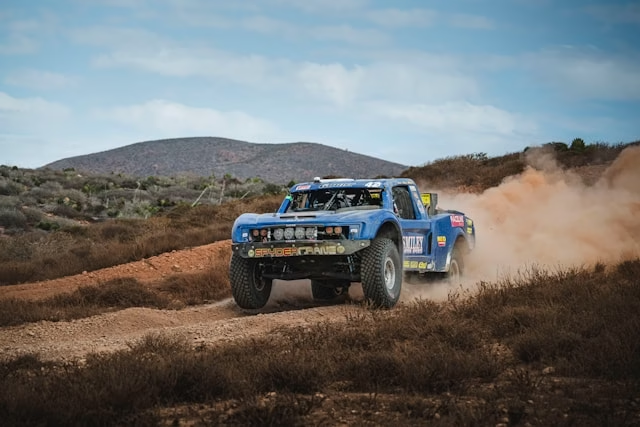
The roar of an engine, the spray of mud, and the challenge of a trail that seems impossible- this is the heart of off-road driving. It’s a pursuit that pushes vehicles and their drivers to the absolute limit. But what makes a machine capable of conquering boulder fields, deep sand, and steep, slippery inclines? It’s not magic; it’s a symphony of sophisticated engineering designed to deliver power, maintain grip, and withstand incredible punishment.
How Off-Road Racing Shapes Vehicle Engineering
The world of off-road racing is the ultimate proving ground for vehicle technology. Competitions like the Baja 1000 force engineers to innovate constantly, creating components that are both incredibly strong and surprisingly agile. The lessons learned from these brutal events directly influence the design of consumer vehicles. Automakers apply principles of frame rigidity, suspension geometry, and powertrain durability developed through off-road competition to their production vehicles. While purpose-built race trucks are engineered for extreme conditions, many of those lessons influence heavy-duty models like the Chevy Silverado 2500 HD, which combines robust construction, capable suspension, and powerful towing performance for demanding work and recreational use. The result is a truck that benefits from decades of engineering refined in challenging off-road environments.
Traction Control Systems in Off-Road Vehicles
Power is useless if you can’t get it to the ground. Traction is the critical link between the engine’s output and the vehicle’s movement. In a controlled environment like a drag strip, the goal is to maximize grip on a prepared surface, a science detailed in drag racing product info. Off-road, the challenge is infinitely more complex. Surfaces can change from loose gravel to slick mud in an instant. This is where modern traction control systems become essential. An advanced electronic antiskid system uses sensors to detect wheel slip. When a tire starts to spin, the system can apply brake pressure to that wheel or reduce engine power, redirecting torque to the wheels that still have grip. This allows the vehicle to keep moving forward even when all four wheels are on different surfaces.
Off-Road Suspension for Rough Terrain
An off-road vehicle’s suspension does much more than just provide a comfortable ride. It’s responsible for keeping the tires in contact with the ground over wildly uneven terrain. Key to this is suspension travel, the total distance the wheel can move up and down. More travel allows the suspension to absorb huge impacts from rocks or jumps without bottoming out or transferring the shock to the vehicle’s frame and occupants. Equally important is damping, which is controlled by the shock absorbers. Good dampers prevent the vehicle from bouncing uncontrollably after hitting a bump, keeping the driver in control. This same principle is critical in endurance events such as the Baja 1000, where maintaining tyre contact over rough terrain can make the difference between finishing and retiring.
Off-Road Engines Built for Tough Terrain
The engine in an off-road powerhouse isn’t just about peak horsepower. While having ample power is important, the way that power is delivered is even more critical. Off-road driving often happens at low speeds, where engine torque is king. Torque is the rotational force that gets the vehicle moving from a standstill and helps it climb steep grades without straining. These engines are also built for extreme durability. They must be able to operate at high loads for extended periods and at awkward angles that could starve a normal engine of oil. Robust cooling systems are also a must-have to prevent overheating during slow, high-effort climbs.
Essential Off-Road Vehicle Features for Challenging Terrain
Beyond the core mechanical systems, a truly capable off-road vehicle is designed with the entire driving experience in mind. High ground clearance is fundamental, providing the space needed to drive over obstacles without damaging the undercarriage. Short front and rear overhangs create steep approach and departure angles, allowing the vehicle to tackle sharp inclines and declines without the bumpers digging into the ground. Even details like reinforced skid plates protecting the engine and fuel tank, durable all-terrain tires, and excellent driver visibility play a huge part in successfully handling difficult terrain.
Ultimately, the ability to power through any terrain comes from a holistic approach to vehicle design. Every component, from the engine to the tires, is part of a system engineered to work in harmony, turning seemingly impassable obstacles into just another part of the adventure.
Photo by Nattipat Vesvarute on Unsplash