

How to Avoid Side Impact Collisions Using Motorsport Vision
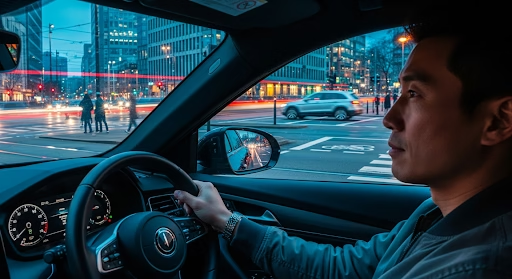
Featured Image generated by Gemini
The light turns green. You ease your foot off the brake, but a flash of color in your peripheral vision makes you hesitate. A split second later, a car blasts through the red light, missing your front bumper by inches. This heart-stopping near-miss is an all-too-common scenario at busy city intersections, the primary stage for dangerous side-impact, or “T-bone,” collisions.
These crashes are shockingly frequent and devastatingly severe. The need for advanced defensive skills is particularly high in some regions; for instance, Mississippi has one of the highest traffic fatality rates per capita in the country. However, the same proactive awareness techniques that professional endurance racers use to navigate a track packed with 60 other cars can be applied to your daily commute, turning you from a reactive driver into a proactive one.
The Racer’s Mindset: Shifting from Reactive to Proactive Driving
At the core of a professional driver’s skill set is something called “motorsport vision” or pre-visualization. It’s the art of seeing what’s going to happen seconds before it does. This isn’t about having a crystal ball; it’s about training your brain to process information faster and more comprehensively than the average driver.
Seeing the Race, Not Just the Road
Endurance racers don’t just react to the car directly ahead. They anticipate the flow of traffic several moves in advance, predicting where chaos is likely to erupt and planning for it. This is the crucial difference between passively seeing a green light and actively scanning the entire intersection for potential threats before moving. Commercial fleets are adopting a similar mindset, discovering they learn more from near-misses than actual crashes. For every one collision organizations document, they identify seven near-collisions, using this data to coach drivers and prevent future incidents.
The Anatomy of a T-Bone Crash
Side-impact collisions are uniquely dangerous because vehicles offer far less structural protection on their sides compared to the front and rear crumple zones. Side-impact collisions represent a critical driver of road accident fatalities. These “T-bone” crashes are second only to frontal impacts in lethality, accounting for roughly 25% of passenger vehicle occupant deaths nationwide. This vulnerability makes catastrophic injuries like traumatic brain injuries, internal organ damage, and severe spinal trauma far more likely when a vehicle is struck from the side.
Your 3-Step Scan: Applying Motorsport Vision at Every Junction
You can train yourself to use this motorsport technique at every intersection. It involves a simple, three-step mental checklist that quickly becomes second nature. This scan transforms a junction from a simple “stop and go” situation into a dynamic environment you can safely manage.
Step 1: Look Through the Traffic
Your vision needs to go beyond the traditional “look left, right, then left again.” Broaden your field of view and actively search for information. Look through the windows of the cars stopped next to you to see approaching cross-traffic they might be blocking. Check the reflections in large shop windows for a glimpse of vehicles you can’t see directly. Watch for the movement of pedestrian feet or bicycle wheels emerging from behind a parked truck—these small cues signal a hidden hazard.
Step 2: Judge Closing Speed, Not Just Distance
A car’s distance can be dangerously deceptive; what truly matters is its closing speed. A vehicle that seems far away but is traveling at a high rate of speed is a much greater threat than a closer car that is actively braking. Racers instinctively make this judgment call dozens of times per lap. In a city like Jackson, where speeding is a known factor in serious collisions, learning to spot and react to a speeding driver is a critical survival skill.
Step 3: Always Have an Escape Route
A core tenet of racing is to never enter a situation without knowing how to get out of it. Before you even enter an intersection, you must identify your potential “outs.” This mental map gives you pre-planned options if another driver makes a mistake, allowing you to react instantly instead of freezing.
- The Abort Zone: Identify the space you can brake into safely if a car runs the light.
- The Acceleration Lane: Determine if you can safely accelerate through the intersection to avoid a side impact from a slower-moving threat.
- The Shoulder or Adjacent Lane: Note if the shoulder or the lane next to you is clear, providing a potential swerve path as a last resort.
- The Defensive Position: Position your vehicle in your lane to maximize your visibility and reaction time (e.g., not tailgating the car in front).
Putting Skills to the Test in High-Risk Collision Zones
Applying these techniques is most effective when you understand the environments where risk is highest. Some intersections, due to their design and traffic patterns, are inherently more dangerous than others, requiring a heightened state of awareness.
Why Some Intersections Are Built for Danger
Certain environmental factors significantly increase the odds of a collision. These include complex merge patterns that confuse motorists, poor visibility from road curvature or obstructions, and poorly timed traffic signals with short yellow lights. Each of these elements reduces a driver’s available reaction time, making proactive scanning techniques even more essential for safety.
A Real-World Focus: Jackson’s High-Risk Hotspots
Applying motorsport vision is most critical in known trouble spots. For drivers in Mississippi’s capital, local legal experts have identified the most dangerous intersections in Jackson MS, which include hotspots like Bailey Avenue & Woodrow Wilson Ave. and Lakeland Drive & Treetops Blvd. Understanding where these high-risk zones are located allows drivers to elevate their awareness and use pre-visualization techniques precisely where they are needed most. After a crash, the knowledge of a local attorney who understands these specific traffic patterns and road designs can be invaluable in determining fault.
Driver Control vs. External Factors
While you can’t control the behavior of other drivers or the design of the road, you can control your own actions and awareness. It’s important to recognize which safety factors are in your hands and which are external. Modern vehicles are increasingly equipped with technology like automatic emergency braking and blind spot monitoring to help mitigate these external risks, an important factor in ensuring safety during unavoidable collisions.
| Driver-Controlled Factors | External & Environmental Factors |
|---|---|
| Proactive Scanning & Pre-visualization | Road Design & Visibility |
| Speed Management & Following Distance | Traffic Signal Timing & Coordination |
| Seatbelt Usage | Weather & Road Conditions |
| Avoiding Impairment & Distractions | Vehicle Safety Features (AEB, Blind Spot Monitoring) |
| Maintaining Vehicle Condition (brakes, tires) | Other Drivers’ Behavior |
A Final Thought: Become the Master of Your Driving Environment
Using motorsport vision isn’t about driving faster; it’s about thinking faster. It’s a conscious shift away from being a passive vehicle operator who simply hopes for the best. By actively scanning, predicting traffic flow, and always knowing your escape route, you become an active manager of your own safety.
This proactive approach is the ultimate form of defensive driving. You learn to identify and neutralize threats before they can ever materialize, making the road a safer place for yourself and everyone around you.
