

Pannonia Ring – Hungary Circuit Guide (Layout, History, FAQ)

Originally published April 2017. Last updated September 2026: added labelled circuit map (Wikimedia Commons, with attribution in caption)
Pannónia-Ring is a permanent road-racing circuit at Ostffyasszonyfa in western Hungary, a few kilometres south of the spa town of Sárvár near the Austrian border. Opened in 1996 as a motorcycle-first venue, it grew into one of Central Europe’s safest test tracks — wide gravel, long straights, and F1-standard timing — yet it never attracted the headline world championships that visit Hungaroring.
The layout is longer and more flowing than Hungary’s Formula One home. Drivers and riders praise its combination of fast corners and heavy braking zones on a largely flat 4.740 km lap. For regional contrast see Red Bull Ring in Austria or Automotodrom Brno in the Czech Republic.
Today Pannonia Ring hosts Alpe Adria motorcycle championships, sidecar world championship rounds, national car series, and busy private test calendars — a professional facility without grand prix traffic.
Contents
Pannonia Ring facts
| Location | Ostffyasszonyfa, Vas County, western Hungary (near Sárvár) |
|---|---|
| Circuit type | Permanent road course with separate kart / mini circuit |
| Opened | 1 August 1996 |
| Length | 4.740 km (clockwise main course) |
| Turns | 18 (11 right, 7 left) |
| Width | 11–13 m |
| Main events | Alpe Adria International Motorcycle Championship; FIM Sidecar World Championship; national GT and formula support |
| Notable feature | Homologated bidirectional layout until 2014; wide run-off zones |
Lap record note: Arnold Wagner’s 1:46.707 in a Dallara SN01 (2009 Formula Nissan) is the published car reference. Motorcycle and touring categories use different tyres and slower benchmark times.
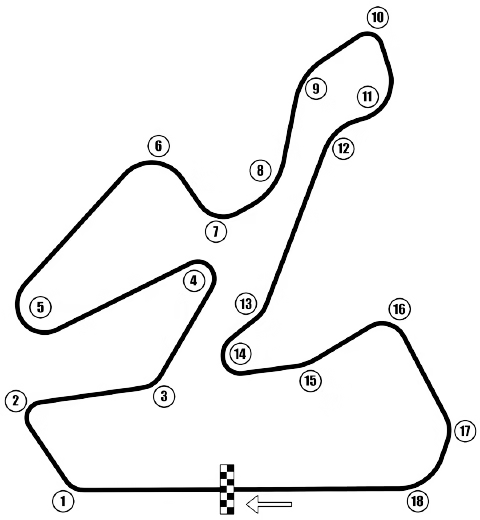
Pannónia-Ring — 4.740 km clockwise layout — Map: DarthKrilasar2 / CC BY-SA 4.0 via Wikimedia Commons
Challenging track that lacks big events
Construction began in February 1996 with the ambition to give Hungary a second major circuit tuned for bikes. When the track opened that summer, the focus was motorcycle national and regional championships, though formula and touring cars soon tested here.

Cars and bikes share national and regional race weekends at Pannonia Ring
Despite safety upgrades and a generous paddock, the circuit was overlooked by Formula One, WorldSBK permanence, and DTM. Hungary’s international spotlight stayed at Hungaroring. Pannonia instead became a favourite for teams seeking affordable track time between Austria, Slovakia, and the Czech Republic.
Flat, fast, and once reversible
The lap is mostly flat, 11 to 13 metres wide, with an 18-turn mix of long curves and stop-and-go chicanes. A 700 m start-finish straight helps top speeds on superbikes and prototype sportscars.
Unusually, the circuit was homologated to run clockwise and anti-clockwise. Permanent curbs installed in 2014 ended everyday counter-clockwise use, but the track retains rare certification for opposite-direction events.

Control tower and podium at Pannónia-Ring
National grids and sidecar world championship
Recent calendars lean on the Alpe Adria International Motorcycle Championship and periodic FIM Sidecar World Championship visits. Austria Formula 3 Cup and IDM Superbike rounds have appeared in the past; today the business model mixes sanctioned races with manufacturer tests and track-day hire.

Pit lane and garages at Pannonia Ring
Professional infrastructure, modest grandstands
The venue packs serious infrastructure into rural western Hungary: roughly 35,000 m² of paddock, 35 pit garages, race control with offices, medical centre, restaurant, guesthouse with 25 double rooms, workshop space, and a helicopter pad. Transponder timing meets Formula One standards.
What the circuit lacks is large spectator seating — most fans watch from grass banks or hospitality terraces. A separate 1.071 km kart track doubles as a motorcycle short course.
Getting to Pannonia Ring
Follow road 8451 to Ostffyasszonyfa. There is no major airport next door; Vienna (~130 km), Bratislava and Graz (~150 km), and Budapest Ferenc Liszt (~220 km) are the usual gateways.
On-site Paddock Hotel rooms fill quickly on race weekends. Many visitors stay in Sárvár, about a 15-minute drive north. Official information and booking: pannonia-ring.com.
Fast facts about Pannonia Ring
- Pannónia-Ring opened on 1 August 1996 near Sárvár.
- The main course measures 4.740 km with 18 turns.
- The track could originally run clockwise or anti-clockwise.
- 2014 curbs limited everyday use to clockwise laps.
- Wide gravel traps earn a reputation as one of Europe’s safer bike circuits.
- Hungaroring hosts Formula One; Pannonia does not.
- Arnold Wagner holds the published car lap record at 1:46.707.
- Alpe Adria and sidecar world championship rounds visit regularly.
- 35 pit boxes and a 35,000 m² paddock support testing.
- A 1.071 km kart track sits inside the complex.
Frequently asked questions about Pannonia Ring
Where is Pannonia Ring?
Pannónia-Ring (often called Pannonia Ring) sits at Ostffyasszonyfa in western Hungary, south of the spa town of Sárvár and roughly 130 km from Vienna. The venue is close to the Austrian border in Transdanubia.
How long is the Pannonia Ring race track?
The main clockwise course measures 4.740 km with 18 turns. Track width is 11–13 m and the start-finish straight is about 700 m long.
When did Pannonia Ring open?
Ground was broken in February 1996 and the circuit opened on 1 August 1996. It was conceived mainly for motorcycle racing but cars and formula categories followed.
Has Formula 1 raced at Pannonia Ring?
No. Hungary's Formula One home is Hungaroring near Budapest. Pannonia Ring hosts national championships, Alpe Adria motorcycle rounds, and historic sidecar world championship events instead.
Could Pannonia Ring be driven in both directions?
Yes, originally. The layout was homologated for clockwise and anti-clockwise running. Permanent curbs installed in 2014 limited everyday use to clockwise only, though the track retains rare bidirectional certification.
What is the lap record at Pannonia Ring?
The published race lap record is 1:46.707 by Arnold Wagner in a Dallara SN01 during 2009 Formula Nissan competition. Motorcycle and touring-car categories use different specifications and slower reference times.
Is Pannonia Ring good for track days and testing?
Yes. Wide gravel run-off, F1-standard transponder timing, and a large paddock make it a popular private test venue. It lacks big grandstands but offers pit garages, a hotel, and on-site catering.
How does Pannonia Ring compare with Hungaroring?
Hungaroring is shorter, tighter, and hosts the Formula One Hungarian Grand Prix. Pannonia Ring is longer and flatter, with faster corners and fewer headline international events — often described as more flowing for bikes and cars alike.
How do I get to Pannonia Ring?
Drive via road 8451 to Ostffyasszonyfa. The nearest major airports are Vienna (~130 km), Bratislava and Graz (~150 km), and Budapest Ferenc Liszt (~220 km). Many visitors stay in Sárvár, about 15 minutes away.
What facilities does Pannonia Ring have?
The complex includes a 35,000 m² paddock, 35 pit bays, control tower, medical centre, restaurant, guesthouse with 25 double rooms, and a helicopter landing site. A separate 1.071 km kart track can host motorcycle track days.
Related reading
- Hungaroring — Hungary’s Formula One circuit
- Red Bull Ring — Austrian Grand Prix venue
- Automotodrom Brno — Czech Republic’s main track
- Spa-Francorchamps — Ardennes classic
- Mantorp Park — Scandinavian national circuit
Address: Pannonia Racing Kft, H-9512 Ostffyasszonyfa, Hungary · Phone: +36 95 394 300 · Website: pannonia-ring.com