


Fuji Speedway – Japanese Grand Prix & WEC 6 Hours Guide

Originally published February 2016. Last updated September 2026: expanded Tier B circuit guide, facts table, table of contents, internal links, FAQ schema, and editorial refresh while preserving legacy narrative and images.
Fuji Speedway is a 4.563-kilometre permanent race circuit in Shizuoka Prefecture, Japan, with Mount Fuji on the horizon and one of motorsport’s longest main straights. Formula One raced here four times — in 1976, 1977, 2007, and 2008 — and the 1976 Japanese Grand Prix became legend when Niki Lauda withdrew in torrential rain while James Hunt clinched the title.
Fuji matters because it shows how Japanese motorsport tried to copy American superspeedways, then rebuilt itself into a modern road course. Super GT, Super Formula, and the FIA World Endurance Championship’s 6 Hours of Fuji keep the calendar busy; Toyota ownership since 2000 funded Hermann Tilke’s 2005 redesign.
Compare Fuji with Suzuka, Okayama International Circuit, and Autopolis — three Japanese venues that split Formula One, touring cars, and endurance racing across different eras.
Contents
- Fuji Speedway facts
- The failed NASCAR-style dream
- Daiichi banking and the 1974 rebuild
- 1000 km of Fuji and early Grands Prix
- 1976 Japanese Grand Prix
- 1977 Japanese Grand Prix tragedy
- Sportscars and the 6 Hours of Fuji
- Chicanes, Ota crash, and safety upgrades
- Toyota, Tilke, and the 2005 layout
- 2007 and 2008 Formula One returns
- Fuji Speedway today
- Frequently asked questions
Fuji Speedway facts
| Location | Oyama, Sunto District, Shizuoka Prefecture, Japan (foothills of Mount Fuji) |
|---|---|
| Circuit type | Permanent road course (current layout); abandoned high-banked section from 1960s plan |
| Opened | December 1965 (current major layout reopened 2005 after Tilke rebuild) |
| Length | 4.563 km (16 turns, current FIA Grade 1 layout) |
| Main straight | About 1.475 km — among the longest in world motorsport |
| Main events | Super GT; Super Formula; FIA WEC 6 Hours of Fuji; domestic club racing |
| Formula One | 1976, 1977, 2007, 2008 Japanese Grand Prix (no F1 since 2008) |
| Owner | Toyota Motor Corporation (since 2000 buy-out from Mitsubishi Estate) |
| Designer (2005) | Hermann Tilke |
Lap record note: GT, prototype, and Formula One cars run different tyres and downforce levels. Compare lap times only within the same series and circuit configuration.
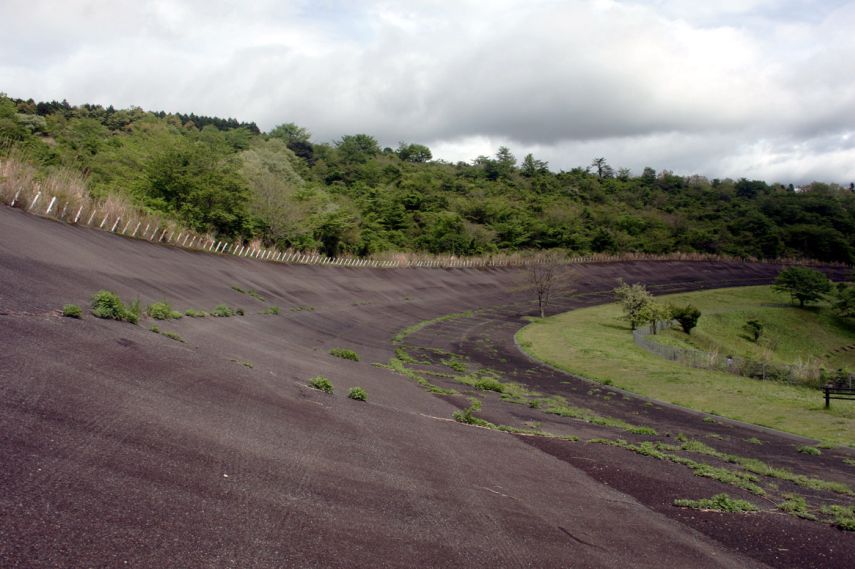
Abandoned 30-degree high bank is a reminder that Fuji was once planned as an American-style speedway
Japan NASCAR Corporation and unfinished banking
The Japan NASCAR Corporation formed in 1963 to build a 2.5-mile high-banked superspeedway like Daytona. Money ran out before the full oval could be completed; only one 30-degree banking section, later called Daiichi, was finished. The first layout combined that banking with a road course for roughly 6 km and 15 turns.
Mitsubishi Estate Co. invested in 1965, took management rights, and opened the circuit in December 1965. Fuji quickly became known for a 1.475 km main straight — still one of the longest in the sport.
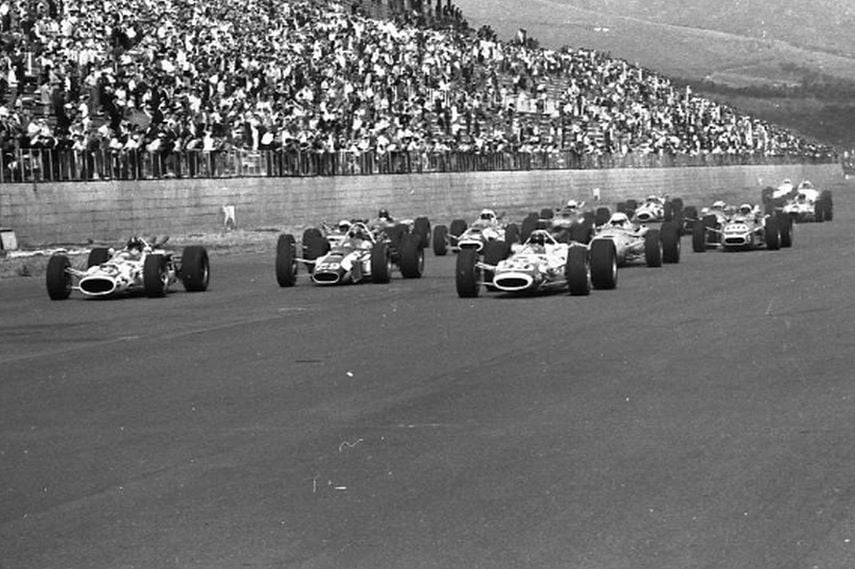
Jackie Stewart won the USAC non-championship race at Fuji in 1966
Daiichi banking forced a new 4.36 km course
International visitors arrived early. On 9 October 1966 a USAC 200-mile non-championship race brought Jackie Stewart and Bobby Unser; Stewart won. Can-Am ran in 1968 anticlockwise to reduce speed onto the banking.
Daiichi proved lethal. After fatal accidents and a crash on 2 June 1974 that killed drivers Hiroshi Kazato and Seiichi Suzuki and injured six others, organisers abandoned the banking. The rebuilt course measured 4.36 km with five fast corners removed from the old layout.

Hiroshi Fushida scored the most wins at the 1000 km of Fuji
1000 km of Fuji and pre-F1 Japanese Grands Prix
The 1000 km of Fuji became the signature domestic endurance race from 1967. Hiroshi Fushida won five times. Non-championship Japanese Grands Prix predated Formula One’s arrival; John Surtees won in 1972 and Jacques Laffite in 1976.

Fuji Speedway track layout
1976: Hunt’s title in the rain
The first Formula One world championship Japanese Grand Prix at Fuji closed the 1976 season and framed the Hunt–Lauda rivalry. Lauda led the standings by three points but refused to continue in torrential rain after one lap. Mario Andretti won; Hunt finished third and took the drivers’ title.

1976 Japanese Grand Prix at Fuji — Niki Lauda withdraws from the race
1977: Villeneuve–Peterson crash and two fatalities
The 1977 Japanese Grand Prix was the season finale with Lauda already champion. On lap five Gilles Villeneuve and Ronnie Peterson collided; debris killed a marshal and a photographer who had entered a prohibited area.
Hunt won again ahead of Carlos Reutemann and Patrick Depailler in the six-wheeled Tyrrell P34. Formula One left Fuji and Japan entirely until Suzuka hosted the championship in 1987.

Marshal and photographer were killed in the Villeneuve–Peterson accident at the 1977 Japanese Grand Prix
Sportscars and the modern 6 Hours of Fuji
World sportscar racing visited regularly from the 1980s. The All-Japan Sports Prototype Championship formed in 1983; Porsche 956s, Jaguar XJR models, and Japanese prototypes won through the early 1990s.
After sporadic revivals, the FIA World Endurance Championship added the 6 Hours of Fuji in 2012. Toyota won three consecutive years; Porsche took victory in 2015 with the 919 Hybrid.

Toyota scored three consecutive wins at the 6 Hours of Fuji from 2012 to 2014
Chicanes, marshalling, and the Tetsuya Ota fire
Slow corners arrived in stages: a chicane before the final turn in 1984, a tightened Turn 1 in 1986, and the Suntory chicane in 1987. Pit upgrades followed, but the 1998 JGTC fire involving Tetsuya Ota exposed marshalling failures. Ota survived severe burns and later won a landmark lawsuit against promoters.

The current layout reopened in 2005 with Mount Fuji as backdrop
Toyota bought the circuit and closed it for Tilke
Toyota Motor Corporation completed its buy-out from Mitsubishi in October 2000 and announced a Formula One-grade rebuild. Hermann Tilke designed a 4.563 km course; the track closed in 2003 and reopened in 2005.
Hamilton and Alonso won the last Fuji Grands Prix
The 2007 Japanese Grand Prix on 30 September ran in heavy rain and mist with 19 laps behind the safety car before green-flag racing. Lewis Hamilton won from pole; Heikki Kovalainen took his first podium in second.
Organisational complaints — transport, sight lines, catering prices, and restrictions on team banners when Toyota also owned an F1 team — coloured the weekend. 2008 brought Fernando Alonso’s victory ahead of Robert Kubica and Kimi Räikkönen.
Suzuka hosted 2009; Toyota withdrew from hosting F1 after the global financial crisis. Formula One has not returned to Fuji since 2008.
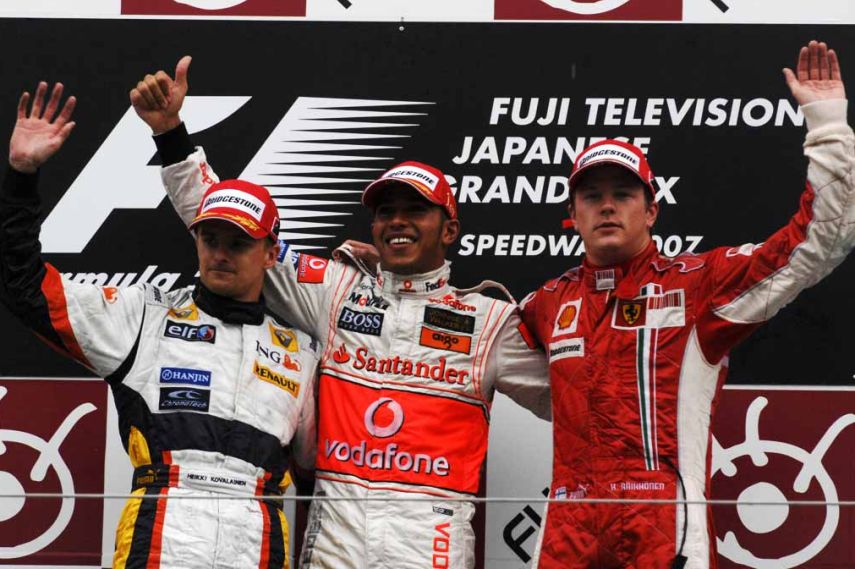
Hamilton, Kovalainen, and Räikkönen on the 2007 Japanese Grand Prix podium

Fernando Alonso won the 2008 Japanese Grand Prix ahead of Kubica and Räikkönen
Fuji Speedway in 2026
Fuji remains a centrepiece of Japanese domestic racing and the WEC calendar. Super GT and Super Formula fans still treat the long straight as a horsepower test; endurance teams use the 6-hour race as a championship pivot. Check fujispeedway.jp for tickets and access from Tokyo or Shizuoka.
Frequently asked questions about Fuji Speedway
Where is Fuji Speedway?
Fuji Speedway is in Oyama, Sunto District, Shizuoka Prefecture, Japan, in the foothills of Mount Fuji. The mailing address is 694 Nakahinata, Oyama-Cho, Sunto-Gun, Shizuoka-Ken 410-1307.
How long is Fuji Speedway?
The current Hermann Tilke layout measures 4.563 km with 16 turns. The main straight is about 1.475 km long.
How many times has Formula One raced at Fuji?
Formula One held the Japanese Grand Prix at Fuji four times: 1976, 1977, 2007, and 2008. There has been no F1 race at Fuji since 2008.
What happened at the 1976 Japanese Grand Prix at Fuji?
In torrential rain, Niki Lauda withdrew after one lap while leading the championship. James Hunt finished third and won the 1976 drivers’ title; Mario Andretti won the race.
Who owns Fuji Speedway?
Toyota Motor Corporation bought the circuit from Mitsubishi Estate in 2000 and funded the major Tilke rebuild that reopened the track in 2005.
Why is there abandoned banking at Fuji?
Builders in the 1960s planned a NASCAR-style superspeedway but ran out of money. The Daiichi 30-degree banking proved dangerous and was abandoned after fatal accidents, including a 1974 crash that killed two drivers.
What is the 6 Hours of Fuji?
The 6 Hours of Fuji is a round of the FIA World Endurance Championship, revived on the current layout in 2012. Toyota won three consecutive races before Porsche’s victory in 2015.
Who won the last Formula One race at Fuji?
Fernando Alonso won the 2008 Japanese Grand Prix for Renault, ahead of Robert Kubica and Kimi Räikkönen.
Does Super GT race at Fuji Speedway?
Yes. Fuji is a core venue for Super GT and Super Formula (formerly Formula Nippon). Domestic GT and single-seater calendars treat the long straight as a signature challenge.
How do you visit Fuji Speedway?
Event tickets and access information are at fujispeedway.jp. Allow travel time from Tokyo or Shizuoka; Mount Fuji weather can affect visibility on race weekends.
Related reading
- Suzuka Circuit — Japan’s figure-of-eight Formula One host
- Okayama International Circuit — Pacific Grand Prix history
- Autopolis Circuit — Kyushu’s mountain Super GT venue
- James Hunt and Niki Lauda rivalry — the 1976 title fight
- Tyrrell P34 — six wheels at the 1977 Japanese GP
Address: Fuji International Speedway Co., Ltd., 694 Nakahinata, Oyama-Cho, Sunto-Gun, Shizuoka-Ken 410-1307, Japan
Phone: +81 550-78 1234
Official website: fujispeedway.jp
