

Bristol Motor Speedway – NASCAR Short Track and Theatre of Speed Guide
Originally published August 2016. Last updated September 2026: expanded Tier B circuit guide, facts table, table of contents, internal links, FAQ schema, and editorial refresh while preserving legacy images and story.
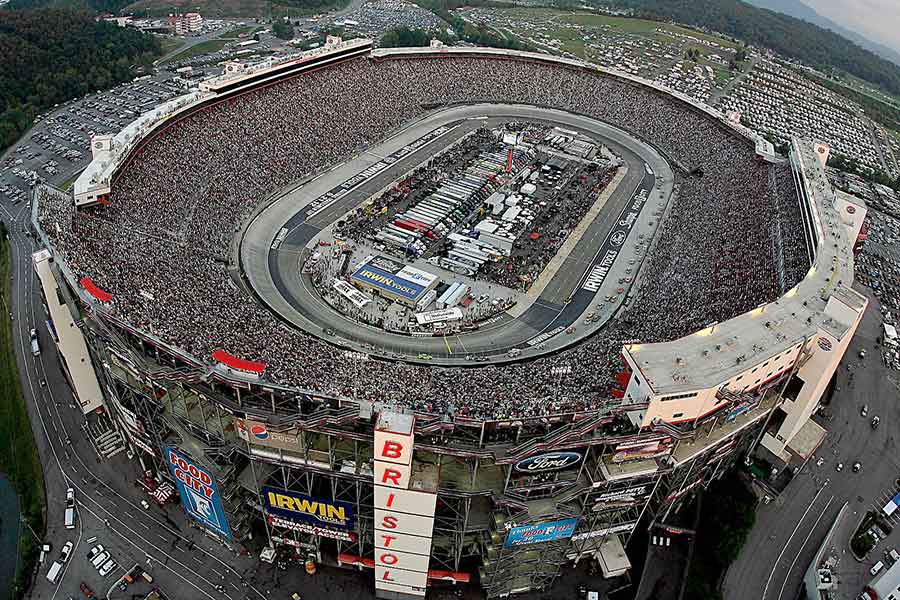
Bristol Motor Speedway is a 0.533-mile (0.857 km) concrete oval in Bristol, Tennessee, and one of the shortest tracks on the NASCAR Cup Series calendar. Fans call it the Theatre of Speed because steep banking and a narrow racing surface produce pack racing, contact, and caution flags at a pace few other venues match. The grandstands rise so close to the action that the noise and sight lines feel more like a stadium than a countryside superspeedway.
The track opened in 1961 when NASCAR was spreading from the Southeast into a national television sport. Larry Carrier and Carl Moore built a half-mile bowl on farmland near the Tennessee–Virginia state line, and the first NASCAR race drew more than 30,000 spectators. Decades later Bristol still sells out spring and summer weekends and remains a rite of passage for drivers who grew up on short tracks.
Bristol is not a forgiving intermediate oval. Concrete grip, 26-degree-plus banking, and tight quarters mean luck and pit strategy matter as much as raw speed. That combination explains why the venue is loved, feared, and impossible to duplicate.
Contents
- Bristol Motor Speedway circuit facts
- Larry Carrier and the 1961 opening
- Layout, concrete, and steep banking
- The unusual pit road
- NASCAR and major events
- Records and Bristol legends
- Speedway Motorsports and Colossus
- Dirt races, football, and pop culture
- Getting to Bristol and accommodation
- Frequently asked questions
Bristol Motor Speedway circuit facts
| Location | Bristol, Tennessee, United States (Tri-Cities region; Tennessee–Virginia border) |
|---|---|
| Circuit type | Paved concrete oval (short track) |
| Opened | 1961 (first NASCAR race: 30 July 1961) |
| Layout length | 0.533 miles (0.857 km) |
| Turn banking | Approximately 24–28 degrees in turns; 4–9 degrees on straights (post-2007 configuration) |
| Surface | Concrete (resurfaced multiple times; most recent major repave 2012) |
| Main events | NASCAR Cup Series (spring and summer races); NASCAR Xfinity Series; NASCAR Craftsman Truck Series; periodic other series |
| Seating capacity | About 82,000 grandstand seats; historically among the largest US motorsport venues when infield camping and overflow are included |
| Nicknames | Theatre of Speed; Thunder Valley |
| Owner | Speedway Motorsports (since 1996) |
Lap record note: Lap times depend on car category, tyre compound, and whether the surface is concrete or temporary dirt. NASCAR Cup qualifying laps often run in the mid-14-second range at roughly 130 mph. Compare records only within the same series, session type, and track configuration.
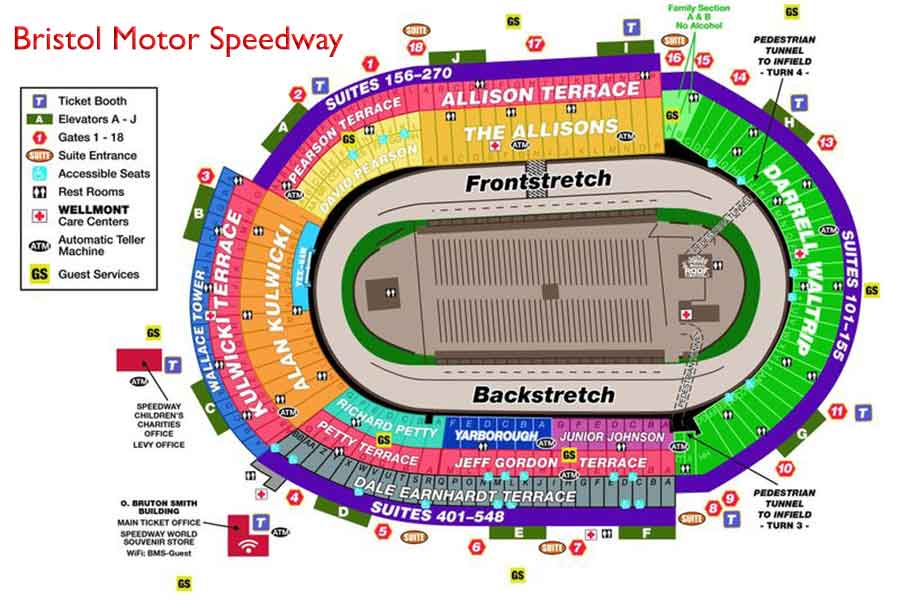
Map: Bristol Motor Speedway track layout
Larry Carrier and the 1961 opening
Larry Carrier and Carl Moore conceived Bristol as a half-mile copy of the short tracks that packed the Carolinas in the 1950s — only bigger. Construction began in 1960 on farmland east of downtown Bristol. When the gates opened in 1961, the paved oval instantly felt different from the dirt bullrings that had trained generations of stock car racers.
Jack Smith won the inaugural NASCAR Grand National race on 30 July 1961. Crowds were enormous from the start: even secondary NASCAR support races could draw six-figure attendance in Bristol’s peak years. The track’s concrete surface and vertical walls created a distinct sound — still one of the loudest environments in American motorsport.
Bristol grew alongside NASCAR’s television era. While Darlington Raceway held the Southern 500 tradition and Daytona built the superspeedway model, Bristol proved that a half-mile could headline national broadcasts if the racing stayed volatile.
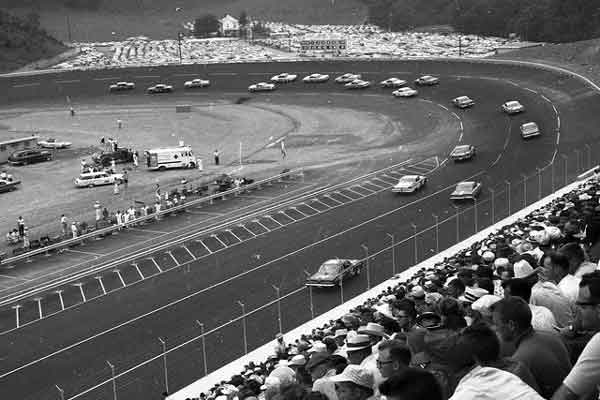
The first NASCAR race at Bristol was held in 1961
Layout, concrete, and steep banking
The defining trait is banking steep enough to race two wide on a lap that takes Cup cars only about fifteen seconds. After expansions in 1969 banking briefly reached roughly 36 degrees in the corners — extreme even by oval standards. The 2007 reconfiguration widened the racing surface to about 4.3 metres and settled turn banking in the mid-20s while keeping the sensory overload fans expect.
Concrete wears tyres quickly and does not forgive a loose car. That is why Bristol races often lead NASCAR in caution laps: contact is common, recovery lanes are narrow, and the wall is always close. Drivers who excel on wide 1.5-mile tracks sometimes struggle here; short-track specialists treat Bristol as a championship-calibre exam.
The venue was resurfaced again in 2012, refreshing grip and bump profiles while preserving the half-mile distance. Night racing under lights — now a signature of the summer Cup date — adds glare and shadow to an already intense sight picture.

Steep banking is one of Bristol’s trademarks
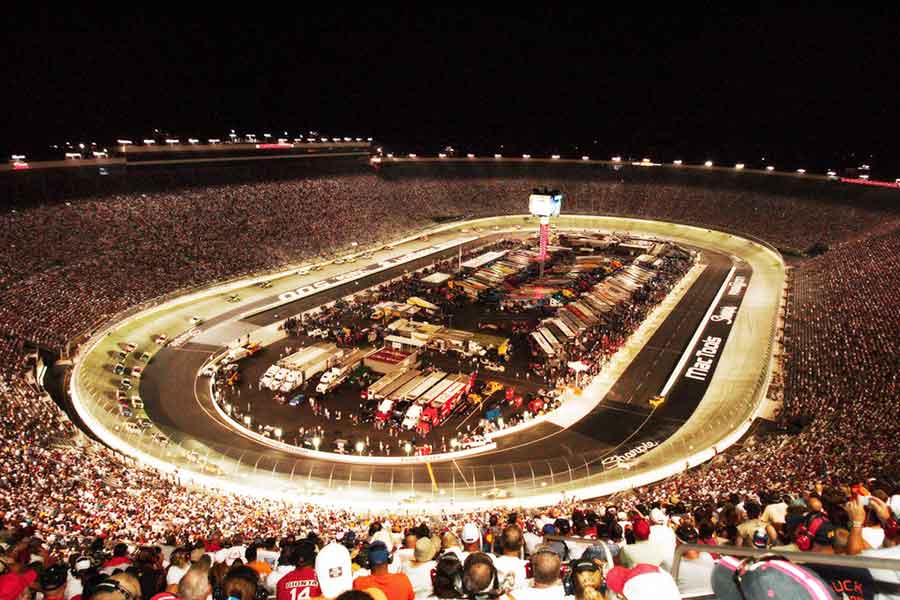
NASCAR night racing at Bristol Motor Speedway
The unusual pit road
Bristol’s footprint is so tight that traditional garage lanes do not fit inside the oval. Teams work from transporters packed into a paved infield, and pit road wraps partially around the apron with rules that exist nowhere else in NASCAR.
Since 2002 NASCAR has used a split entry and exit system. Under caution, cars that need service enter in turn 2, follow the backstretch apron through turns 3 and 4, and rejoin in turn 1. Under green flag, backstretch pit stalls use turn 2 entry and turn 3 exit; frontstretch stalls enter in turn 4 and leave in turn 1. The choreography prevents traffic jams but punishes anyone who misses the correct loop.
That quirk alone makes Bristol a favourite for broadcasters: pit reporters can explain strategy in real time while cars snake around the bottom of the track at reduced speed.
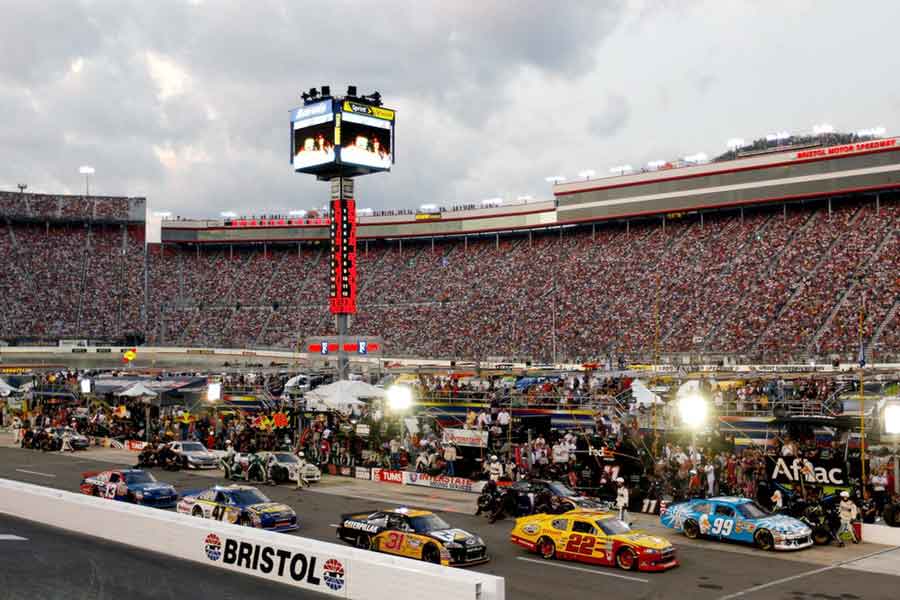
Pit road and grandstands at Bristol Motor Speedway
NASCAR and major events
Two NASCAR Cup Series races anchor each season: a spring race traditionally known as the Food City 500 and a summer night race (long sponsored as the Bass Pro Shops NRA Night Race and later under other title partners). Confirm the current year’s schedule and sponsor names before booking travel — NASCAR rotates dates and branding, but the spring/summer double-header format has been the norm since 1961.
The NASCAR Xfinity Series arrived in 1982 and often draws huge crowds in its own right. The Craftsman Truck Series has raced at Bristol since 1995 and for years hosted one of the few midweek truck races on the calendar. ARCA, USAR Pro, and regional tours still appear on support bills.
Outside NASCAR, Bristol has hosted Global Rallycross, drag racing exhibitions, and other one-off spectacles. The common thread is capacity: when the grandstands are full, Bristol remains one of the best-attended motorsport venues in the United States.
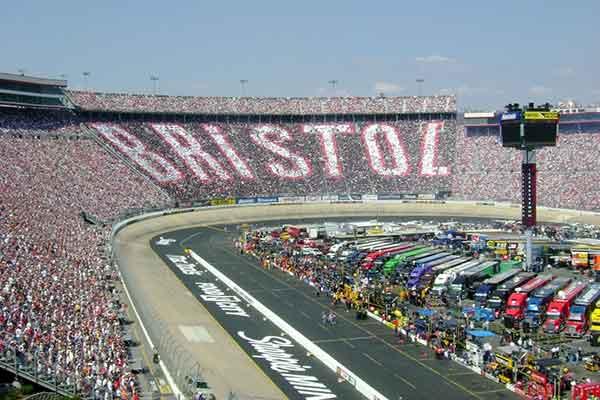
Race-day atmosphere in the Bristol grandstands
Records and Bristol legends
Darrell Waltrip holds the NASCAR Cup Series win record at Bristol with 12 victories — a total that still defines the track’s golden era of the 1980s and early 1990s. Richard Petty made 60 Cup starts at the speedway with 26 top-five finishes, reflecting how often The King ran up front on short tracks.
Modern champions including Jeff Gordon, Kyle Busch, and Denny Hamlin have multiple Bristol wins, but the statistics change every season. Use NASCAR’s official record book for current totals rather than treating any single driver’s count as permanent.
On non-NASCAR machinery, various short-track and sprint-car events have posted sub-13-second laps on auxiliary layouts. Those times are not comparable to Cup qualifying without noting car weight, tyre, and track surface.
Speedway Motorsports and Colossus
Bruton Smith’s Speedway Motorsports purchased Bristol in 1996 and funded a generation of upgrades: expanded seating, a fully paved infield for transporters, modern suites, and the Colossus scoring pylon — a four-sided LED tower that dominates the infield skyline like an arena jumbotron dropped onto a football field.
The paved infield is famously cramped. Crews manoeuvre 18-wheel haulers into spaces that would be illegal on a public road, which is part of the Bristol weekend experience for anyone walking the garage area.
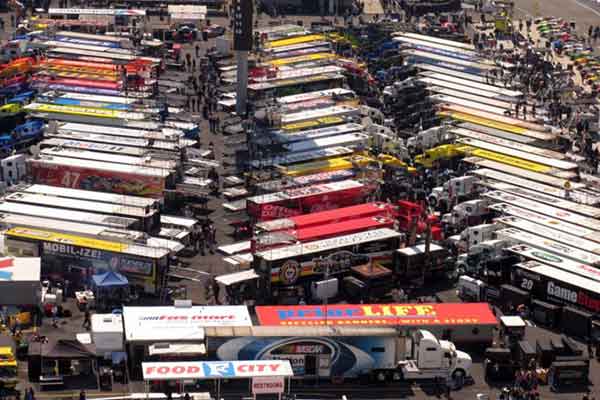
Team haulers in Bristol’s tight infield
Dirt races, football, and pop culture
Bristol experimented with a temporary dirt oval inside the concrete bowl for World of Outlaws sprint cars and later for NASCAR Cup and Truck races in March 2021. The surface was clay over the infield, with banking in the low 20s. Cup returned to concrete for subsequent seasons, but the dirt weekend proved Bristol’s willingness to reinvent itself for television and ticket sales.
The stadium-like bowl has also hosted college football, including the 2016 Battle of Bristol between Tennessee and Virginia Tech, when a gridiron was laid across the infield. Films such as Days of Thunder and Pixar’s Cars borrowed Bristol’s visual identity, and the track runs seasonal events such as Speedway in Lights for charity.
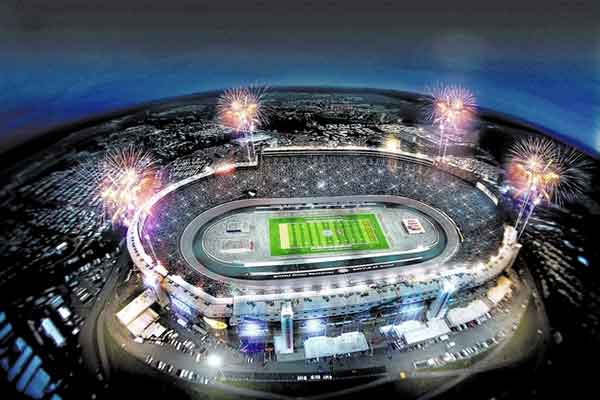
Bristol prepared for the 2016 college football game in the infield
Getting to Bristol and accommodation
Tri-Cities Regional Airport (Blountville, Tennessee) sits about 20 km from the track and handles regional flights. Charlotte Douglas International Airport is roughly 240 km south-east and offers more connections if you are flying from Europe or the west coast.
US Route 11E and Interstate 81 funnel traffic into Bristol on race weekends. Expect heavy congestion on Cup nights; locals often use alternate routes through Virginia or back-road approaches from Johnson City. Arrive early if you are camping — Bristol operates several on-site campgrounds plus RV hookups managed by the speedway.
Hotels in Bristol, Kingsport, and Johnson City fill months ahead for spring and summer NASCAR dates. Track-owned camping remains the most immersive option for fans who want to hear practice sessions from their tents.
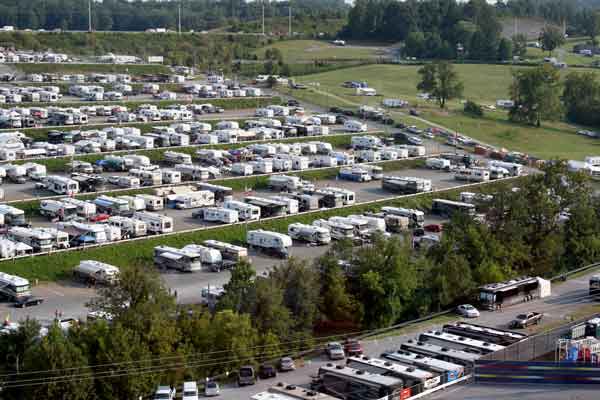
On-site camping during a Bristol race weekend
Fast facts about Bristol Motor Speedway
- Larry Carrier and Carl Moore opened the track in 1961 on a half-mile concrete oval.
- Jack Smith won the first NASCAR Cup race at Bristol in July 1961.
- Turn banking has exceeded 30 degrees at various points in the track’s history.
- NASCAR’s unique Bristol pit-road loops date from 2002.
- Darrell Waltrip’s 12 Cup wins remain the benchmark for Bristol success.
- Speedway Motorsports has owned the venue since 1996.
- Colossus is the infield four-sided LED scoring tower installed during SMI upgrades.
- NASCAR ran on a temporary dirt surface in 2021 before returning to concrete.
- The 2016 Battle of Bristol college football game filled the stadium with a gridiron.
- Five speedway-managed campgrounds operate on race weekends.
Frequently asked questions about Bristol Motor Speedway
Where is Bristol Motor Speedway?
Bristol Motor Speedway is in Bristol, Tennessee, United States, in the Tri-Cities region near the Tennessee–Virginia border. The mailing address is 151 Speedway Boulevard, Bristol, TN 37620.
How long is Bristol Motor Speedway?
The NASCAR oval measures 0.533 miles (about 0.857 km) per lap. It is one of the shortest tracks on the modern NASCAR Cup Series calendar.
Why is Bristol called the Theatre of Speed?
The nickname reflects how fast, close-quarters racing looks and sounds inside a half-mile concrete bowl with steep banking. Cars lap in roughly fifteen seconds, and the grandstands sit so near the wall that the action feels theatrical compared with wider superspeedways.
What is Bristol Motor Speedway known for?
Bristol is known for steep banking, a concrete surface, intense contact, frequent cautions, and two annual NASCAR Cup races (spring and summer). Its unusual pit-road rules and stadium-like seating also make it unique on the calendar.
When did Bristol Motor Speedway open?
The track opened in 1961. Larry Carrier and Carl Moore built the half-mile oval; Jack Smith won the first NASCAR Grand National race on 30 July 1961.
How steep is the banking at Bristol?
After the 2007 reconfiguration, turn banking is typically quoted in the mid-20-degree range with shallower straights. Earlier layouts briefly exceeded 30 degrees in the corners. Always check NASCAR's current track map for the latest figures.
Who has the most NASCAR Cup wins at Bristol?
Darrell Waltrip holds the Cup Series record with 12 wins at Bristol. Richard Petty made 60 Cup starts at the track with 26 top-five finishes.
Did NASCAR race on dirt at Bristol?
Yes, in 2021. NASCAR Cup and Truck races ran on a temporary clay surface inside the bowl. The series returned to the concrete oval for later seasons, but the dirt experiment remains a notable chapter in Bristol's modern history.
How does pit road work at Bristol Motor Speedway?
Because pit road is cramped, NASCAR uses split entry and exit loops introduced in 2002. Under caution, cars enter in turn 2, follow the apron through turns 3–4, and rejoin in turn 1. Green-flag rules differ for backstretch versus frontstretch pit stalls.
Can you visit Bristol Motor Speedway?
Yes. The speedway hosts public tours, camping, and seasonal events such as Speedway in Lights, plus NASCAR race weekends. Check bristolmotorspeedway.com for current tour schedules and ticket information.
Bristol still defines short-track NASCAR
Intermediate ovals and road courses have expanded the Cup schedule, but Bristol remains the place where bumpers trade paint and every restart feels like a sprint. The Theatre of Speed nickname is marketing, yet it fits: there is nowhere else on the calendar where 40 cars circulate a half-mile concrete bowl under lights with this much history.
For fans crossing from road racing or Formula One, Bristol is the essential American contrast — loud, close, and unapologetically contact-friendly. For drivers, it is still a resume line that separates short-track craftsmen from everyone else.
Related reading
- Darlington Raceway — Southern 500 and the Lady in Black
- Daytona International Speedway — temple of endurance racing
- Charlotte Motor Speedway
- Talladega Superspeedway
Address: Bristol Motor Speedway, 151 Speedway Boulevard, Bristol, TN 37620, United States
Phone: +1 423 989 6933
Official website: bristolmotorspeedway.com