

Buddh International Circuit – Indian Grand Prix & Tilke Guide

Originally published March 2016. Last updated September 2026: expanded Tier B circuit guide, facts table, table of contents, internal links, FAQ schema, and editorial refresh while preserving legacy narrative and images.
Buddh International Circuit is a Hermann Tilke-designed permanent track in Greater Noida, Uttar Pradesh, about 40 km from New Delhi. It hosted the Formula One Indian Grand Prix from 2011 to 2013 before tax disputes and calendar politics removed India from the world championship — leaving a $400 million facility that drivers still compare with Spa-Francorchamps for elevation and flow.
The venue opened in October 2011 as Jaypee International Circuit, renamed for Gautam Buddh Nagar district in April 2011. Three seasons of F1 proved the layout’s quality: fast straights, blind crests, and 16 corners over 5.14 km. Sebastian Vettel won every Indian Grand Prix and still holds the lap record.
Today the circuit waits for international series to return. National championships, track days, and Jaypee Sports City’s golf and hockey facilities keep the site busy, but Buddh remains one of Asia’s best circuits without a flagship world championship date.
Contents
Buddh International Circuit facts
| Location | Greater Noida (Gautam Buddh Nagar), Uttar Pradesh, India — about 40 km from Delhi on the Yamuna Expressway |
|---|---|
| Circuit type | Permanent road course (clockwise) |
| Designer | Hermann Tilke |
| Opened | October 2011 (first F1 race: 30 October 2011) |
| Length | 5.141 km (5.14 km quoted in F1 era), 16 turns |
| Capacity | About 120,000 (planned expansion to 200,000) |
| Main events (historic) | Formula One Indian Grand Prix (2011–2013) |
| Notable sections | Long back straight; multi-apex Turn 10–11 complex; elevation changes across the lap |
| Construction cost | About $400 million (2011 estimate) |
Lap record note: the official F1 race lap record is 1:27.249, set by Sebastian Vettel (Red Bull) during the 2011 Indian Grand Prix. Compare only within the same tyre and engine regulations.
Tilke design and Greater Noida opening
Jaypee Group built Buddh International Circuit inside Jaypee Sports City on the Yamuna Expressway. German architect Hermann Tilke — designer of Sepang, Shanghai, and Yas Marina — shaped a layout meant to feel like a classic road course despite modern runoff and safety standards.
The track opened only two weeks before the first Indian Grand Prix, yet drivers and guests praised the facility immediately. Capacity was quoted at 120,000 spectators with room to grow toward 200,000 — enormous by South Asian standards.

Jenson Button at the 2011 Formula 1 Indian Grand Prix
Layout, elevation, and track surface
The Grand Prix circuit runs clockwise over 5.14 km and 16 turns. Tilke used significant elevation change — crests and dips that open overtaking on the brakes and punish cars with weak rear stability. The asphalt uses greywacke aggregate shipped from England, a detail engineers cited when discussing grip levels in hot Uttar Pradesh afternoons.
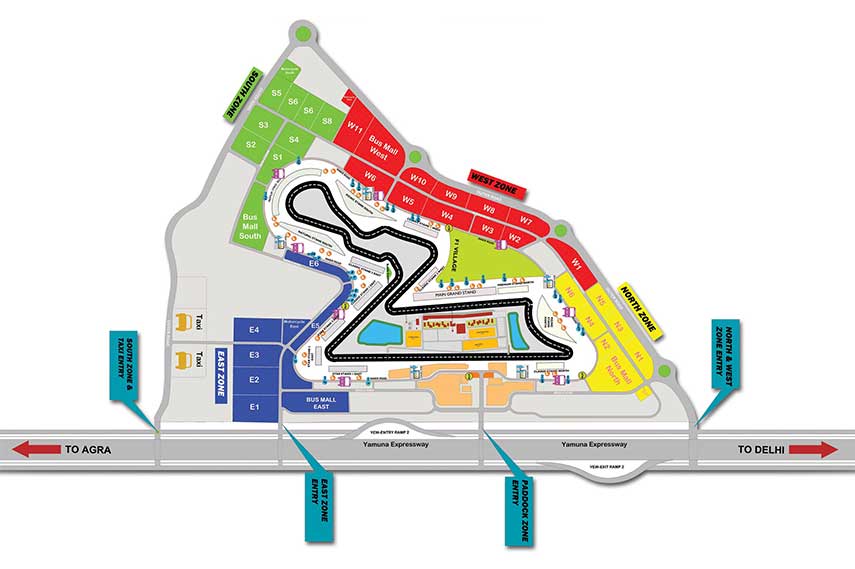
Map: Buddh International Circuit layout
Many drivers compared the flow to Spa-Francorchamps: fast, undulating, and mentally demanding rather than a stop-start street track.
Formula One Indian Grand Prix (2011–2013)
Formula One raced at Buddh for three seasons. Sebastian Vettel won all three Indian Grands Prix for Red Bull Racing and set the lap record of 1:27.249 in 2011. The 2012 and 2013 races kept the same winner’s circle story while midfield battles showed how much drivers enjoyed the layout.

Sebastian Vettel celebrates victory at the Indian Grand Prix
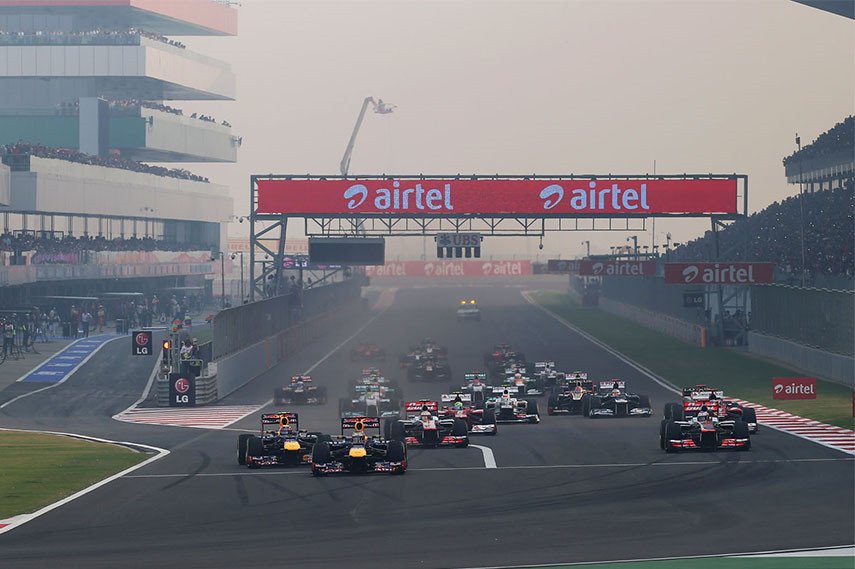
2012 Indian Grand Prix at Buddh International Circuit
Driver praise and the “roller coaster” lap
On-track feedback was overwhelmingly positive. Vettel called Buddh a big roller coaster; Lewis Hamilton said it felt closer to older legendary tracks than many contemporary Tilke venues — high-speed straights paired with challenging corner complexes rather than endless hairpins.
Jaypee Sports City and non-racing facilities
Buddh is one piece of Jaypee Green Sports City: an 18-hole golf course, hockey stadium, sports academy, Grand Plaza, and open areas for concerts and exhibitions share the masterplan. In 2011 the circuit won Motorsport Facility of the Year and twice collected the Best Promoter Trophy — recognition that the Indian Grand Prix organisation matched the hardware.
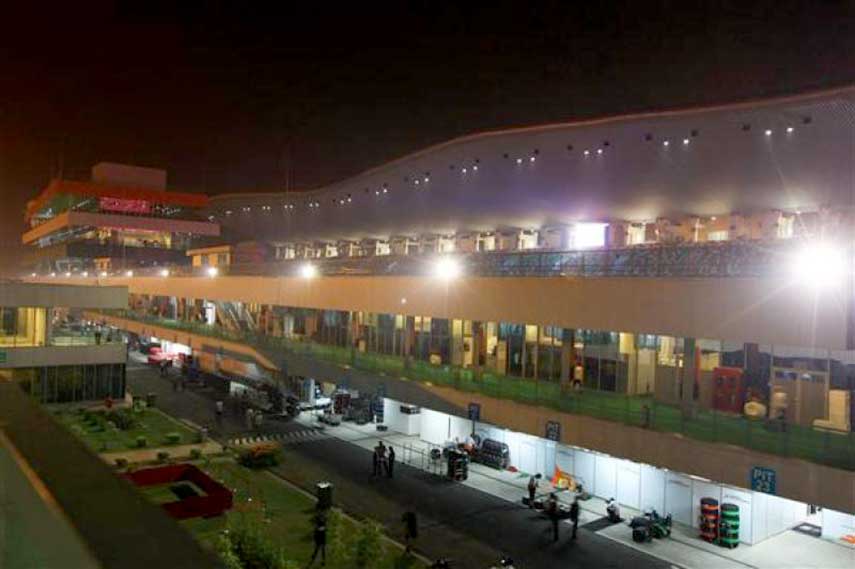
Pit lane at Buddh International Circuit
Why Formula One left and other series stalled
The future looked bright until late 2013, when the FIA dropped the Indian Grand Prix from the 2014 calendar. Tax disputes with the Uttar Pradesh government and bureaucratic complications kept the race off subsequent schedules; a mooted 2016 return never materialised.
International sportscar and bike promoters also struggled. The FIA GT1 World Series planned a 2012 season finale at Buddh but cancelled; World Superbike Championship dates fell through for similar commercial and regulatory reasons. Fees, import duties, and promoter risk still discourage some series from booking India despite the circuit’s quality.
Buddh International Circuit today
Without Formula One, Buddh relies on domestic racing, manufacturer track days, and corporate events. The layout remains homologated for top-level machinery whenever a promoter clears the logistics. Fans comparing Asian venues often pair Buddh with Sepang or Bahrain International Circuit — modern Tilke bowls that briefly hosted F1 before calendar or commercial shifts.
Frequently asked questions about Buddh International Circuit
Where is Buddh International Circuit?
Buddh International Circuit sits in Greater Noida (Gautam Buddh Nagar district), Uttar Pradesh, India — about 40 km from central Delhi on the Yamuna Expressway inside Jaypee Sports City.
When did Buddh International Circuit open?
The track opened in October 2011, only two weeks before the first Formula One Indian Grand Prix on 30 October 2011.
How long is Buddh International Circuit?
The Grand Prix layout measures 5.141 km (often quoted as 5.14 km) with 16 turns on a clockwise permanent road course.
Who designed Buddh International Circuit?
German architect Hermann Tilke designed the circuit — the same designer behind Sepang, Shanghai, and many modern F1 venues.
How many Formula One races were held at Buddh?
Three Indian Grands Prix were held from 2011 to 2013. Sebastian Vettel won all three for Red Bull Racing.
What is the lap record at Buddh International Circuit?
The F1 race lap record is 1:27.249, set by Sebastian Vettel during the 2011 Indian Grand Prix.
Why did Formula One leave India?
The 2014 Indian Grand Prix was dropped amid tax disputes with the Uttar Pradesh government and bureaucratic complications. Planned returns (including 2016) did not happen.
What is the capacity of Buddh International Circuit?
Quoted capacity is about 120,000 spectators, with original plans to expand toward 200,000.
Is Buddh International Circuit only for racing?
No. It sits inside Jaypee Sports City, which also includes golf, hockey, a sports academy, and event plazas for concerts and exhibitions.
How does Buddh compare with Sepang or Shanghai?
All three are Tilke-era Asian Grand Prix circuits. Sepang and Shanghai still host major international series; Buddh last held F1 in 2013 but retains a driver-favourite layout.
Related reading
- Sepang International Circuit — Malaysian Grand Prix venue
- Shanghai International Circuit — Chinese Grand Prix
- Yas Marina Circuit — Abu Dhabi Grand Prix
- Circuit de Spa-Francorchamps — elevation benchmark
- Sebastian Vettel — three-time Indian GP winner
Address: Jaypee Sports City, Yamuna Expressway, Sector-25, YEIDA, Gautam Buddh Nagar, Greater Noida, Uttar Pradesh 203201, India
Phone: +91 120 442 9498
Official website: buddhinternationalcircuit.in