


Zandvoort Circuit – Dutch Grand Prix Circuit Guide

Originally published May 2016. Last updated September 2026: expanded Tier B circuit guide, facts table, table of contents, internal links, FAQ schema, and editorial refresh while preserving legacy narrative and images.
Circuit Zandvoort is a 4.259-kilometre permanent road course in the sand dunes between Zandvoort and the North Sea — the Netherlands’ home of motorsport and the venue of the revived Dutch Grand Prix. Opened in 1948 on roads laid by wartime occupiers, it hosted 30 Formula One world championship races between 1952 and 1985 before financial and safety pressures shortened the track. Formula One returned in 2021 on a revised layout with banked corners that made Tarzan and the final sector famous again.
Compare Benelux neighbours at Circuit Zolder and Spa-Francorchamps, or Central European F1 venues such as Hungaroring and Red Bull Ring.
Contents
Zandvoort Circuit facts
| Location | Zandvoort, North Holland, Netherlands (North Sea dunes) |
|---|---|
| Circuit type | Permanent road course (clockwise) |
| Opened | 1948 (first Dutch Grand Prix as F1 championship round in 1952) |
| Current F1 layout | 4.259 km, 14 turns (2020 revision with banked Turns 3 and 14) |
| Previous GP layout | 4.307 km, 13 turns (1999–2019) |
| Original layout | 4.252 km, 19 turns (1948–1989) |
| Main events | Formula 1 Dutch Grand Prix; DTM; GT World Challenge Europe; historic festivals |
| Notable corners | Tarzan (Turn 1); Hugenholtzbocht; Scheivlak; Arie Luyendykbocht |
| F1 lap record (current layout) | 1:11.097 — Lewis Hamilton (Mercedes, 2021) |
| Operator | Circuit Zandvoort (formerly Circuit Park Zandvoort until 2017) |
Lap record note: Formula One, GT, and touring-car sessions use different tyres and track limits. Compare times only within the same category and configuration.

Aerial view of Circuit Zandvoort between the dunes and the North Sea
Dunes, German roads, and the 1948 opening
The Netherlands produced world-class drivers long before modern academies, but they needed a flagship track. Plans for a Zandvoort circuit existed before World War II; the first post-war race arrived in 1948 on a twisty 4.252 km course with 19 turns.
Roads built by the German army in the dunes dictated much of the original route — a reminder that the venue’s geography, not a flat airfield, always defined its character. The beach resort town of Zandvoort sits minutes from the pits, giving the circuit a holiday atmosphere on summer race weekends.
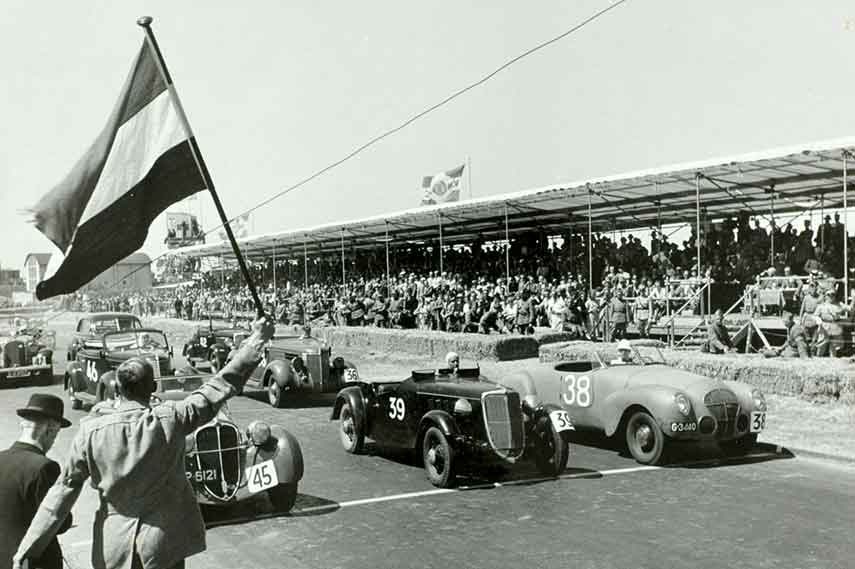
Early motorsport in the Zandvoort dunes, 1939
Formula One, speed, and safety pressure
The inaugural Formula One Dutch Grand Prix counted toward the world championship in 1952. Zandvoort became a calendar staple through 1985, interrupted only occasionally. Legends such as Jim Clark, Jackie Stewart, and Niki Lauda won in the dunes; Gilles Villeneuve thrilled crowds in cars that looked too fast for the narrow asphalt.
As cars grew quicker, safety lagged. Barriers rose in 1972 and a new pit wall followed, yet fatal accidents — including Formula 1 driver Piers Courage in 1970 — forced constant debate about whether the track could stay on the calendar.

Gilles Villeneuve at the 1981 Dutch Grand Prix at Zandvoort
Noise, politics, and the 1980s shortening
By the early 1980s Zandvoort was a municipal headache. Residents protested noise and the cost of owning the venue; after heavy demonstrations in 1982 the ruling party lost local elections. Financial losses mounted until land closest to town was sold for development, cutting the circuit back from its classic full-length form.

Pit lane at Circuit Zandvoort
Circuit Park rebuild and the Hugenholtz lap
A new operating company reopened a shortened 2.6 km course in summer 1989 while construction continued. Dutch government support helped fund a full Grand Prix loop designed with input from John Hugenholtz — the architect behind Suzuka and other classics.
The finished 4.307 km, 13-turn layout became the DTM and GT staple of the 1990s and 2000s, combining fast Scheivlak curves with tight infield sections. The venue traded the old 19-corner lap for safer run-off and modern pits while keeping the dunes as its signature.

Historic map: Zandvoort circuit layout before the 2020 F1 revisions
Formula One returns to the dunes
After decades of GT and touring-car headlines — including crowds of up to 120,000 for A1 GP and DTM — Formula One announced a return in May 2019. The COVID-19 pandemic delayed the first race until 2021, when Max Verstappen won a home Dutch Grand Prix in front of a packed, orange grandstand.
The 2020 layout revision added banking at Hugenholtzbocht and the final sector so modern ground-effect cars could race closer together. The lap now measures 4.259 km with 14 numbered turns. Read more about the event’s place on the calendar in our Dutch Grand Prix feature.

GT and national championships share the dunes with Formula One
Beyond Formula One
Zandvoort still hosts DTM, GT World Challenge Europe, Formula Regional, and national saloon series, plus cycling and athletics on non-race weekends. Track-day programmes and corporate events help fund maintenance of a circuit that remains municipally linked but commercially stronger than in the 1980s crisis years.
Getting there and contact
Amsterdam Schiphol Airport lies about 35 minutes away by road. Trains serve Zandvoort aan Zee; shuttle buses run on major race weekends. The town’s beach promenade is walking distance from the paddock.
Address: Burgemeester van Alphenstraat 108, 2041 KP Zandvoort, Netherlands
Phone: +31 23 574 0740
Website: circuitzandvoort.nl
Frequently asked questions about Zandvoort Circuit
Where is Circuit Zandvoort?
Circuit Zandvoort lies in the sand dunes beside the North Sea at Zandvoort, North Holland, in the Netherlands — about 35 minutes from Amsterdam Schiphol Airport.
How long is the Zandvoort F1 circuit?
The current Formula One layout is 4.259 km with 14 turns, run clockwise. Earlier Grand Prix configurations measured 4.307 km (1999–2019) or the original 4.252 km lap with 19 corners.
When did Zandvoort open?
The circuit opened in 1948. The first Formula One Dutch Grand Prix counted toward the world championship in 1952.
When did Formula One return to Zandvoort?
Formula One announced a comeback in 2019. The first race on the revised layout was held in 2021 after the COVID-19 pandemic delayed the 2020 schedule.
What is special about Zandvoort's corners?
The 2020 F1 revision added banking at Hugenholtzbocht (Turn 3) and the final sector so modern cars can carry more speed. Classic names such as Tarzan, Scheivlak, and Arie Luyendykbocht remain fan favourites.
How many F1 races did Zandvoort host historically?
Zandvoort hosted 30 Formula One world championship Dutch Grands Prix between 1952 and 1985 before the event left the calendar during the circuit’s financial crisis.
What is the lap record at Zandvoort in F1?
Lewis Hamilton set 1:11.097 for Mercedes during the 2021 Dutch Grand Prix on the current 4.259 km layout.
Who designed the modern Zandvoort layout?
John Hugenholtz shaped the 4.307 km Grand Prix loop that reopened in the 1990s. He also designed Suzuka and contributed to several European circuits.
What other racing happens at Zandvoort?
The venue regularly hosts DTM, GT World Challenge Europe, Formula Regional, national tin-top series, track days, and non-motorsport events such as cycling.
Why was the old Zandvoort circuit shortened?
Local protests over noise and municipal costs in the early 1980s, combined with safety concerns and financial losses, led to land sales and a shortened course. The modern circuit reopened in 1989 before growing back to Grand Prix length.
Related reading
Related Posts