Brands Hatch – British Grand Prix History and Kent Circuit Guide

Originally published August 2015. Last updated September 2026: expanded Tier B circuit guide, facts table, table of contents, internal links, FAQ schema, and editorial refresh while preserving legacy narrative and images.
Brands Hatch near West Kingsdown in Kent is one of Britain’s best-loved road courses — a natural amphitheatre that hosted fourteen Formula One world championship races and still packs the calendar with BTCC, British GT, and club events. The Grand Prix loop dips and climbs through Paddock Hill Bend and Druids; the shorter Indy circuit shares the same pit straight. Few venues combine club-racing roots, world championship history, and modern MSV operation so visibly.
The circuit matters because Jim Clark, Nigel Mansell, and Nelson Piquet all scored landmark wins here, while Jo Siffert’s 1971 fatality forced a safety overhaul that shaped British circuit design. Compare Kent with Silverstone, Goodwood, Donington Park, and Croft.
Contents
- Brands Hatch facts
- Grass-bowl origins and 1950 opening
- 1960 Grand Prix extension
- Formula One British Grand Prix 1964–1986
- 1976 Hunt–Lauda controversy
- European Grand Prix at Brands Hatch
- Mansell’s first wins and 1986 finale
- Why F1 stayed at Silverstone
- Brands Hatch 1000 km and sportscars
- WTCC, DTM, and modern headlines
- Alex Zanardi at the 2012 Paralympics
- Grand Prix and Indy layouts
- Visiting Brands Hatch
- Frequently asked questions
Brands Hatch facts
| Location | Fawkham, Longfield, Kent, England (near West Kingsdown) |
|---|---|
| Operator | MotorSport Vision (MSV) Group |
| Circuit type | Permanent road course (two layouts) |
| First car meeting | 16 April 1950 (500 Club) |
| Grand Prix circuit | 3.916 km (2.433 miles), 9 turns |
| Indy circuit | 1.945 km (1.208 miles), 5 turns (since 1978 naming) |
| Racing direction | Clockwise (since the 1950s) |
| Formula One world championship races | 14 (1964–1986) |
| Main events today | BTCC, British GT, British Superbikes, MSV track days, historic festivals |
Lap record note: F1, GT, touring cars, and motorcycles use different classes and tyre rules. Compare lap times only within the same series and layout.

Aerial view of Brands Hatch
Grass-bowl origins and 1950 opening
Cyclists and cross-country runners used the natural hollow at Brands Hatch in the 1920s; the first motorcycle race followed in 1926. After the Second World War, the 500 Club (founded 1946) persuaded managing director Joe Francis to invest in tarmac. About £17,000 extended the course from 0.75 to one mile, making Brands Hatch England’s first dedicated post-war racing circuit. The first car meeting ran on 16 April 1950.
The Half Litre Club — later the British Racing and Sports Car Club (BRSCC) — built the venue’s reputation through the 1950s. Druids Bend arrived in 1953–54, lengthening the lap to 1.24 miles, adding a pit lane and spectator banks, and reversing direction to clockwise. Formula 3 dominated early calendars before sports cars and national single-seaters expanded the programme.
1960 Grand Prix extension
Kent County Council approved a major extension in January 1960, doubling the track to about 2.65 miles with separate long and short loops. The new layout debuted in August with Formula One practice entries from BRM, Cooper, Ferrari, and Lotus.
Jack Brabham won the Silver City Trophy in a works Cooper-Climax, 4.4 seconds ahead of Graham Hill in the BRM P48, after Jim Clark’s Lotus retired from the lead.

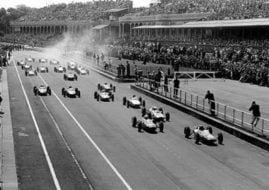
First Formula One British Grand Prix at Brands Hatch, 1964
Fourteen Formula One British Grands Prix
Brands Hatch hosted 14 Formula One world championship races between 1964 and 1986. From 1964 to 1982 the British Grand Prix alternated with Silverstone every two years; five consecutive British GPs were held here from 1982 to 1986 before Silverstone signed a long-term deal.
Clark won the inaugural championship British Grand Prix on 11 July 1964 in the Lotus 25, 2.8 seconds clear of Hill’s BRM and John Surtees’ Ferrari. The non-championship Race of Champions also became a Brands Hatch tradition — Clark won the 1965 event across two 40-lap heats while team-mate Mike Spence took the aggregate.
Jack Brabham and Denny Hulme finished one-two in the 1966 British Grand Prix, the first year of 3-litre rules. Jo Siffert won in 1968; Jochen Rindt took 1970 after a protest over his Lotus aerofoil was overturned. Emerson Fittipaldi won in 1972; Jody Scheckter triumphed in 1974.

Grand Prix and Indy layouts share the Brands Hatch pit straight
Jo Siffert’s 1971 fatality
Fatalities in the 1960s included George Crossman, Tony Flory, and Stuart Duncan. In October 1971 Siffert died in the Rothmans World Championship Victory Race when his BRM P160 hit the bank at Hawthorn Hill and caught fire. A three-year safety programme followed.

Brands Hatch has welcomed racers since 1950
1976 Hunt–Lauda controversy
The 1976 British Grand Prix stopped on lap one after James Hunt’s accident. Hunt restarted in a spare car, won, and was disqualified for not completing the first lap — then reinstated on appeal. Niki Lauda was credited with the victory after the FIA ruling. Carlos Reutemann won for Ferrari in 1978; that year the shorter loop was renamed the Indy Circuit after IndyCar demonstration runs.
European Grand Prix at Brands Hatch
Alan Jones won the 1980 British Grand Prix en route to the drivers’ title with Williams. Lauda scored again in 1982 with McLaren. When the New York street race was cancelled in 1983, FISA added the European Grand Prix at Brands Hatch; Nelson Piquet won for Brabham. Lauda took a third British GP win in 1984 ahead of Derek Warwick and Ayrton Senna.

Nigel Mansell at the 1985 European Grand Prix at Brands Hatch
Mansell’s maiden win and 1986 finale
Cancelled New York plans returned in 1985, so Brands Hatch hosted another European Grand Prix. Nigel Mansell scored his first Formula One victory for Williams-Honda.
On 13 July 1986 Brands Hatch held its last world championship Formula One race. A first-lap pile-up at Paddock Bend seriously injured Jacques Laffite. Mansell used a spare Williams after his race car stopped; he beat Piquet after the restart with Alain Prost third.
Why Formula One left for Silverstone
From 1987 the British Grand Prix has stayed at Silverstone. FISA favoured long-term circuit contracts; Silverstone and the BRDC offered expansion room Brands Hatch lacked. MSV still runs one of Europe’s busiest national calendars without F1.

Brands Hatch pit lane on a modern race weekend
World Sportscars, F3000, BPR Global GT, A1 Grand Prix, World Touring Car Championship, DTM, and NASCAR Whelen Euro have all visited. Today British Superbikes, BTCC, British GT, truck racing, and Blancpain-style GT events anchor the schedule alongside MSV track days.
Brands Hatch 1000 km and sportscars
From 1966 to 1989 Brands Hatch staged endurance races from the BOAC 500 through six-hour and 1000-km formats. David Piper and Bob Bondurant won the 1966 BOAC 500 in an AC Cobra.

Jacky Ickx and Brian Redman won the 1968 BOAC 500 with a Ford GT40
Jacky Ickx holds the record with four Brands endurance wins — with Brian Redman (GT40, 1968), Mario Andretti (Ferrari 312PB, 1972), and twice with Porsche alongside Jochen Mass (1977) and Derek Bell (1982). The 1989 World Sportscar round was shortened to 480 km; a 1996 BPR Four Hours win went to Hans-Joachim Stuck and Thierry Boutsen in a Porsche 911 GT1.
WTCC and DTM visits
The World Touring Car Championship first raced at Brands Hatch in May 2006 (Yvan Muller and Alain Menu won). Menu became the venue’s most successful WTCC driver before the series left in 2010. DTM also debuted in 2006; Mattias Ekström won the first race. DTM stayed until 2013 with winners including Bernd Schneider, Gary Paffett, and Paul di Resta.
The BTCC — founded in 1958 as the British Saloon Car Championship — has opened countless seasons at Brands Hatch and still treats the Indy loop as a championship staple.
Alex Zanardi at the 2012 Paralympics
Brands Hatch hosted Paralympic road cycling in September 2012, combining the circuit with local roads. Former F1 driver Alex Zanardi, who lost both legs in a 2001 racing accident, won two gold medals in the men’s H4 time trial and road race on the same tarmac where he had raced Formula 3000 in 1991 and WTCC in 2008.

Alex Zanardi at Brands Hatch during the 2012 Paralympic road cycling events

Map: Brands Hatch Grand Prix and Indy layouts
Grand Prix and Indy layouts
Cambers, elevation, and fast corners such as Paddock Hill Bend explain why drivers still rank Brands Hatch among the world’s favourite laps. The Grand Prix circuit measures 2.433 miles (3.916 km) with nine turns; the Indy circuit is 1.208 miles (1.945 km) with five turns.
MSV also operates Oulton Park, Snetterton, Cadwell Park, and Bedford Autodrome, running championships for professionals and amateur track-day drivers.
Visiting Brands Hatch
Major BTCC, BSB, and GT weekends sell through MSV ticketing. The circuit lies close to the M20/M25 with parking on event days; check brands hatch.co.uk for calendars, hospitality, and driving experiences.
Frequently asked questions about Brands Hatch
Where is Brands Hatch?
Brands Hatch is near West Kingsdown in Kent, England, at Fawkham, Longfield (postcode DA3 8NG). It sits south-east of London with access from the M20 and M25 motorways.
How many Formula One races did Brands Hatch host?
Brands Hatch hosted 14 Formula One world championship races between 1964 and 1986, including British Grands Prix and European Grands Prix when calendar slots moved from cancelled New York events.
What are the two layouts at Brands Hatch?
The Grand Prix circuit is 3.916 km (2.433 miles) with nine turns. The shorter Indy circuit is 1.945 km (1.208 miles) with five turns; it was named after IndyCar demonstration races in 1978.
When did Brands Hatch open for car racing?
The first dedicated car race meeting was held on 16 April 1950, promoted by the 500 Club after tarmac was laid on a former grass-bowl motorcycle course used since the 1920s.
Who won the first Formula One British Grand Prix at Brands Hatch?
Jim Clark won the inaugural championship British Grand Prix at Brands Hatch on 11 July 1964 in the Lotus 25, ahead of Graham Hill and John Surtees.
Why did Formula One leave Brands Hatch after 1986?
FISA pursued long-term circuit contracts. Silverstone and the BRDC offered more expansion potential; from 1987 the British Grand Prix has remained at Silverstone.
What happened at the 1976 British Grand Prix at Brands Hatch?
The race was red-flagged after a first-lap incident involving James Hunt. Hunt restarted in a spare car, won, was disqualified, then reinstated on appeal; Niki Lauda was eventually credited with the victory.
When did Nigel Mansell win his first Formula One race?
Nigel Mansell took his maiden F1 victory at the 1985 European Grand Prix at Brands Hatch, driving Williams-Honda. He also won the final F1 world championship race at the circuit in 1986.
Who owns Brands Hatch today?
MotorSport Vision (MSV) operates Brands Hatch alongside Oulton Park, Snetterton, Cadwell Park, and Bedford Autodrome, promoting national championships and public track days.
What major non-car event used Brands Hatch?
The 2012 Summer Paralympics road cycling programme used Brands Hatch as its base, with start and finish on the circuit. Alex Zanardi won two gold medals in H4 events on the track where he had previously raced single-seaters and touring cars.
Related reading
- Silverstone Circuit — British Grand Prix home since 1987
- Goodwood Circuit — Revival and Festival of Speed
- Donington Park — East Midlands history
- Croft Circuit — North East club racing
- Knockhill Racing Circuit — Scotland’s national track
Address: Fawkham, Longfield DA3 8NG, United Kingdom
Phone: +44 1474 872331
Official website: brandshatch.co.uk