


Circuito del Jarama – Spanish Grand Prix Circuit Guide

Originally published April 2017. Last updated September 2026: added labelled current-layout circuit map (Wikimedia Commons, with attribution in caption)
Circuito del Jarama (Circuito Permanente del Jarama) is a permanent road course in San Sebastián de los Reyes, north of Madrid, and the oldest operating race track in Spain. Opened in 1967, it hosted the Spanish Grand Prix eleven times through 1981 and remains a national motorsport venue best known today for club racing, driving schools, and the FIA European Truck Racing Championship.
Jarama matters because it bridges Spain’s pre-war street-racing past and the modern calendar centred on Barcelona-Catalunya. Dutch designer John Hugenholtz drew a tight, twisty 3.4 km layout on limited land — the same engineer behind Suzuka and Zolder. Formula One left when safety standards outgrew narrow runoff; the story since then is extension, national championships, and repeated plans to modernise the facility.
The circuit is not a power track. Overtaking was always hard, which made the 1981 Spanish Grand Prix — Gilles Villeneuve holding off four rivals within 1.24 seconds — one of the most famous processions in F1 history.
Contents
Circuito del Jarama facts
| Location | San Sebastián de los Reyes, Community of Madrid, Spain (about 20 km north of central Madrid) |
|---|---|
| Circuit type | Permanent road course |
| Opened | 2 July 1967 (official); first race on unfinished course December 1966 |
| Designer | John Hugenholtz (Royal Automobile Club of Spain / RACE commission) |
| Layout length | 3.850 km (current configuration since 1990); 3.404 km original; 3.314 km for final F1 races (1981) |
| Turns | 13 (original); current count varies slightly by series |
| Main events (historic) | Spanish Grand Prix (F1, 1968–1981); Motorcycle Grand Prix; World Sportscar Championship; WTCC |
| Main events (today) | Spanish national car and bike championships; FIA European Truck Racing Championship; track days and schools |
| Named corners (historic) | Nuvolari, Fangio, Varzi, Ascari, Bugatti, Monza, Portago, and others |
Lap record note: the official Formula One race lap record on the 1981 configuration is 1:16.44, set by Gilles Villeneuve during the 1979 Spanish Grand Prix. Modern categories use different car rules — compare times only within the same series and layout.
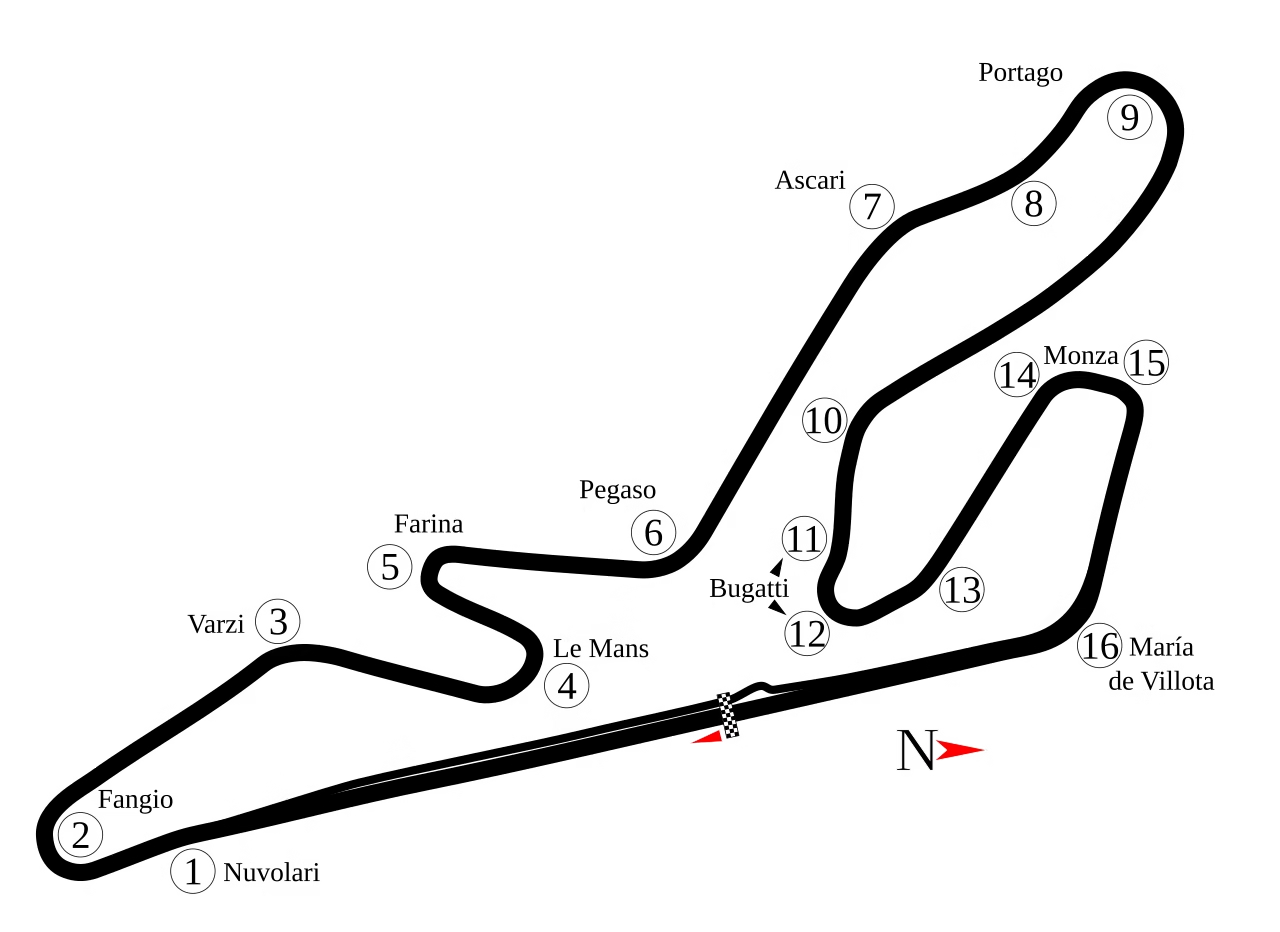
Circuito del Jarama — current permanent layout (3.85 km) — Map: Will Pittenger / public domain via Wikimedia Commons

Historic layout: Circuito Permanente del Jarama as used for early Spanish Grands Prix
RACE, Hugenholtz, and construction
Spain had rich motorsport history but no permanent circuit after Pedralbes closed following the 1955 Le Mans disaster. By the mid-1960s the Royal Automobile Club of Spain (RACE) chose land at San Sebastián de los Reyes and hired Hugenholtz to design a compact course on a tight budget and footprint.
Construction began in 1966 under Alessandro Rocci. Drivers could not wait for the ribbon cutting: an unofficial race ran on the unfinished track on 18 December 1966. The circuit officially opened on 2 July 1967 as the Circuito Permanente del Jarama, with thirteen corners named for racing legends.

Circuito Permanente del Jarama in its early years
Formula One at Jarama (1967–1981)
Jim Clark won the first Formula 2 race at Jarama in August 1967, then took a non-championship Spanish Grand Prix victory in November — beating Graham Hill and Jack Brabham.
Jarama joined the world championship in 1968. Clark had died at Hockenheim that April; Hill won for Lotus in a field still mourning the Scot. Through the 1970s Jarama alternated with Barcelona’s Montjuïc street circuit until Montjuïc was deemed unsafe after 1975; Spain’s Grand Prix then stayed at Jarama until 1981.
Highlights include Niki Lauda‘s maiden F1 win in 1974, Mario Andretti becoming the only double winner (1977–1978), and Jacques Laffite setting blistering qualifying times without ever winning the race.

Formula One cars raced at Jarama eleven times
Villeneuve’s last Spanish Grand Prix
The 1981 race became legend. Villeneuve’s Ferrari 126CK was fast on Jarama’s short straights but vulnerable in the corners. Four rivals — Jacques Laffite, John Watson, Carlos Reutemann, and Elio de Angelis — queued behind him for much of the distance, unable to pass on the narrow track. Villeneuve won with the top five covered by 1.24 seconds.

1981 Spanish Grand Prix — Villeneuve’s tactical win in Formula One’s last visit to Jarama
For 1981 the Bugatti esses were revised and the course shortened slightly to 3.314 km with extra runoff. It was not enough. Formula One left Spain after 1981; the next championship Spanish Grand Prix was at Jerez in 1986.
After Formula One left
MotoGP visited through 1988. Sportscars, Formula 3000, WTCC, and the World Sportscar Championship appeared in the 1980s — including a WTCC win for Roberto Ravaglia and Emanuele Pirro in 1987 and a WSC victory for Jean-Louis Schlesser and Jochen Mass in 1989.

The main straight at Circuito del Jarama
1990 extension and modern layout
RACE lengthened the main straight and added a new link between the Ascari and Portago corners in 1990, taking the lap to 3.850 km with extended pits and garages. World Superbike visited in 1991–1992; international car traffic thinned as Catalunya became Spain’s primary F1 home.
Occasional international sportscar and Renault World Series events appeared around 2000–2006, but the calendar is now dominated by national series, schools, and corporate track days.

FIA European Truck Racing Championship at Jarama
Jarama today
The Proyecto Jarama 2021 investment programme announced new grandstands, pit buildings, control tower, and track revisions. Check the official site for current construction status before planning a visit — projects of this scale can shift dates.
Compared with Ardennes classics such as Spa-Francorchamps, Jarama is shorter, flatter, and built for national competition rather than world-championship downforce wars. Its place in history rests on the Spanish Grand Prix years and on one Sunday when Villeneuve proved that defending can be as spectacular as attacking.
Visiting Circuito del Jarama
Public track days, driving experiences, and national race meetings still use the circuit. Truck racing weekends draw the largest modern international crowds. Combine a visit with Madrid sightseeing — the track sits just off the A-1 motorway.
Frequently asked questions about Circuito del Jarama
Where is Circuito del Jarama?
Circuito del Jarama is in San Sebastián de los Reyes, north of Madrid, Spain, just off the A-1 motorway at kilometre 28. The venue is also called Circuito Permanente del Jarama.
How long is the Jarama circuit?
The current permanent layout measures 3.850 km, after the 1990 extension. Formula One used shorter configurations — 3.404 km originally and 3.314 km for the final 1981 Spanish Grand Prix.
When did Formula One last race at Jarama?
Formula One held its last Spanish Grand Prix at Jarama on 21 June 1981. Gilles Villeneuve won in a famous tactical drive; the world championship returned to Spain at Jerez in 1986.
Who designed Circuito del Jarama?
Dutch engineer John Hugenholtz designed the track for the Royal Automobile Club of Spain (RACE). He also designed Suzuka and Zolder among other circuits.
Who won the first Spanish Grand Prix at Jarama?
Jim Clark won the non-championship Spanish Grand Prix in November 1967. The first world championship race at Jarama was won by Graham Hill for Lotus in 1968 after Clark's death earlier that season.
Why did Formula One leave Jarama?
Jarama was considered too narrow and too short for growing downforce cars, with insufficient runoff for early-1980s safety standards. Spain moved its Grand Prix to Jerez and later to Barcelona-Catalunya.
What races are held at Jarama today?
Most events are Spanish national car and motorcycle championships, driving schools, and corporate track days. The main international fixture is the FIA European Truck Racing Championship Grand Prix of Spain.
What is Jarama's most famous Formula One moment?
The 1981 Spanish Grand Prix, when Gilles Villeneuve held off four faster cars within 1.24 seconds on a track where overtaking was almost impossible — one of the most celebrated defensive drives in F1 history.
Related reading
- Spa-Francorchamps — Ardennes speed and elevation
- Circuit de Barcelona-Catalunya
- Jerez Circuit — Spain’s motorcycle capital
- Nürburgring Nordschleife
- Darlington Raceway — another track defined by narrow grooves and tyre wear
Address: Circuito del Jarama, Autovía A1, Km 28, 28700 San Sebastián de los Reyes, Madrid, Spain
Phone: +34 91 657 08 75
Official website: jarama.org
