

Darlington Raceway – NASCAR Oval and Southern 500 Guide
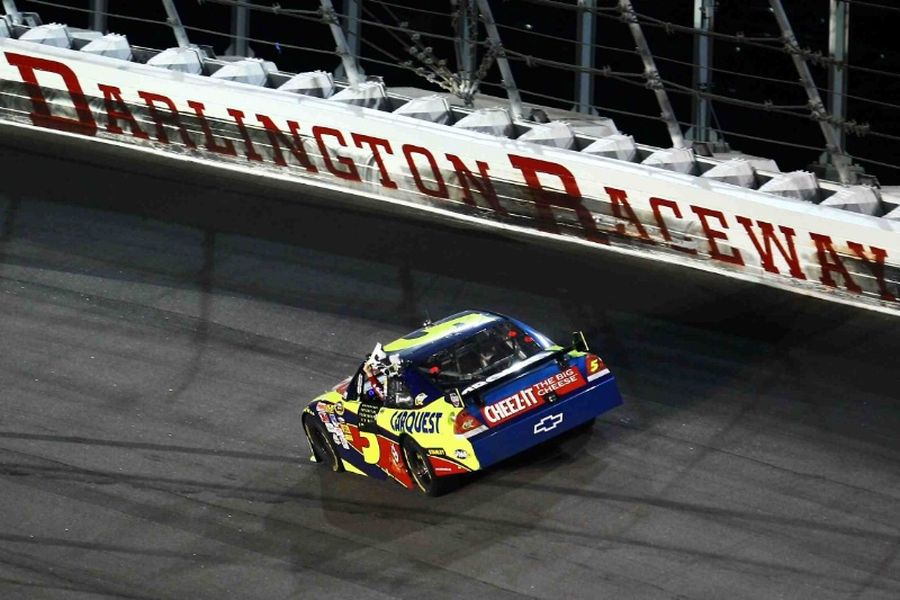
Originally published September 2016. Last updated September 2026: expanded Tier B circuit guide, facts table, table of contents, internal links, FAQ schema, and editorial refresh while preserving legacy images and story.
Darlington Raceway is a 1.366-mile paved oval in Darlington, South Carolina, and one of the oldest superspeedways on the NASCAR Cup Series calendar. Opened in 1950, it hosted the inaugural Southern 500 before Daytona International Speedway existed and still carries the marketing line “a NASCAR Tradition.” Fans know it as the Lady in Black or the Track Too Tough to Tame — nicknames earned by worn white walls and an egg-shaped layout that punishes the smallest mistake.
The track matters because it predates almost every other venue in modern NASCAR. Harold Brasington built it to bring Indianapolis 500-scale spectacle to the Carolinas. Bill France Sr. put the Southern 500 on the first Grand National schedule. Seventy-five years later, the Labor Day weekend race remains one of the sport’s Crown Jewels.
Darlington is not wide or forgiving. Its corners do not mirror each other, tyre wear is brutal, and the racing groove is narrow. That combination produces the black stripes on the doors — Darlington stripes — that define stock car folklore.
Contents
- Darlington Raceway circuit facts
- Harold Brasington and the fish pond
- The inaugural Southern 500
- Layout changes and night racing
- Lady in Black and Too Tough to Tame
- NASCAR calendar at Darlington
- Records and Darlington legends
- Safety, wrecks, and the Stock Car Museum
- Visiting Darlington Raceway
- Frequently asked questions
Darlington Raceway circuit facts
| Location | Darlington, South Carolina, United States |
|---|---|
| Circuit type | Paved superspeedway oval (asymmetric) |
| Opened | 1950 (first race: Southern 500, 4 September 1950) |
| Layout length | 1.366 miles (2.198 km) since 1953 |
| Original length | 1.250 miles (1950-1952 configuration) |
| Turn banking | Turns 1-2: 23 degrees; turns 3-4: 25 degrees (historic figures; verify for current NASCAR setup) |
| Main events | NASCAR Cup Series Southern 500; NASCAR Xfinity Series; occasional other national series |
| Seating capacity | Approximately 65,000 (expanded during 2000s upgrades) |
| Nicknames | Lady in Black; Track Too Tough to Tame |
| Founder | Harold Brasington |
Lap record note: NASCAR publishes separate records for qualifying and race distance. A widely quoted modern benchmark is 26.705 seconds (184.145 mph), set by Aric Almirola in Richard Petty’s #43 car during 2014 time trials. Compare lap times only within the same session type, car rules package, and year.
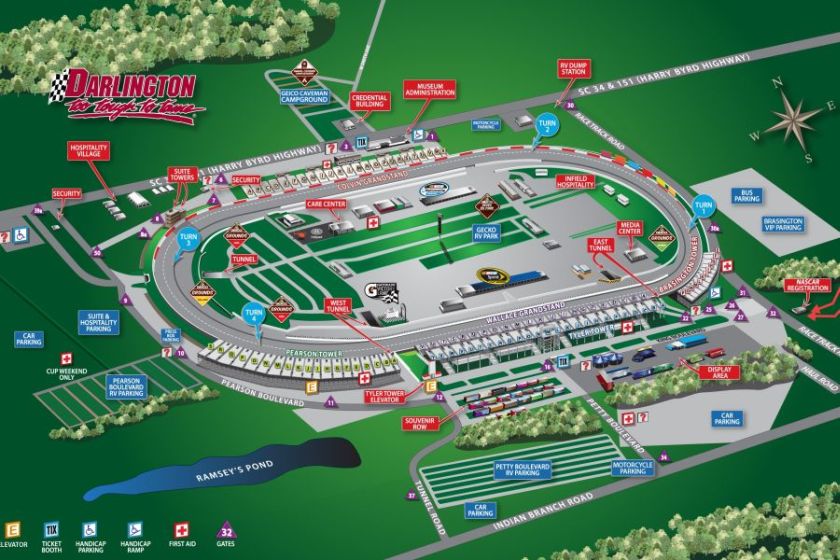
Map: Darlington Raceway track layout
Harold Brasington and the fish pond
The story begins with retired racer Harold Brasington, who left competition in the late 1940s to concentrate on farming and construction. A trip to the Indianapolis 500 convinced him that South Carolina could support a similar spectacle — a paved oval big enough for the new stock car series forming under Bill France Sr.
Brasington bought land from farmer Sherman Ramsey on the edge of Darlington but promised Ramsey that a fish pond on the west side of the property would remain untouched. To keep that promise, Brasington drew an egg-shaped oval instead of a symmetrical bowl. Turns 1 and 2 became tighter than turns 3 and 4, giving the track a personality that symmetrical ovals never acquired.
Construction took nearly a year. When the surface was ready, France agreed to place Darlington on the inaugural Grand National Series calendar. The gamble was enormous for a rural town; the payoff was a race that still defines NASCAR heritage.

Harold Brasington — the father of Darlington Raceway
The inaugural Southern 500
The first Southern 500 ran on 4 September 1950. Qualifying followed a two-week scheme modelled on Indianapolis: eighty drivers attempted to qualify and seventy-five filled a grid of twenty-five rows of three cars.
About 25,000 spectators watched Johnny Mantz win the 400-lap, 500-mile race from the last starting position. Mantz ran durable truck tyres and never pitted for rubber while rivals shredded tyres on the abrasive surface. The race lasted more than six hours and immediately established Darlington as a marathon, not a sprint.
Until Daytona International Speedway opened and the first Daytona 500 was held in 1959, the Southern 500 was the biggest event on the NASCAR calendar. It remains the oldest superspeedway race on paved oval and anchors the sport’s Crown Jewel list alongside Daytona, Talladega, and Charlotte.
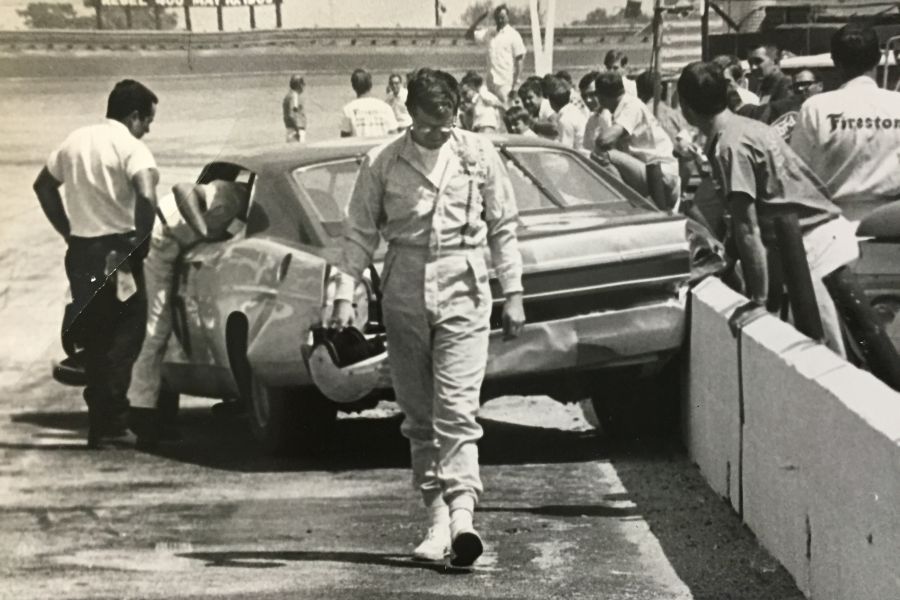
Hundreds of drivers have met the walls at Darlington Raceway
Layout changes and night racing
In 1953 turns 3 and 4 were revised and the track was lengthened to its present 1.366 miles. The asymmetry remained the defining trait: drivers cannot settle into a rhythm the way they might at a symmetrical mile-and-a-half track.
A major orientation change arrived in 1997 when the front stretch became the back stretch and corner numbering was reversed. The wider former turns 3 and 4 became the new turns 1 and 2 that drivers see on television today. The change confused fans briefly but did not soften the challenge.
Lights installed in 2003 allowed night racing, adding glare and shadow to an already demanding surface. Seating grew to roughly 65,000 places during successive grandstand projects. A $10 million upgrade in 2007 modernised facilities while keeping the narrow racing character intact.
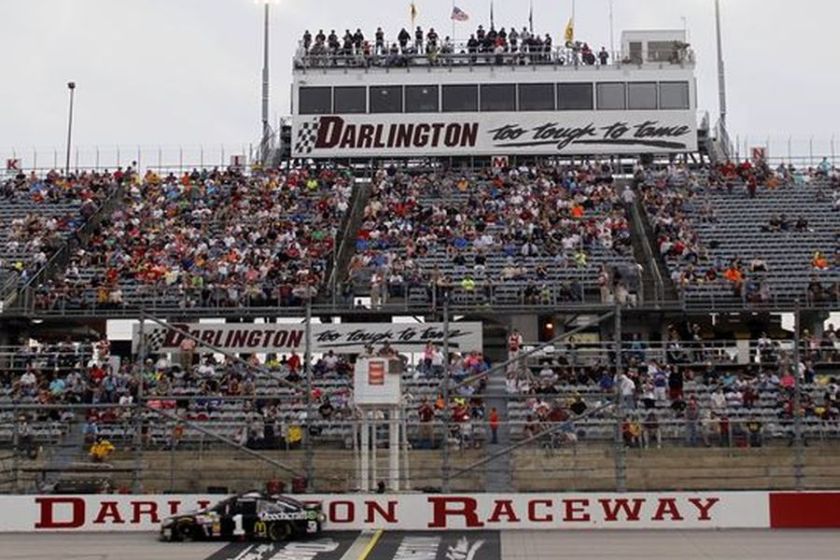
Darlington’s grandstands during a NASCAR race weekend
Lady in Black and Too Tough to Tame
The Lady in Black refers to the walls. Officials paint them white before the race; by the finish they are streaked black with rubber and paint transferred from passing cars. The image fits a track that feels alive and unforgiving.
The Track Too Tough to Tame is literal. The egg shape means entry and exit speeds differ corner to corner. Drivers who hug one line perfectly may be wrong on the next lap as tyres fade. Many champions have left with a stripe of wall paint on the doors — the famous Darlington stripe — and a story about misjudging the groove by inches.
Unlike wide repaved ovals where multiple grooves produce side-by-side racing, Darlington often rewards patience and tyre management. That is why veteran skill still matters here when newer venues favour aerodynamic packs.
NASCAR calendar at Darlington
From 1957 Darlington hosted two Cup Series races each year: a spring event and the Southern 500 on Labour Day weekend. Schedule politics reshuffled that tradition. The Southern 500 moved to November in 2004, NASCAR cut Darlington to a single Cup date in 2005, and the race shifted to May for several seasons.
In 2015 the Southern 500 returned to Labour Day weekend, restoring the historical slot fans associate with the end of summer and the chase for playoff points. Confirm the current year’s NASCAR schedule before booking travel because date realignments remain possible when the broader calendar changes.
The NASCAR Xfinity Series (formerly Busch and Nationwide) has been a regular visitor since the 1982 TranSouth 200. Support races on Southern 500 weekend give younger drivers their first taste of a surface that punishes rookies.
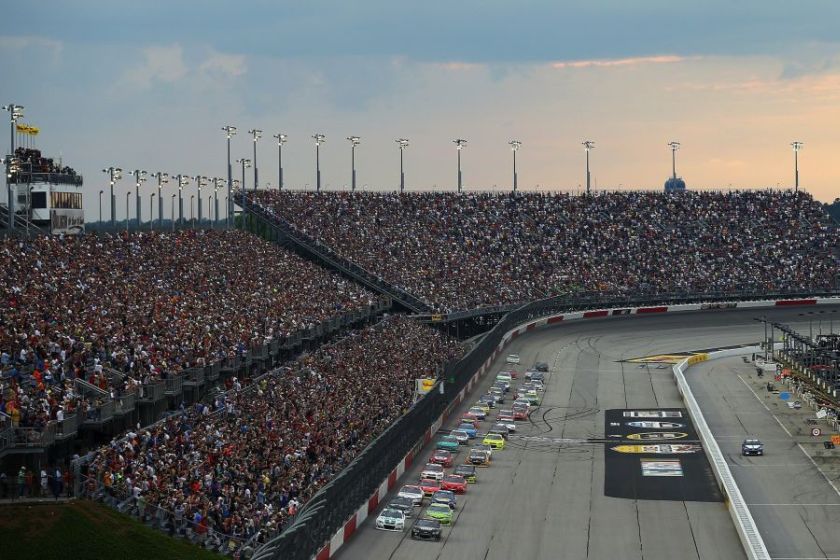
Start of a NASCAR Cup Series race at Darlington in 2013
Records and Darlington legends
David Pearson owns the Cup Series win record at Darlington with ten victories and twelve pole positions. Dale Earnhardt won nine times, Jeff Gordon seven, and Cale Yarborough, Bobby Allison, Bill Elliott, and Darrell Waltrip each reached five.
Richard Petty started more Darlington races than anyone else — 65 appearances — with two Rebel 400 wins and a single Southern 500 victory in 1967. In the Xfinity Series, Denny Hamlin has four wins at the track.
The combination of Pearson, Earnhardt, and Gordon defines how fans remember Darlington: three drivers with contrasting styles who all mastered the same unforgiving pavement.
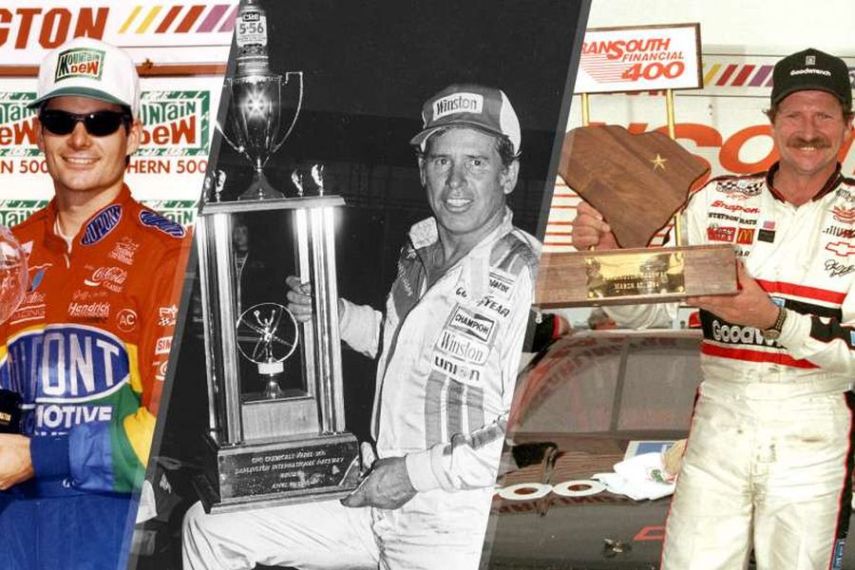
Darlington legends: Jeff Gordon, David Pearson, and Dale Earnhardt
Safety, wrecks, and the Stock Car Museum
Darlington’s narrow walls have produced countless hard impacts — part of the track’s reputation — but only one fatality occurred in competition. In 1960 Bobby Johns crashed into the pit wall, killing a car owner, a mechanic, a NASCAR official, and injuring several others. The broken wall accelerated safety improvements for pit road and barrier design. No further fatal accidents have occurred in NASCAR competition at Darlington since that day.
As one of NASCAR’s oldest venues, Darlington is a natural home for the Stock Car Museum. NASCAR champion Joe Weatherly conceived the project before his death in 1964; the Joe Weatherly Stock Car Museum opened in 1965 and expanded in 2003. Exhibits include the 1950 Plymouth Johnny Mantz drove in the first Southern 500, memorabilia from decades of racing, and the National Motorsports Press Association Hall of Fame.

Darlington Raceway Stock Car Museum
Visiting Darlington Raceway
The museum and track tours attract visitors year-round, while Southern 500 weekend remains the peak experience. Accommodation in Florence, Sumter, and the Myrtle Beach corridor fills quickly when NASCAR returns to Labour Day weekend.
Arrive early on race day: US 52 and local roads bottleneck when tens of thousands of fans descend on a town of roughly 6,000 residents. Parking and gate policies change by event; use the official site rather than third-party resellers for tickets.
Combine a museum visit with a walk along the grandstands to see how close the walls sit to the racing line. That perspective explains the nicknames better than any statistic.
Fast facts about Darlington Raceway
- Harold Brasington opened the track in 1950 after promising to preserve a fish pond on the property.
- The inaugural Southern 500 paid Johnny Mantz for a last-to-first win on truck tyres.
- The oval measures 1.366 miles with unequal corner radii.
- Turn numbering was reversed in 1997 when the front stretch became the back stretch.
- Lights arrived in 2003; capacity grew to about 65,000 seats.
- David Pearson’s ten Cup wins remain the track record.
- Richard Petty made 65 Cup starts at Darlington.
- The Southern 500 returned to Labour Day weekend in 2015.
- Only one fatal accident has occurred in NASCAR competition at the track (1960).
- The Stock Car Museum has operated on site since 1965.
Frequently asked questions about Darlington Raceway
Where is Darlington Raceway?
Darlington Raceway is in Darlington, South Carolina, United States, on the Harry Byrd Highway (US Route 52) about 65 miles north-west of Charleston. The mailing address is 1301 Harry Byrd Highway, Darlington, SC 29532.
Why is Darlington called the Track Too Tough to Tame?
The nickname reflects how difficult the egg-shaped oval is to drive consistently. Uneven corner radii and narrow racing grooves punish small mistakes; generations of drivers have left Darlington stripes on the walls from scraping the paint.
What is the Lady in Black?
The Lady in Black is another nickname for Darlington Raceway. The track's walls are painted white before the race; by the end of the event they are often stained black from tyre rubber and contact, as if the circuit were wearing a dark dress.
How long is Darlington Raceway?
The current NASCAR oval measures 1.366 miles (about 2.198 km). The original 1950 layout was 1.250 miles before turns 3 and 4 were adjusted in 1953.
What is the Southern 500?
The Southern 500 is NASCAR's oldest superspeedway race on a paved oval, first held at Darlington on 4 September 1950. It is one of the series' traditional Crown Jewel events alongside Daytona, Talladega and Charlotte.
Who won the first Southern 500?
Johnny Mantz won the inaugural 500-mile race in 1950 after starting last on the grid. He used durable truck tyres and completed the 400 laps without a tyre change while many rivals struggled with wear on the abrasive surface.
Who has the most NASCAR Cup Series wins at Darlington?
David Pearson holds the Cup Series record with 10 victories at Darlington. Dale Earnhardt won nine times and Jeff Gordon seven.
Is Darlington Raceway an oval?
Yes. Darlington is a paved superspeedway oval, but it is deliberately asymmetric: turns 1 and 2 are tighter than turns 3 and 4 because the land was shaped around a farmer's fish pond when Harold Brasington laid out the track in 1949-50.
Can you visit Darlington Raceway?
Yes. The Darlington Raceway Stock Car Museum (with the National Motorsports Press Association Hall of Fame) is on site, and NASCAR race weekends still fill the grandstands. Check darlingtonraceway.com for museum hours and ticket information for the current season.
Darlington remains NASCAR’s toughest tradition
Modern NASCAR visits faster ovals and road courses, but Darlington still separates drivers who respect history from those who treat every track as interchangeable pavement. The Lady in Black does not forgive a lazy line, and the Southern 500 still feels like a championship test even in the playoff era.
For fans of American stock car racing, Darlington is the bridge between the sport’s dirt-track roots and the superspeedway age. The walls are closer, the tyres wear faster, and the stories last longer.
Related reading
- Daytona International Speedway — temple of endurance and the Daytona 500
- Bristol Motor Speedway — Theatre of Speed NASCAR Guide
- Talladega Superspeedway
- Charlotte Motor Speedway
Address: Darlington Raceway, 1301 Harry Byrd Highway, Darlington, SC 29532, USA
Phone: +1 843 395 8900
Official website: darlingtonraceway.com