

WeatherTech Raceway Laguna Seca – Corkscrew and Monterey Guide

Originally published September 2016. Last updated September 2026: added labelled current-layout circuit map (Wikimedia Commons, with attribution in caption)
WeatherTech Raceway Laguna Seca near Monterey, California, is a 3.602-kilometre road course famous for the Corkscrew — a blind, plunging left-right that drops 18 metres in a handful of car lengths. Opened in 1957 on drained lake bed beside the former Fort Ord army base, the track replaced outlawed racing on Pebble Beach public roads and became a cornerstone of American sports-car, motorcycle, and Indy car history.
Laguna Seca matters because it compresses elevation, spectator access, and manufacturer heritage into one compact lap. IMSA’s Monterey round, the Superbike World Championship, the Monterey Motorsports Reunion during Car Week, and countless manufacturer test days all treat the Californian circuit as a reference point for US road racing.
Compare West Coast road courses with Sonoma Raceway, Road Atlanta, and Watkins Glen International.
Contents
- Laguna Seca Raceway facts
- Opened in 1957 on a dry lake
- The Corkscrew and elevation
- Sports cars, IMSA, and prototypes
- Indy car and open-wheel history
- MotoGP and World Superbike
- 1988 layout extension
- Lap records and Zanardi’s pass
- Monterey Motorsports Reunion
- Visiting Laguna Seca
- Frequently asked questions
Laguna Seca Raceway facts
| Location | Salinas / Monterey, California, United States (Monterey-Salinas Highway) |
|---|---|
| Current name | WeatherTech Raceway Laguna Seca (previously Mazda Raceway Laguna Seca) |
| Circuit type | Permanent road course |
| Opened | 9 November 1957 (first SCCA National Sports Car Championship race) |
| Length | 2.238 miles (3.602 km) current full course |
| Turns | 11 |
| Elevation change | About 180 ft (55 m) lap to lap; Corkscrew drop about 59 ft (18 m) |
| Direction | Clockwise |
| Main events | IMSA WeatherTech SportsCar Championship; MotoGP (1988–2013); World Superbike; Monterey Motorsports Reunion; Ferrari Racing Days and manufacturer events |
| Named features | Corkscrew (Turns 8–8A); Andretti Hairpin (Turn 2); Rahal Straight; Rainey Curve (Turn 9) |
| Official Indy car qualifying record | 1:07.722 — Helio Castroneves (CART, 2000) |
Lap record note: IMSA, superbike, historic, and demonstration runs use different tyres and session types. Compare times only within the same category and year.
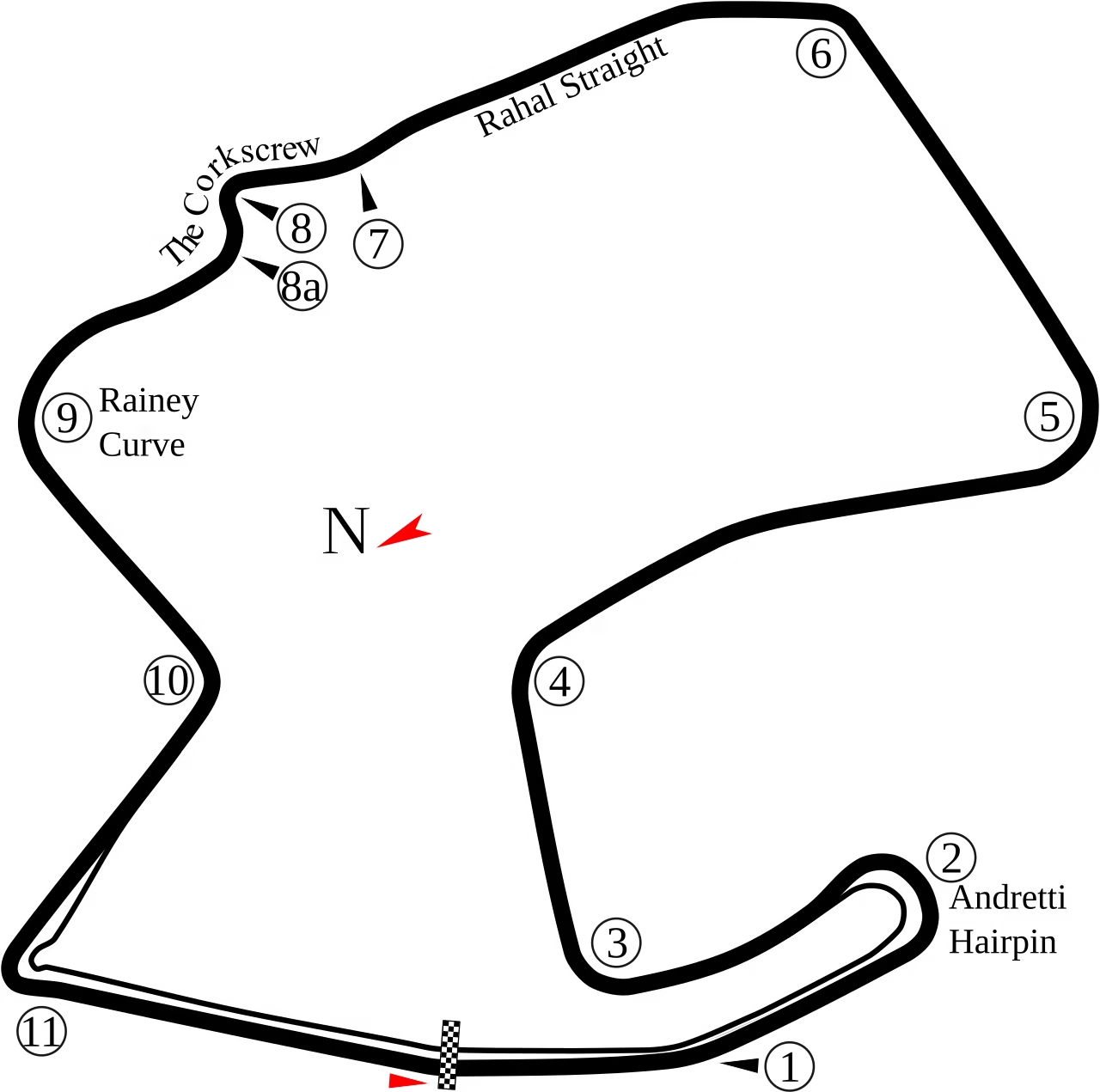
Laguna Seca — full road course layout (3.602 km) — Map: Wikimedia Commons
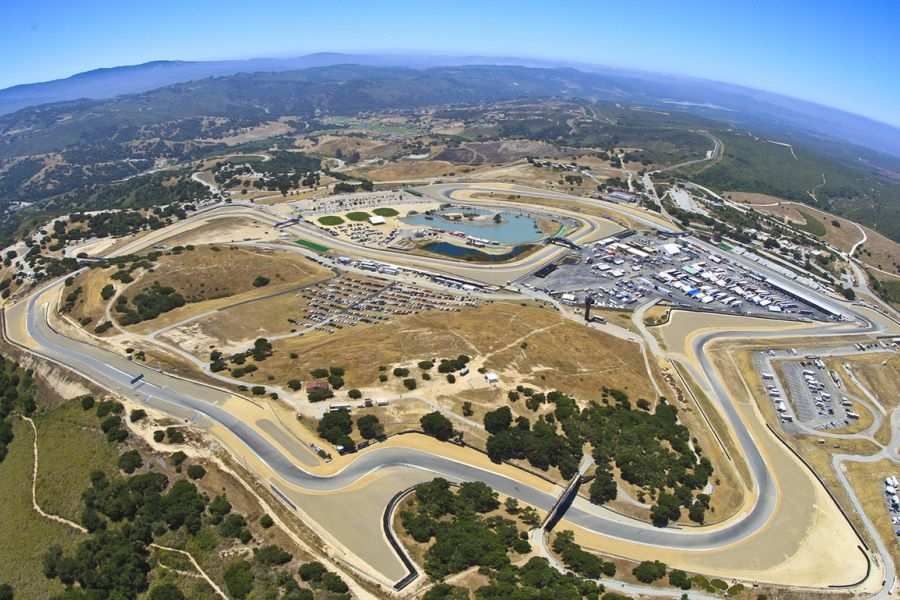
Aerial view of Laguna Seca — ten miles inland from the Pacific coast
Opened in 1957 after Pebble Beach closed
When racing on the Pebble Beach street course was banned, local clubs raised about $1.5 million to build a permanent track on drained lake bed near Laguna Seca Ranch. The name means “dry lake” in Spanish — a literal description of the terrain.
The original 1957 design was a 1.9-mile (3.05 km), nine-turn anti-clockwise course. The first winner on 9 November 1957 was Pete Lovely in a Ferrari 500 TR during SCCA National Sports Car Championship competition.

The Corkscrew section in Laguna Seca’s opening season
The Corkscrew and elevation
Turns 8 and 8A form the Corkscrew, Laguna Seca’s signature combination. Drivers blind over a crest, then dive downhill with a sudden left-right sequence. Spectators on the hillside see the entire plunge; onboard cameras rarely convey the g-forces.
Across the lap, elevation change reaches roughly 180 feet (55 m), with the Corkscrew alone accounting for about 59 feet (18 m) of drop.
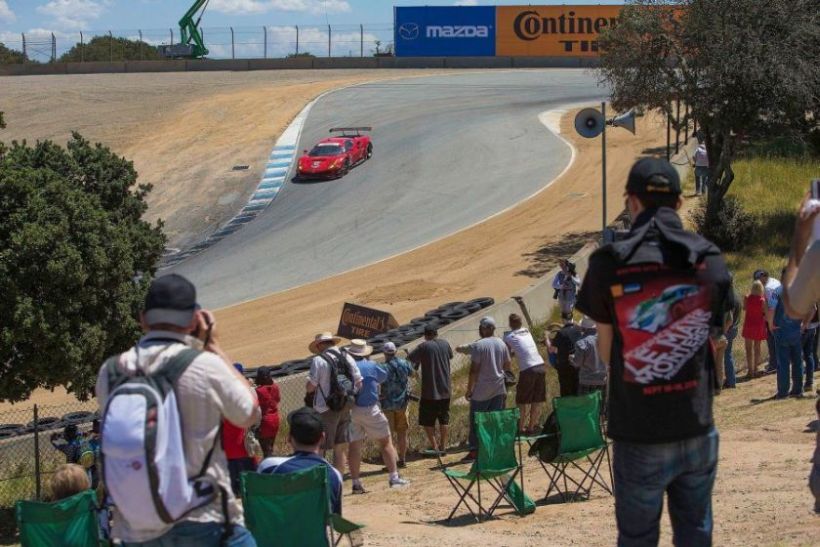
Spectator view of the Corkscrew
Sports cars, IMSA, and Le Mans–grade prototypes
The Monterey Triple Crown joined IMSA GT in 1973 and remained through the American Le Mans Series era until 2013. Laguna Seca hosted Porsche 962, Audi R8, and Audi R10 TDI machinery that also won at Le Mans.
Multiple winners include Al Holbert, Hans-Joachim Stuck, Peter Gregg, and Klaus Ludwig. During Audi’s ALMS dominance, Frank Biela, Allan McNish, and Rinaldo Capello collected repeated victories.
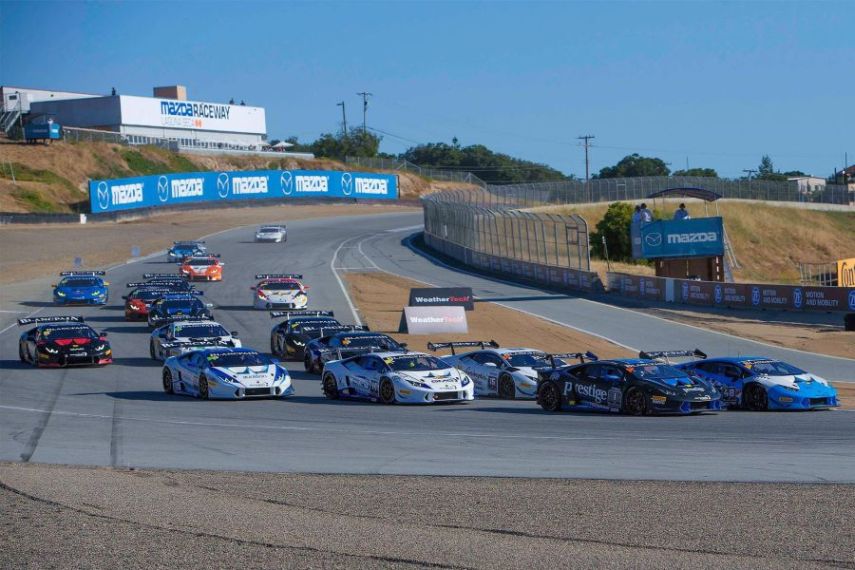
Sports car racing at Laguna Seca
Indy car and open-wheel history
Laguna Seca was not only a sports-car temple. Can-Am, Formula 5000, and other open-wheel categories visited before the CART Indy Car Series raced from 1983 to 2004. Legends including Stirling Moss, Mario Andretti, Bobby Rahal, and Al Unser Jr won here in various formulae.
Teo Fabi won the first CART race in 1983; Bobby Rahal took four consecutive victories from 1984–1987 plus a Can-Am win, giving him five Laguna Seca wins — the reason the straight between Turns 6 and 7 carries his name.
Mario Andretti lends his name to Turn 2 (Andretti Hairpin); Wayne Rainey is honoured at Turn 9 (Rainey Curve).
MotoGP and World Superbike
Laguna Seca hosted the United States Motorcycle Grand Prix from 1988 after a layout change (see below). Eddie Lawson won the inaugural MotoGP race; Americans Wayne Rainey, John Kocinski, and Nicky Hayden also triumphed before the series left after 2013.
The Superbike World Championship arrived in 1995 and remained a fixture for years. Motorcycle racing remains central to the circuit’s identity even as car calendars evolved.
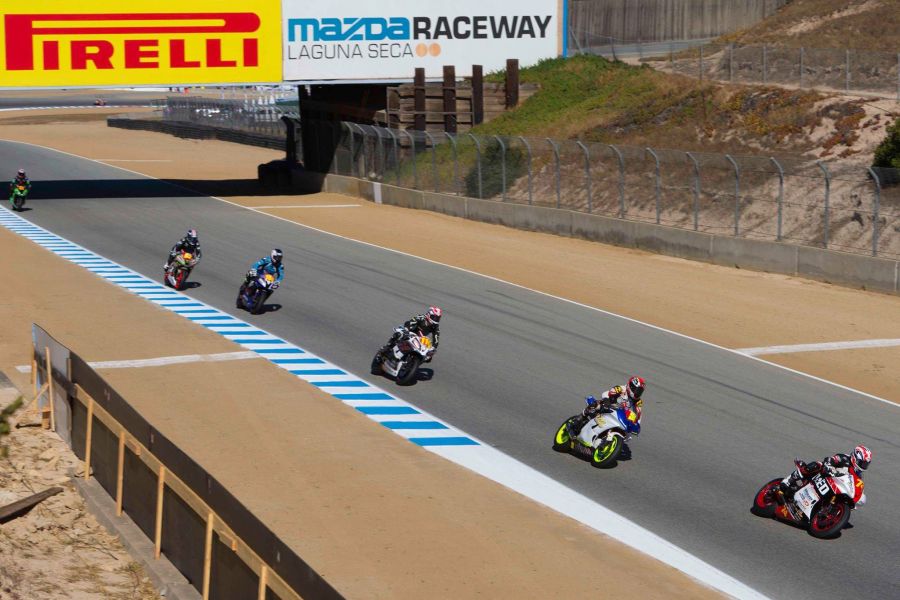
Motorcycle competition at Laguna Seca
1988 layout extension and the F1 near-miss
To meet FIM MotoGP requirements, an infield section between Turns 2 and 3 was added in 1988, lengthening the course to about 2.2 miles (3.5 km) on the configuration of the day. The current full course is widely listed at 2.238 miles (3.602 km).
After Detroit lost Formula 1, Laguna Seca was considered for the United States Grand Prix, but Phoenix won the bid. Formula 1 cars have never officially raced at Laguna Seca, though demonstration laps (including Ferrari F2003 runs) have produced unofficial benchmark times.
Lap records and Zanardi’s Corkscrew pass
Helio Castroneves holds the official qualifying record of 1:07.722 from the 2000 Monterey Grand Prix. The race fans remember most is 1996, when Alex Zanardi passed Bryan Herta through the Corkscrew on the final lap to win.
Sébastien Bourdais lowered the outright CART benchmark to 1:05.880 in 2007 testing; Marc Gené lapped in 1:05.786 with a Ferrari F2003 during Ferrari Racing Days in 2012 — unofficial but often quoted.
CART left for San Jose in 2005; a planned 2008 return died when Champ Car merged with the Indy Racing League. Open-wheel racing has not returned as a championship round since.
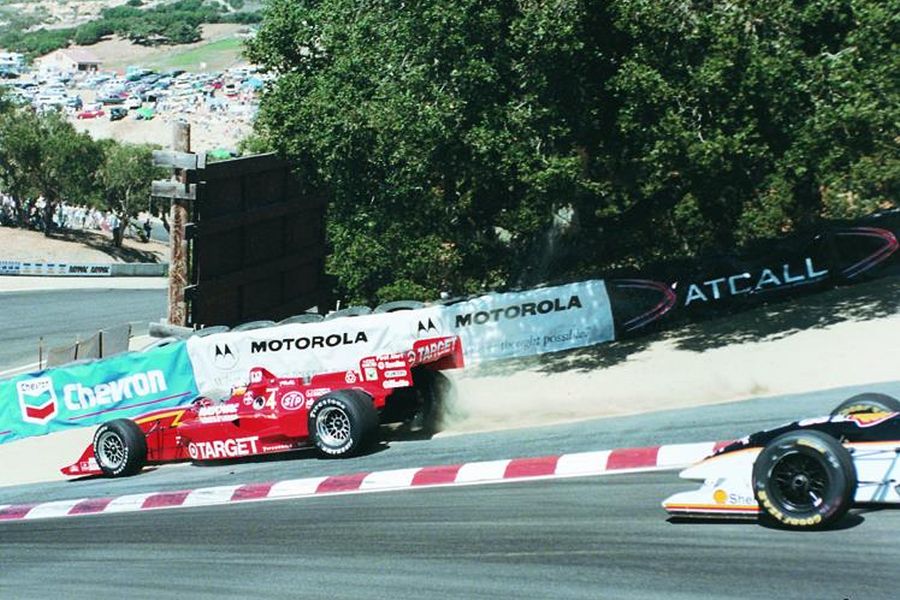
Alex Zanardi’s legendary 1996 pass at the Corkscrew
Monterey Motorsports Reunion and Car Week
Manufacturer anniversaries, historic meetings, and corporate track days fill gaps between headline championships. The Monterey Motorsports Reunion — founded by Steve Earle in 1974 as the Monterey Historic Automobile Races — anchors Monterey Car Week alongside the Pebble Beach Concours d’Elegance.
Visiting Laguna Seca
The circuit sits on 1021 Monterey-Salinas Highway, Salinas, CA 93908, inland from the Monterey Peninsula. Major weekends sell grandstand and hillside passes early; combine a race visit with Car Week only if you plan accommodation months ahead.
Frequently asked questions about Laguna Seca Raceway
Where is Laguna Seca Raceway?
WeatherTech Raceway Laguna Seca is at 1021 Monterey-Salinas Highway, Salinas, CA 93908, inland from Monterey on California’s central coast. It sits on drained lake bed near the former Fort Ord army base, roughly ten miles from the Pacific.
What is Laguna Seca called now?
The circuit’s official name is WeatherTech Raceway Laguna Seca. It was previously branded Mazda Raceway Laguna Seca. Most fans and drivers still say “Laguna Seca.”
How long is Laguna Seca?
The current full road course measures 2.238 miles (3.602 km) with 11 turns run clockwise. A 1988 infield extension lengthened the track to meet MotoGP requirements.
What is the Corkscrew at Laguna Seca?
The Corkscrew is the famous Turns 8 and 8A — a blind crest followed by a steep left-right drop of about 59 feet (18 m). It is Laguna Seca’s signature corner and one of the most photographed sections in US road racing.
When did Laguna Seca open?
The track opened with its first race on 9 November 1957. Pete Lovely won in a Ferrari 500 TR during SCCA National Sports Car Championship competition after Pebble Beach street racing ended.
Who holds the lap record at Laguna Seca?
Helio Castroneves holds the official Indy car qualifying record of 1:07.722 from 2000. Faster unofficial times include Sébastien Bourdais in 2007 testing and Marc Gené in a Ferrari F2003 demonstration in 2012.
Did Formula 1 ever race at Laguna Seca?
No. Laguna Seca was considered when the US Grand Prix left Detroit, but Phoenix hosted Formula 1 instead. F1 cars have not raced there in an official world championship event.
Does Laguna Seca still host MotoGP?
Laguna Seca hosted the United States Motorcycle Grand Prix from 1988 until 2013. MotoGP has since moved to other US venues; the circuit still hosts motorcycle events including World Superbike history and club racing.
What is the Monterey Motorsports Reunion?
The Monterey Motorsports Reunion is a historic race meeting founded in 1974 (originally the Monterey Historic Automobile Races). It runs during Monterey Car Week alongside the Pebble Beach Concours d’Elegance and manufacturer celebrations at Laguna Seca.
What happened in the 1996 Laguna Seca Indy car race?
Alex Zanardi passed Bryan Herta through the Corkscrew on the final lap to win the 1996 Monterey Grand Prix — one of the most replayed overtakes in Indy car history.
A Californian landmark built on a dry lake
Laguna Seca began as a club-funded escape from street racing and became a global reference for the Corkscrew, sports-car endurance battles, and Indy car drama. WeatherTech branding reflects modern sponsorship, but drivers still call it Laguna Seca.
Related reading
- Sonoma Raceway — NASCAR and IndyCar in wine country
- Road Atlanta — Petit Le Mans and sports-car history
- Watkins Glen International — US sports-car cradle
- Charlotte Motor Speedway — NASCAR oval hub
Address: WeatherTech Raceway Laguna Seca, 1021 Monterey-Salinas Highway, Salinas, CA 93908, USA
Phone: +1 831 242 8201
Official website: weathertechraceway.com