

Top 5 Fastest Le Mans Cars Ever
Originally published March 2015. Last updated July 2026: added methodology, comparison table, modern-era context, and FAQ. The Top 5 qualifying-average rankings below are unchanged.
The 24 Hours of Le Mans always was an event full of records. In its long history, every year something new was achieved and the cars went faster and further pushing the boundaries. For every motorsport enthusiast, the main thing was the speed and ever since the first Le Mans race was held, the speed was the main goal followed with stamina of the driver and the machine.
How this list was ranked
These five cars are ranked by fastest average speed on a single qualifying lap at the Circuit de la Sarthe — not by top speed on the Mulsanne Straight and not by fastest race lap. Qualifying laps reflect the maximum pace a car could sustain over one complete 13.6 km lap, combining straight-line speed, braking, cornering, and downforce. Circuit layout in each year matters: pre-1990 Mulsanne had no chicanes, so top-speed figures from that era are not directly comparable to modern Hypercar or LMP1 times.
Three ways Le Mans measures speed
Searchers often mix up three different “fastest” records at Le Mans. Each tells a different story:
- Top speed (Mulsanne Straight) — the highest speed reached on the long straight. The record is 405 km/h, set by the WM-P88 Peugeot in 1988 (see below).
- Fastest qualifying average speed — the metric used for this Top 5 list. It rewards overall lap pace in qualifying trim.
- Fastest race lap — the quickest lap during the 24-hour race itself. As of 2015, Andre Lotterer set a 3:17.475 in the Audi R18 e-tron quattro. See our full breakdown in Le Mans 24 Hours – Records, Facts and Figures.
Top speed alone does not win Le Mans. Average lap speed — and reliability over 24 hours — is what separates record-breakers from race winners.
Top speed of 405 km/h wasn’t enough for victory
However, the top speed is not the key to the win at the Le Mans and the average lap speed is much more important since that result show the overall capability of the car (braking, cornering, downforce…).
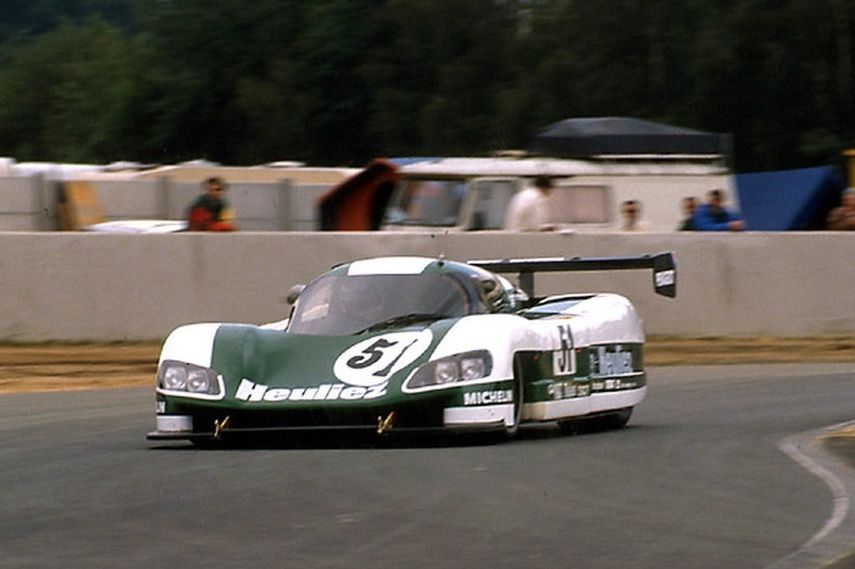
Top speed record at Le Mans is 405 km/h, and it was set on Mulsanne Straight in 1988, by the prototype WM-P88 with Peugeot’s 2.8 V6 Turbo engine, driven by Roger Dorchy.
In 1988, the Circuit de la Sarthe had no chicanes on the Mulsanne Straight, so the Team WM Peugeot had a chance to break the speed record that year. The WM-P88 Peugeot, driven by Frenchman Roger Dorchy, managed to reach a top speed of 405 km/h at the end of the six kilometre long Mulsanne Straight. Later on in the race, the #51 car struggled with reliability and ended the race after 59 laps.
- In 1988, WM P88-Peugeot reached the biggest top speed of 405 km/h
Why the Mulsanne changed the numbers
Two chicanes were added to the Mulsanne Straight in 1990 after concerns about top speeds exceeding 400 km/h. That permanently lowered maximum straight-line speeds, but lap averages remained the best way to compare cars across eras because they reflect the whole circuit.
When you see 401 km/h from the 1989 Sauber Mercedes C9 or 405 km/h from the WM-P88, remember those figures came on an uninterrupted six-kilometre straight. Modern LMP1 and Hypercar prototypes are faster over a full lap in many cases, but they will never match those raw Mulsanne numbers — which is why this article separates top speed from fastest qualifying average.
The average speed is more important
The top speed is one thing, and it’s nice to break a record, but the average speed is more important, because it shows how the car and the driver can manage the complete 13.6-km circuit configuration.
This is the list of Top 5 fastest Le Mans cars by fastest average speed achieved on the track. Most of these lap speeds are qualifying laps — driven harder and faster than race pace.
| Rank | Car | Year | Avg speed | Qualifying lap | Driver |
|---|---|---|---|---|---|
| 1 | Porsche 962C | 1985 | 251.815 km/h | 3:14.80 | Hans-Joachim Stuck |
| 2 | Porsche 917 LH | 1971 | 250.069 km/h | 3:13.9 | Pedro Rodriguez |
| 3 | Sauber Mercedes C9 | 1989 | 249.826 km/h | 3:15.040 | Jean-Louis Schlesser |
| 4 | Peugeot 908 HDi FAP | 2008 | 247.160 km/h | 3:18.513 | Stéphane Sarrazin |
| 5 | Peugeot 905 Evo 1B | 1992 | 243.329 km/h | — | #2 Peugeot |
5. Peugeot 905 – 243.329 km/h (1992)
At the 1992 24 Hours of Le Mans, Peugeot were dominant. The #2 Peugeot 905 Evo 1B set the fastest time in the qualifying, reaching the top speed of 351 km/h. However, the fastest qualifiers weren’t fastest in the race, so the #1 Peugeot took the victory. The victorious car was driven by Derek Warwick, Yannick Dalmas and Mark Blundell.
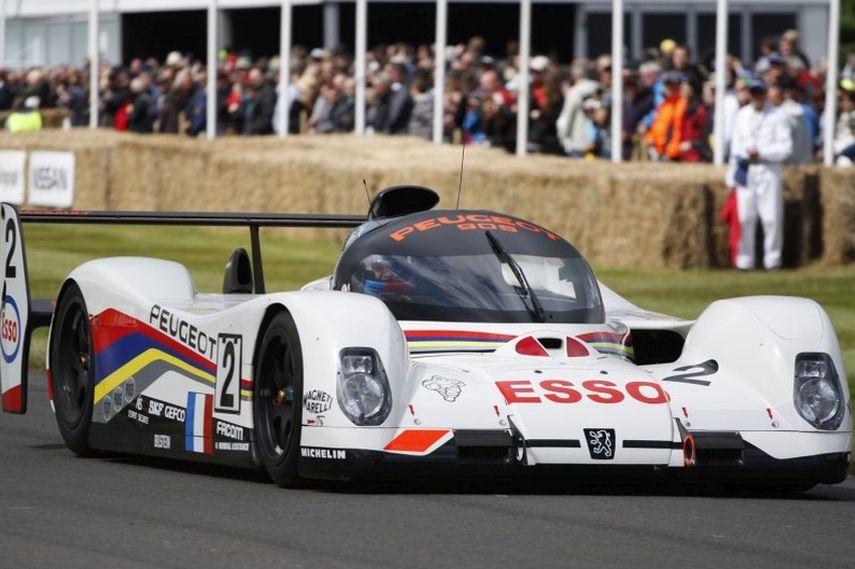
- The #2 Peugeot 905 was the fastest qualifier at 1992 Le Mans race, but the #1 car Peugeot took the victory
4. Peugeot 908 HDi FAP – 247.160 km/h (2008)
The French car on the French circuit was fastest in 2008 but the winner was Audi R10 TDI. The fastest qualifier was Stephane Sarrazin in the #8 Peugeot 908 HDi FAP. He grabbed the pole position with lap time 3.18.513. In the race, the #8 car, driven by Sarrazin, Pedro Lamy and Alex Wurz, had to pit early because of headlight repairs. The #7 Peugeot took the lead, but at the end the #1 Audi won the race.
3. Sauber Mercedes C9 – 249.826 km/h (1989)
Beautiful Mercedes race cars were fastest during the qualifying for 1989 24 hours of Le Mans and Team Sauber Mercedes scored 1-2 victory with cars #63 and #61. The fastest car in the qualifying was the #62 Sauber Mercedes C9, driven by Jean-Louis Schlesser, Jean-Pierre Jabouille and Alain Cudini. The maximum speed was 401 km/h at Mulsanne Straight, which had no chicanes for the last time. The best qualifying lap was 3.15.040.
In the race, the #62 finished fifth overall, nine laps behind winning crew in the #63 car. The winning drivers were Jochen Mass, Manuel Reuter and Stanley Dickens.
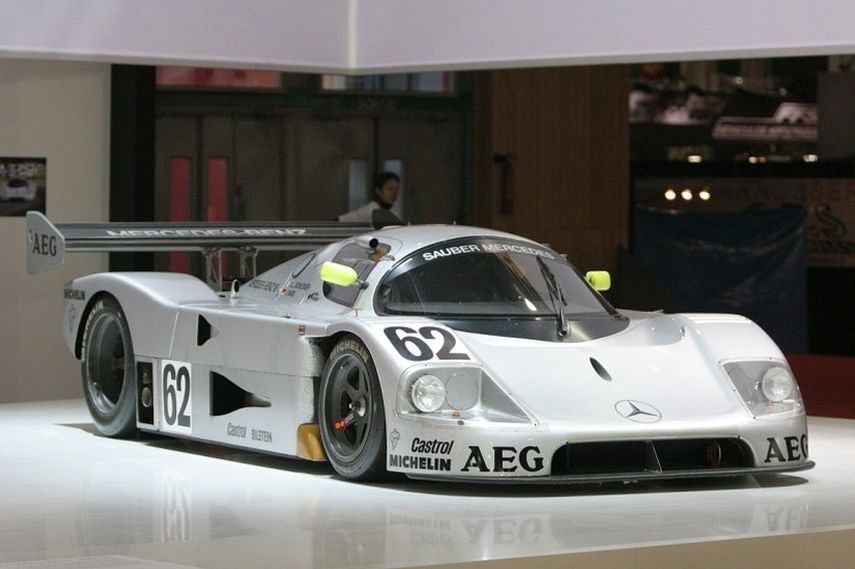
- 1989 Sauber-Mercedes C9
2. Porsche 917 LH – 250.069 km/h (1971)
It is amazing how 917 was fast and powerful. This average speed shows that this Porsche 917 is one of the greatest racing cars in history. The average speed record, set in 1971, lasted for 14 years, until another fast Porsche came.
Pedro Rodriguez and Jackie Oliver were the drivers of the long-tailed #18 Porsche 917 LH which set the fastest qualifying lap at the 1971 24 hours of Le Mans, with lap time 3.13.9. The top speed of the car, reached during the race, was 362 km/h. Rodriguez and Oliver led the first hours of the race, but they didn’t finish the race and victory was taken by #22 Martini Racing Porsche 917K, driven by Helmut Marko and Gijs van Lennep.
1. Porsche 962 – 251.815 km/h (1985)
This record average speed was achieved during 1985 Le Mans qualifying and even decades later, this is still the fastest average qualifying lap speed at the Sarthe. The record was set with #2 Rothmans Porsche 962C, driven by Hans-Joachim Stuck. His qualifying lap time, which earned him pole position, was 3.14.80.
In the race, Stuck was sharing the car with Derek Bell and they finished third, seven laps behind winning #7 Porsche 956B of Joest Racing, driven by Klaus Ludwig, Paolo Barilla and John Winter.
Also among the fastest at Le Mans
These cars did not make our historical Top 5 by qualifying average speed, but any serious conversation about the fastest machinery at Le Mans should include them:
Audi R18 e-tron quattro (2015)
Andre Lotterer’s 3:17.475 during the 2015 race remains the fastest lap ever recorded in competition at Le Mans — an average of roughly 248.5 km/h under race conditions, not qualifying. That is a different metric from this list, but it shows how far LMP1 hybrid technology pushed lap pace. Read more in our Audi R18 e-tron quattro profile and the Le Mans records article.
Porsche 919 Hybrid (2015–2017)
Porsche’s LMP1 hybrid dominated the mid-2010s and repeatedly broke the lap record in both qualifying and race trim. Timo Bernhard’s 2015 qualifying lap in the 919 Hybrid was among the fastest ever seen at the circuit in the modern era. See our full story on the Porsche 919 Hybrid.
Audi R10 TDI (2006–2008)
The diesel-powered R10 TDI won Le Mans three times and, while not topping this qualifying-average list, it defined the speed and efficiency benchmark of its generation. Profile: Audi R10 TDI.
Toyota GR010 Hybrid / TS050 (2018–present)
Toyota’s Hypercar and LMP1 prototypes have set the pace in the 2020s, with lap times that would challenge many entries on this list — under tighter regulations and a shorter Mulsanne than the Group C era enjoyed. The comparison is instructive, not direct.
Learn more about each car in the Top 5
- Porsche 962 – eight victories at world’s greatest endurance races
- Porsche 917 – legendary race car with an amazing career
- Sauber C9 – one of two Mercedes cars to win Le Mans
- Peugeot 908 HDi FAP – French diesel power for Le Mans victory
- Peugeot 905 – the first Lion-badged car to win at Le Mans
Frequently asked questions
What is the fastest top speed ever recorded at Le Mans?
405 km/h, set by Roger Dorchy in the WM-P88 Peugeot on the uninterrupted Mulsanne Straight during qualifying for the 1988 24 Hours of Le Mans.
What car holds the fastest lap at Le Mans?
The fastest race lap is 3:17.475, set by Andre Lotterer in the Audi R18 e-tron quattro in 2015. The fastest qualifying average speed remains the Porsche 962C at 251.815 km/h (1985). See our Le Mans records page for the full breakdown.
Is the Porsche 962 still the fastest Le Mans car ever?
It still holds the record for fastest average qualifying lap speed at Le Mans. Modern prototypes have posted faster individual lap times in race and qualifying, but by the specific metric used in this article — average speed on the fastest qualifying lap — the 962C’s 1985 mark has not been surpassed.
Why doesn’t the fastest car always win Le Mans?
Le Mans rewards reliability, strategy, and consistency over 24 hours. The fastest qualifier or the car with the highest top speed often suffers mechanical failure, accidents, or pace-management in the race. Several cars on this list set records in qualifying but did not win that year.
How did Mulsanne chicanes affect top speeds?
Chicanes installed in 1990 cut the effective length of the straight and forced cars to slow. Top-speed records from before 1990 cannot be replicated under current circuit configuration.
What was the fastest Le Mans car in the hybrid era?
The Porsche 919 Hybrid and Audi R18 e-tron quattro were the defining LMP1 hybrids of the 2010s, both setting lap records that rank among the fastest in Le Mans history. Toyota’s later LMP1 and Hypercar prototypes continued that trend into the 2020s.
Related reading
- Le Mans 24 Hours – Records, Facts and Figures
- Top 5 Le Mans Crashes
- Porsche 919 Hybrid – ready for museum after three Le Mans wins
- 1955 Le Mans disaster that marked motorsport forever

